
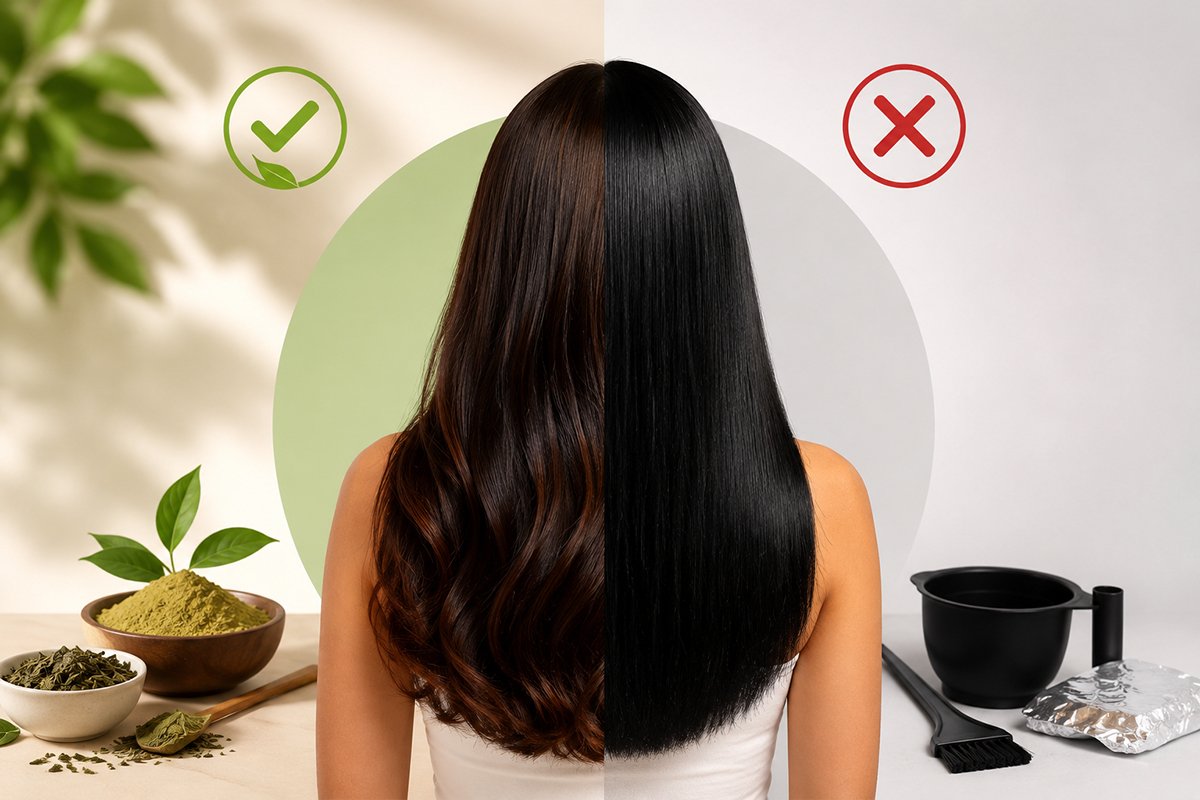
I used henna on my greys for almost three years, and I won’t pretend the journey was smooth. There were months I dreaded hair colour day. But here’s the thing — even on my most frustrated days, I never once considered switching to a chemical dye. That should tell you something. After everything I went through, I still stand by henna as the best choice for grey hair, and this is the honest story of why.
If you’ve ever Googled “does henna actually work for grey hair” hoping someone would just say the real, unfiltered truth, this is that article. I’m not here to sugarcoat the learning curve — but I am here to tell you why, once you get it right, nothing else comes close.
It Started Well. That Was the First Clue.
The first few applications were genuinely lovely. My hair felt thicker, the greys took on this warm, coppery tone I actually liked, and there was something satisfying about using a plant-based product instead of a box dye full of ammonia. Henna felt like a small win from day one — and looking back, that instinct was right. I just hadn’t figured out the details yet.
The Challenges I Faced (And Why They Didn’t Change My Mind)
Somewhere around month four or five, a few frictions started showing up. None of them were reasons to quit henna — they were reasons to understand it better.
1. The Colour Only Ever Went One Direction — At First
Pure henna, on its own, dyes hair orange to reddish-brown. That’s just chemistry — the lawsone molecule in henna binds with keratin and produces that colour range, full stop. For someone with naturally dark hair and a handful of greys, this meant my greys turned a bright, coppery orange while the rest of my hair barely changed.
I tried mixing in indigo to tone it down toward brown or black, which helped, but it introduced guesswork about ratios. What I didn’t realise yet was that a properly blended herbal formulation solves this exact problem — no home guesswork required.
2. The Time Commitment Took Getting Used To
A proper henna application — mixing the paste, letting it sit, applying it, waiting a couple of hours, then washing it out — takes real time. Not because henna is inefficient by design, but because raw, unrefined henna powder needs that release time to actually work. It’s a different rhythm than a fifteen-minute box dye, but it’s also the reason henna doesn’t carry the damage a chemical dye does — the trade-off is worth it once you plan around it.
3. The Mess Was Real, But Manageable
Henna paste stains — your sink, your towels, your hands if you skip gloves. It’s a legitimate downside of DIY application. But it’s also a solvable one with the right prep, not a reason to write off the ingredient itself.
4. Inconsistent Batches Taught Me the Real Lesson
This is the part that actually pushed me to dig deeper. Not every henna powder I bought behaved the same way. Some batches gave rich, deep colour. Others barely tinted my greys even after leaving the paste on overnight. I assumed I was doing something wrong — until I learned that raw henna quality varies significantly depending on where and how it’s grown, harvested, and processed. This wasn’t a henna problem. It was a sourcing problem.
5. Stubborn Greys Needed a Better Formulation, Not a Different Product
Plain, unrefined henna often struggled to fully cover very resistant, wiry grey strands near my temples. That sounded like a reason to give up — until I found out it was actually a reason to look for a better-formulated blend, not a different category of product altogether.
So I Didn’t Quit Henna. I Quit Guessing.
Here’s the pivot that actually mattered: I stopped assuming all henna products were the same, and started paying attention to where mine actually came from and how it was made.
That search led me to Kirpal Export Overseas, a manufacturer working specifically with henna-based and herbal hair colour formulations, sourcing quality henna from Rajasthan’s Sojat belt — a region known for producing henna with a notably higher natural dye content than what’s typically found in generic retail powders. The difference wasn’t subtle once I compared batches side by side: more consistent colour development, better grey coverage without needing to double up with indigo guesswork at home, and none of that “did this even work?” uncertainty I’d gotten used to.
What changed my mind wasn’t marketing language — it was understanding that henna performance isn’t just about the plant, it’s about how it’s grown, harvested, dried, and blended. That’s the part a proper hair colour manufacturer controls and a random unbranded powder simply doesn’t.
Why Henna Still Beats Every Alternative
Once I had the right source, the comparison wasn’t even close.
- Versus chemical dyes: No ammonia, no scalp irritation, no cumulative damage to hair structure. Chemical dyes cover grey fast, but they trade long-term hair health for short-term convenience.
- Versus semi-permanent dyes: Henna doesn’t just deposit colour — it conditions and strengthens hair over repeated use. Semi-permanent dyes fade unevenly and offer none of that benefit.
- Versus “natural” dyes with hidden chemical enhancers: Many products marketed as natural still contain synthetic additives to speed up processing time. Genuine, well-sourced henna doesn’t need them.
The wait time and the mixing are the only real trade-offs — and they’re the price of a product that actually improves your hair instead of just covering it.
What I’d Tell Someone Just Starting Out
If you’re considering henna for grey coverage, here’s what I’d say based on where I landed:
- Source matters more than most people realise. Henna from a manufacturer that controls quality from harvest to packaging behaves far more predictably than random retail powder with no traceability.
- Blended herbal formulations solve the orange problem. A well-formulated henna-indigo or multi-herb blend, mixed by the manufacturer rather than by you at home, gives far more consistent, natural-looking tones.
- Ask about lawsone/dye content, not just “100% natural” claims. Every henna product claims to be natural. Far fewer can tell you their actual dye concentration or sourcing region.
- Give it a fair trial with a trusted source before writing off natural hair colour. My frustration was never really with henna as a concept — it was with inconsistent, low-grade product. That’s a fixable problem.
The Honest Conclusion
I didn’t stop believing in henna for grey hair — if anything, three years in, I believe in it more than when I started. The only thing that changed was the version of henna I was using. Once I understood that quality herbal hair colour depends heavily on which manufacturer is actually behind the product, the whole experience changed. I still colour my greys with henna-based formulas today, and nothing else comes close — not once you’re using the right henna.
FAQs
Q1: Does natural henna really work for covering grey hair? Yes — natural henna is highly effective for grey coverage when it’s properly sourced and formulated. Quality matters far more than most people realise; raw, unrefined henna varies widely, while a well-blended herbal formulation from a trusted manufacturer gives consistent, predictable results.
Q2: Why does henna turn grey hair orange? Pure henna contains lawsone, a natural dye molecule that binds with keratin to produce a reddish-orange tone. This is normal chemistry, not a flaw — blending henna with indigo or other herbs (ideally pre-formulated by the manufacturer) tones this down to natural browns and blacks.
Q3: Is henna better than chemical hair dye for grey hair? For long-term hair health, yes. Henna is ammonia-free and doesn’t damage hair structure the way repeated chemical dyeing can. The trade-off is a longer application time, but many find it worth it for healthier hair over time.
Q4: How long does henna take to work on grey hair? A typical application requires the paste to sit for two to four hours to fully release colour, depending on the henna’s quality and freshness. Better-sourced henna with higher natural dye content tends to work more efficiently.
Q5: Why do different henna brands give different results? Henna quality depends heavily on where and how it’s grown, harvested, and processed. Henna sourced from regions like Rajasthan’s Sojat belt is known for higher natural dye content, which is why sourcing from a quality-focused hair color manufacturer makes a noticeable difference.