
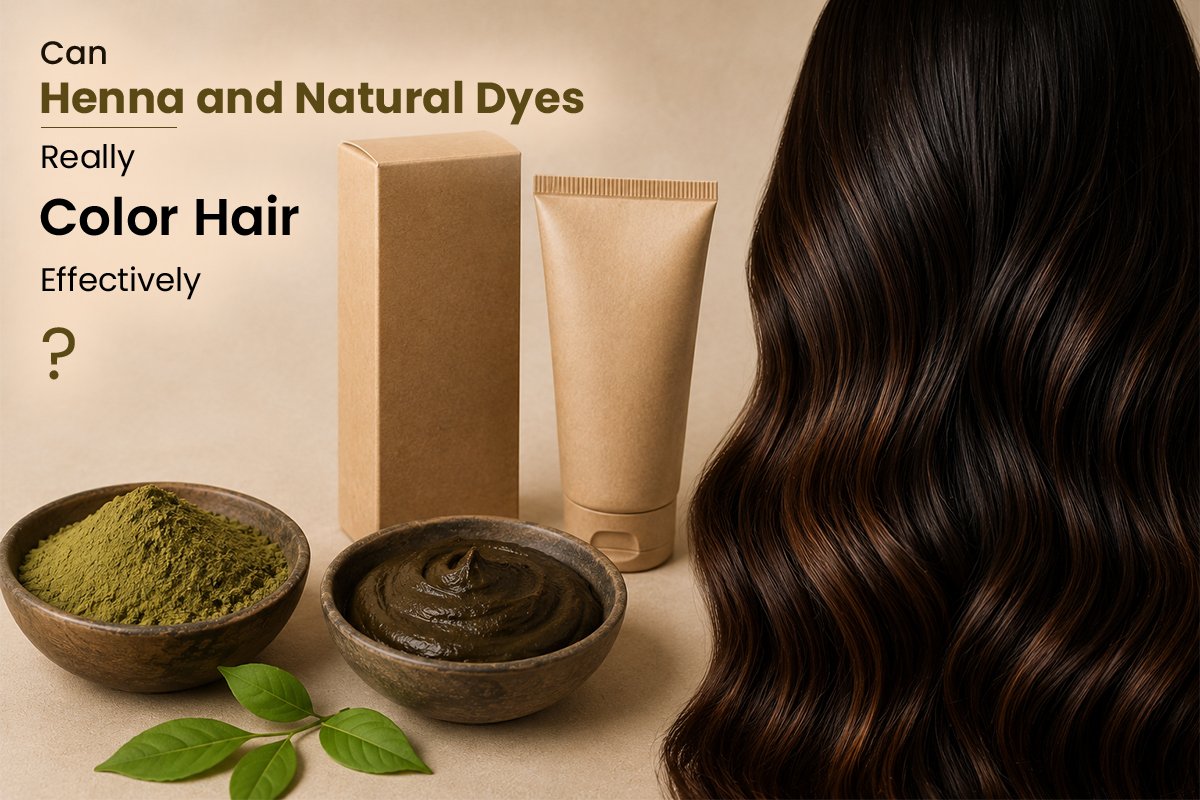
Can Henna and Natural Dyes Really Color Hair Effectively?
Yes — but only within a specific chemical lane. Henna and other natural dyes like indigo, cassia, and amla color hair through staining, not oxidation. That mechanism makes them excellent at rich reds, coppers, deep browns, and blacks, and it makes them one of the most reliable options for gray coverage on the market. What natural dye cannot do is lighten hair, produce ash or pastel tones, or finish the job in thirty minutes. The real question isn’t whether henna “works” — it’s whether henna’s specific chemistry matches what you’re trying to achieve. Below is the mechanism, the honest results by category, the application process that actually produces predictable color, and what separates pure, effective henna from the diluted or adulterated powder that gives natural dye a bad name.
How Henna Actually Colors Hair (The Real Chemistry)
Most articles on this topic stop at “henna stains hair.” That’s true, but it skips the part that actually determines whether your results look good or look muddy.
Lawsone: The Molecule Doing All the Work
Henna (botanically Lawsonia inermis) contains lawsone, a naphthoquinone pigment molecule that exists in the leaf in an inactive, bound form. Lawsone doesn’t do anything until it’s released — which is why dry henna powder sitting in a jar has no dyeing power at all. Release happens when the powder is mixed with a mildly acidic liquid and given time to sit. During that window, the plant’s cell walls break down and lawsone becomes bioavailable, ready to migrate into hair.
Once released, lawsone acts as what chemists call a Michael acceptor. It reacts with the amine groups in keratin, the structural protein that makes up roughly 95% of hair fiber, forming a conjugate bond that is chemically stable and resistant to shampooing. This is functionally closer to a reactive dye — the kind used on cotton and wool — than to a typical semi-permanent color rinse that simply coats the hair shaft and washes away in a few weeks.
Cuticle, Cortex, and Melanin: Where the Color Actually Goes
Hair has three relevant structural layers for this discussion:
- Cuticle — the outer layer of overlapping scales. It has to be raised, even slightly, for any dye molecule to get past it. This is why acidic henna paste (which swells and softens the cuticle) penetrates better than a neutral-pH rinse.
- Cortex — the fibrous inner core where lawsone ultimately binds to keratin. This is also where melanin, your hair’s natural pigment, lives.
- Melanin — natural dyes never touch this. Henna and indigo deposit color on top of existing melanin; they do not bleach, lift, or remove it. This single fact explains almost every limitation on this list.
Staining vs. Oxidizing: Two Completely Different Reactions
A synthetic oxidative dye uses hydrogen peroxide to swell the cuticle, partially dissolve melanin, and simultaneously deposit new color molecules that form inside the hair shaft through an oxidation reaction. That’s a two-part chemical event — lightening and depositing at once — which is why box dye can take you from black to blonde in one sitting.
Henna does one of those two things. It deposits. It never lightens. There is no developer, no peroxide, and no melanin removal anywhere in the process. Understanding this distinction is the single most important thing separating people who get results they love from people who are disappointed by henna.
The Complete Natural Dye Toolkit (Not Just Henna)
Most consumer content treats “natural hair dye” as a synonym for henna. In practice, professional formulators combine several botanicals to control tone, and any serious henna powder manufacturers operation stocks more than one raw material.
Indigo (Indigofera tinctoria): Blue-Black Without Chemicals
Indigo leaf powder contains indican, which converts to indoxyl and then oxidizes into indigotin — the same blue pigment historically used in textile dyeing. On its own, indigo gives hair a blue-to-blue-black cast that most people find flat or unnatural. Layered over henna’s red-orange base, though, indigo produces convincing browns and blacks. This is why the two-step henna manufacturers and formulators recommend — henna first, indigo second — remains the standard protocol for anyone who wants dark, natural-looking color without synthetic dye.
Cassia (Neutral Henna): Shine With No Color Shift
Cassia (commonly Cassia obovata, also classified as Senna italica) contains little to no lawsone. It doesn’t meaningfully change hair color, which is exactly the point — it’s used for conditioning, shine, and body on blonde or light-colored hair where even a trace of red would be unwelcome. Marketing that calls cassia a color treatment is misleading; it’s a texture and shine treatment that happens to share a supply chain with dye botanicals.
Amla, Katam, and Other Traditional Modifiers
Amla (Phyllanthus emblica, Indian gooseberry) is acidic and rich in vitamin C. In dye blends, it’s used to cool down henna’s warmth and add gloss rather than to shift hue dramatically. Katam (Buxus dioica) is a regional additive used in some traditional recipes to deepen brown tones. Beyond these, walnut hull, beetroot, coffee, tea, chamomile, hibiscus, rhubarb root, and logwood all appear in artisanal and semi-professional formulations — mostly as tone-adjusters layered on top of a henna or indigo base rather than as primary dyes in their own right.
Mineral and Metallic Dyes: Why Reputable Manufacturers Avoid Them
Lead acetate, bismuth citrate, and silver nitrate have historically been used in “progressive” or gradual darkening dyes. These are metallic salts, not botanicals, and they create serious downstream problems — most critically, incompatibility with any future chemical hair service. A supplier claiming “natural” while quietly including metallic salts is the single biggest quality risk in this category, covered in more detail below.
How Effective Is Henna, Really? A Category-by-Category Breakdown
“Effective” isn’t one answer. It changes depending on what you’re measuring.
Gray coverage is where henna performs best. Lawsone stains gray and white strands a translucent copper-red that blends convincingly with surrounding hair, and when indigo is layered over it, gray hair can match dark natural color almost seamlessly. This is arguably henna’s single strongest use case, and it’s the reason so much of the demand from hair color manufacturers and private label brands centers on gray-coverage positioning.
Color payoff and shade range run from vibrant red-orange (henna alone) through deep brown-black (henna plus indigo) to subtle golden highlights (cassia or coffee rinses) and richer burgundy tones (henna with amla or katam). What natural dye cannot produce, under any combination, is true blonde, ash, cool-toned brunette, or pastel color. If a shade requires lifting melanin, henna is the wrong tool.
Longevity varies by botanical. Henna is functionally permanent — it fades slowly over months rather than washing out, and it cannot be stripped the way synthetic color can. Indigo fades noticeably faster since its bond to keratin is weaker than lawsone’s. Other botanicals like coffee or tea are temporary, lasting only a wash or two.
Hair health and conditioning tend to improve with pure henna. The lawsone-keratin bond adds a coating effect that increases strand thickness, boosts shine, and reduces frizz — many users report hair that feels noticeably thicker after a few applications. Indigo, used alone in high concentration, can be more drying. Because there’s no peroxide lifting the cuticle, damage from pure henna is minimal compared to bleaching — though it does loosen curl pattern somewhat in curly and coily hair types, which is worth knowing before a full-head application.
What henna cannot do deserves its own honest paragraph, because most commercial content buries this. It cannot lighten hair by even one level. It cannot produce a subtle, low-maintenance look — results are vivid, not soft. Outcomes vary meaningfully based on starting hair color, porosity, paste freshness, and even local water quality, so two people using identical powder can get different results. Repeated full-length applications build up over time and can shift hair toward an opaque burgundy-black that’s difficult to lighten later. And because the lawsone-keratin bond is so stable, henna is notoriously difficult to remove — color correction sometimes requires cutting out treated length rather than chemically stripping it.
Natural Dye vs. Synthetic Oxidative Dye — Where Each One Actually Wins
These two categories aren’t competing on the same axis, which is why direct comparisons in most articles miss the point. Synthetic oxidative dye wins decisively on speed, predictability, and range — it can lighten, it can hit an exact shade from a swatch book, and it works in one 30-45 minute session. Henna and other natural dyes win on a different set of criteria entirely: conditioning benefit, absence of ammonia and peroxide, gentler treatment for chemically sensitized hair, and a safety profile that doesn’t carry PPD-related allergy risk when the henna is pure. Direct dyes, the category natural pigments fall under, deposit onto the hair surface and slightly into the cortex without chemical alteration of the hair’s internal structure. Reactive dyes — and henna’s keratin-binding behavior resembles this category more than it resembles a typical direct dye — form actual covalent-style bonds, which is exactly why henna lasts as long as it does and why it resists being washed or even chemically stripped out. Porosity plays a role in both categories, but it matters more with natural dye: high-porosity hair (already roughened by heat, color, or chemical treatment) absorbs pigment faster and can end up darker or cooler than intended, so a strand test matters more with henna than with a box dye you’ve used before.
The practical decision usually comes down to one question: do you need to go lighter, or are you working within your natural depth or darker? If it’s the former, natural dye isn’t the right category at all. If it’s the latter — especially for gray coverage in the red-brown-black range — henna and indigo are genuinely competitive with, and in some respects superior to, synthetic oxidative options.
How to Apply Henna and Indigo for Predictable Results
Most disappointing henna results trace back to process errors, not the botanical itself.
- Start with verified, pure powder. Confirm lawsone content and sourcing before anything else — this single step prevents most of the problems described later in this guide.
- Mix the paste with the right acidic liquid (lemon juice, strong tea, or amla water) and let it sit for six to twelve hours at room temperature. This is the dye-release window; skipping or shortening it is the most common reason for weak, patchy color.
- Run a strand test. Because outcome depends on your starting color, hair porosity, and paste freshness, a small test section on a cut clipping or an inconspicuous strand tells you more than any product description can.
- Apply for full saturation, covering the paste and leaving it on with gentle heat if possible — warmth accelerates pigment penetration and binding.
- For brown or black tones, use the two-step method. Apply henna first, rinse, then apply a separate, freshly mixed indigo paste (mixed with plain water, no acid) one to two days later. Combining both powders into a single paste for a “one-step black henna” does not work chemically and is often where compound, metallic-salt products enter the market instead.
- Rinse with water only at first, avoiding shampoo for 24-48 hours to let the stain fully oxidize and set.
- For touch-ups, plan on full saturation rather than root-only application. Henna’s demarcation lines are soft compared to synthetic dye, so partial application blends more forgivingly than with box color — but full coverage still gives the most even result.
- For a lighter, subtler effect, dilute henna into a “gloss” — mixed with conditioner rather than acidic liquid — for tone-refreshing between full applications.
The Risk Nobody Talks About: Compound Henna and Metallic Salts
This is the section most consumer-facing articles skip entirely, and it’s the difference between henna being safe or genuinely hazardous.
BAQ Henna vs. Compound “Black Henna”
Body Art Quality (BAQ) henna — a standard borrowed from the temporary-tattoo industry but increasingly used as a purity benchmark for hair henna too — refers to finely sifted, single-ingredient Lawsonia inermis powder with no sand, no pesticide residue, and no metallic additives. Compound henna is a different product entirely: pure henna cut with metallic salts like lead acetate or bismuth citrate to force a faster, darker “black henna” result than lawsone alone can produce. It’s frequently sold without disclosure, marketed simply as “black henna” or “brown henna.”
The danger isn’t cosmetic. Metallic salts react violently and unpredictably with hydrogen peroxide — meaning anyone who has used compound henna and later gets a conventional chemical color or perm can experience scalp burns, sudden heat reactions, or hair that breaks or melts during processing. This is one of the most consistently under-reported risks in natural hair dye content, and it’s the reason wholesale buyers and salon professionals should never source henna without verified purity documentation.
How to Verify Purity Before You Buy
Serious buyers — private label brands, distributors, and salon chains — should require, at minimum:
- A Certificate of Analysis (COA) confirming lawsone content, typically reported in the 1-4% range for commercial-grade crop, with premium Sojat-grown material often testing toward the higher end
- HPLC (high-performance liquid chromatography) verification of active dye content, not just visual or sensory testing
- Confirmation of zero metallic salt content, explicitly tested rather than assumed
- ISO, GMP, or HALAL certification from the manufacturing facility itself, not just the raw agricultural input
Any henna suppliers unwilling to provide lab-backed documentation on request should be treated as a risk, regardless of price.
Sourcing Henna and Indigo Powder at Scale: What Brands and Distributors Need to Know
For private label cosmetic brands, wholesale importers, and professional salon chains, the effectiveness question above translates directly into a sourcing question: which indigo powder manufacturers and hair color manufacturers can actually back up purity claims with documentation, and which are reselling generic, untested crop.
Sojat City in Rajasthan, India, holds Geographical Indication (GI) recognition for its henna — the result of specific soil and climate conditions that consistently produce high-lawsone-content crop, which is part of why the region supplies a disproportionate share of the world’s dye-grade henna. Working with henna manufacturers based directly in this growing region, rather than intermediary traders, gives buyers a shorter, more traceable supply chain from farm to finished powder. That farm-to-factory model — combined with triple-sifted processing to remove sand and fiber, batch-level Certificate of Analysis documentation, and PPD-free formulation — is what separates dependable henna bulk wholesale manufacturers from generic commodity resellers.
For brands building or expanding a natural hair color line, the practical checklist looks like this:
- Confirm lawsone content by HPLC, not by supplier claim alone
- Require a batch-specific Certificate of Analysis with every shipment
- Verify ISO, GMP, and HALAL certification at the manufacturing facility level
- Ask directly about metallic salt testing — a supplier should be able to answer this without hesitation
- Evaluate OEM and private label capability if you’re building a branded product rather than reselling bulk powder
- Check export experience and Incoterms flexibility (FOB, CIF, EXW) if you’re importing across North America, Europe, MENA, Russia/CIS, or Southeast Asia
With three decades of farm-to-factory experience in Sojat, Kirpal Export Overseas has built its reputation among henna manufacturers and exporters on exactly this documentation-first approach — triple-sifted, GI-tagged, lawsone-verified henna and indigo powder, supplied to private label brands, distributors, and salon chains across multiple continents. For technical specifications, HPLC data, or private label inquiries, visit Kirpal Export Overseas directly.
Quick Decision Framework: Is Henna the Right Fit?
- You want gray coverage in red, brown, or black tones → Henna (with indigo for darker shades) is one of the strongest options available, natural or synthetic.
- You need to lighten hair or hit a cool/ash tone → Natural dye is the wrong category; look at synthetic oxidative options instead.
- You’re sourcing for a private label or wholesale line → Prioritize suppliers with COA documentation, HPLC-verified lawsone content, and zero metallic salt contamination over price alone.
- You have chemically treated or bleached hair → Strand test first; high porosity hair can absorb natural dye faster and darker than expected.
- You want minimal processing damage → Pure henna is gentler than bleach-based lightening, though it isn’t damage-free for curl pattern in textured hair.
Buyers evaluating henna powder manufacturers for the first time can find additional technical resources and formulation guidance through Herbal Hair Colors, and detailed manufacturing standards documentation through Henna Manufacturers. For direct wholesale and bulk export inquiries, Henna Supplier maintains current pricing and MOQ information. Readers interested in the founder’s perspective on three decades of Sojat’s henna industry can find further writing at Sunil Walia.
Frequently Asked Questions
Q: Can henna lighten hair color?
A: No. Henna and other natural dyes deposit pigment on top of existing melanin without a developer or peroxide, so they cannot lift or lighten natural hair color under any circumstances.
Q: Is henna permanent or semi-permanent?
A: Henna is functionally permanent because lawsone forms a stable bond with keratin that resists shampooing and fades only gradually over months. Indigo, used alone, fades faster and behaves more like a semi-permanent stain.
Q: Can I use conventional chemical hair color after using henna?
A: Pure, Body Art Quality henna is generally safe to color over after a strand test, since it contains no metallic salts. Compound or “black henna” containing metallic salts can react dangerously with peroxide-based color and should never be chemically processed over.
Q: How long does henna take to color gray hair?
A: A single application typically produces visible coverage on gray hair immediately after processing, staining it a translucent copper-red. For deeper brown or black tones, a second application of indigo one to two days later is standard practice.
Q: What’s the difference between henna and “black henna”?
A: Pure henna only produces red-orange tones on its own. Products marketed as “black henna” that achieve dark color in one step, without a separate indigo application, typically contain metallic salts or synthetic additives rather than pure Lawsonia inermis.
Q: Does henna damage hair the way bleach does?
A: No. Henna involves no peroxide and no cuticle-lifting oxidation, so it causes far less structural damage than bleaching. It can loosen curl pattern in textured hair and, once applied, is very difficult to remove or lighten afterward.
Q: How do I know if the henna I’m buying is pure?
A: Request a Certificate of Analysis with HPLC-verified lawsone content and explicit confirmation of zero metallic salt contamination. Reputable henna manufacturers provide this documentation on request; suppliers who can’t or won’t should be treated as a quality risk.