
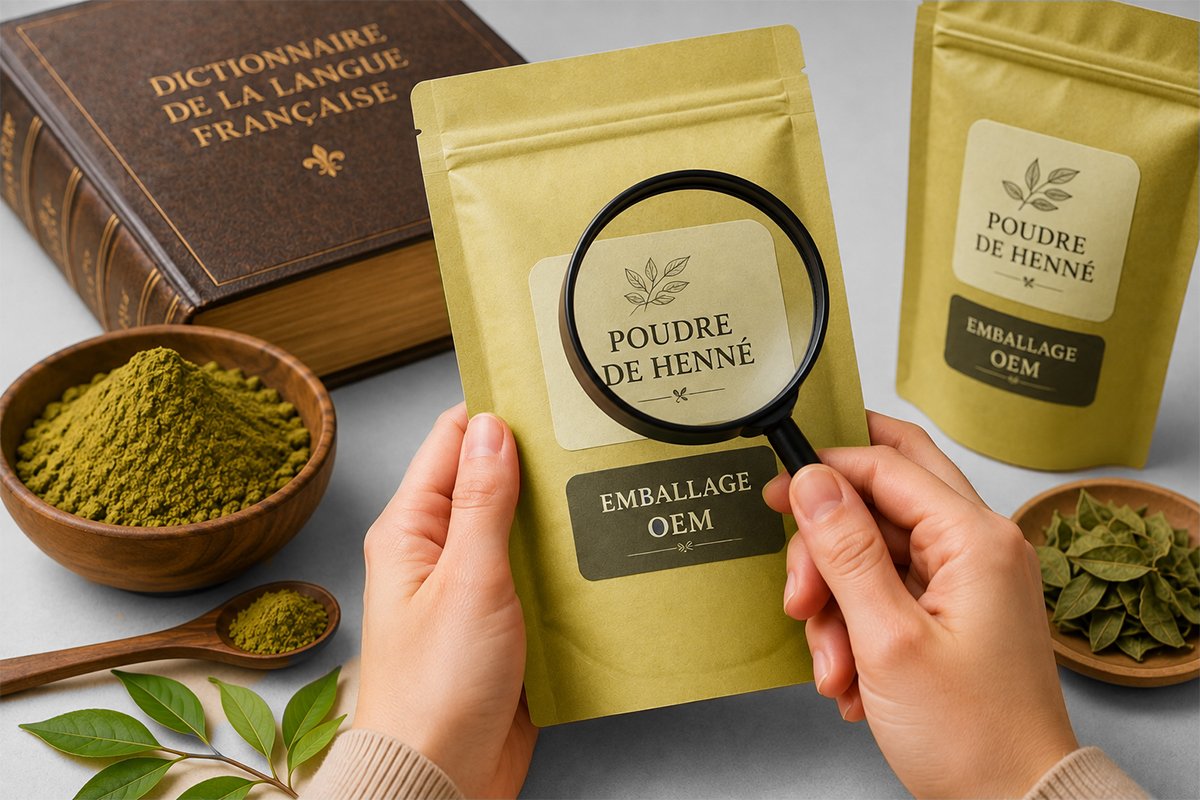
How to Read Henna Labels in French: A Buyer’s Guide
To read a henna label in French correctly, check three things, in order. First, find the Ingrédients or Composition panel and confirm the first entry is Lawsonia inermis — the Latin name for real henna — not a brand name standing in for it. Second, scan the full list for five red-flag chemicals: p-Phenylenediamine (PPD), Toluène-2,5-diamine, Résorcinol, Ammoniaque, or undisclosed metallic salts. Any of these means the product is not pure henna, whatever the front of the box says. Third, look for a genuine certification mark — COSMOS Organic, COSMOS Natural, or Ecocert — printed with a traceable certificate number, not just a green leaf graphic. No ingredient list at all is the biggest red flag of all: it’s illegal under EU law, and it’s the single most common trick behind toxic “black henna.”
The rest of this guide walks through why, and how to apply it at the shelf, at customs, or in a wholesale contract.
Why French Henna Labels Are Legally Regulated, Not Just Marketing
Reading a henna label isn’t a courtesy French brands extend to curious shoppers — it’s a legal obligation with two layers of enforcement behind it. Understanding both layers is what turns label-reading from guesswork into a repeatable check.
The EU Cosmetic Regulation Framework
Every cosmetic product sold in France, henna included, falls under EU Cosmetic Regulation (EC) 1223/2009. Article 19 of that regulation is the labeling backbone, and it requires a fixed set of disclosures on every unit sold: the identity of a Responsible Person established in the EU, the nominal content (net weight), a Period After Opening (PAO) symbol or an explicit expiry date, precautions for use, a batch number, and — critically — a full ingredient list written in INCI nomenclature and introduced by the word “Ingrédients” or “Composition.”
Two details trip up most buyers. First, ingredients above 1% concentration must appear in descending order by weight; anything below 1% can be listed in any order at the end — so a botanical name buried at the very bottom of a long list is likely present only in trace amounts, not as a meaningful active. Second, for henna manufactured outside the EU, the country of origin must appear on the label — this single line is one of the fastest ways to confirm you’re looking at a compliant import rather than a repackaged, unlabeled batch.
One thing cosmetics never carry, despite what some overseas sellers claim: a CE mark. CE marking applies to toys, electronics, and machinery — not cosmetics, which are governed entirely through EC 1223/2009’s own notification system (CPNP registration and a Product Information File held by the Responsible Person). If a seller tells you their henna is “CE certified,” that’s a sign they don’t understand the regulation they’re claiming to comply with.
France’s Cosmetics Watchdog — and a 2026 Update Most Guides Miss
Here’s where a lot of buyer’s guides go stale. For years, market surveillance of cosmetics in France was split between the DGCCRF (Direction générale de la concurrence, de la consommation et de la répression des fraudes) — France’s consumer-fraud enforcement body — and ANSM (Agence nationale de sécurité du médicament et des produits de santé). As of January 1, 2024, that split changed: the DGCCRF now handles cosmetics market surveillance alone, running annual compliance inspections and pursuing mislabeled or adulterated products directly. Meanwhile, cosmetovigilance — the ongoing collection of adverse-reaction reports tied to cosmetic products — moved from ANSM to ANSES (Agence nationale de sécurité sanitaire de l’alimentation, de l’environnement et du travail). If you’re researching a supplier and see an old article citing ANSM as the relevant authority for henna labeling complaints, that reference predates the reorganization.
For buyers, the practical upshot is a single free tool: RappelConso, the government’s public recall registry, run by DGCCRF. Before you commit to a supplier or a specific SKU — especially at wholesale volume — search the brand or product name there. Recalled cosmetics, including mislabeled henna and PPD-adulterated “black henna,” get logged with batch numbers and distributor names.
Decoding INCI: The Universal Ingredient Language on French Labels
INCI (International Nomenclature of Cosmetic Ingredients) is the naming system every cosmetic label in the EU is built on. In France, the surrounding text — headings, warnings, instructions — must be in French, but the INCI ingredient names themselves follow the same international standard everywhere. Once you know the pattern, an ingredient list stops being a wall of unfamiliar words and starts reading like a checklist.
Botanical Names Follow a Latin Binomial Pattern
Genuine plant-derived ingredients in henna and herbal hair color are listed under their Latin binomial name — genus and species, always. These are the ones you want to see leading the list:
- Lawsonia inermis — the henna plant itself; the source of lawsone, the molecule responsible for henna’s natural reddish-orange to auburn stain.
- Indigofera tinctoria — true indigo, used after a henna application in a two-step process to deepen color toward brown or near-black.
- Cassia obovata — often sold as “neutral henna,” used for golden or blonde tones, or purely as a conditioning treatment with no color change at all.
- Emblica officinalis (amla, Indian gooseberry) — frequently added for shine and conditioning, not color.
If a product markets itself as natural henna manufacturer-sourced or an organic henna manufacturer product but the ingredient panel doesn’t lead with one of these Latin names, that’s a mismatch worth questioning before you buy.
Synthetic Additives Hide Behind Plain Chemical Names
Synthetic actives break the Latin-name pattern — they appear as single chemical terms, not genus-species pairs. Training your eye to spot the format difference is faster than memorizing every chemical name individually: if an entry in the ingredient list isn’t italicized Latin, isn’t a well-known plant name, and reads like something from a chemistry textbook, treat it as a flag worth investigating rather than skimming past.
The Red Flag vs. Green Flag Framework
Use this as a working decision framework rather than a memorization exercise — five chemicals that should stop a purchase, and four signals that a product is genuinely what it claims to be.
Red flags — chemicals that mean the product is not pure henna:
- p-Phenylenediamine (PPD) — the most common adulterant. Legally, PPD is permitted only in oxidative hair dye formulations at a strictly capped concentration, and any product containing it must carry a standardized allergy warning printed on the label. Its use in any product intended for direct skin coloring — including temporary “black henna” tattoo paste — is banned outright in the EU. If PPD shows up on a henna label with no accompanying allergy warning, the product is very likely non-compliant, not just risky.
- Toluène-2,5-diamine (PTD) — a chemical cousin of PPD, used as an alternative dye precursor. It carries the same cross-reactive allergy risk and the same regulatory restrictions.
- Résorcinol — a coupling agent used in oxidative dye systems. It’s a known skin and respiratory irritant, and its presence in a “pure henna” product signals a chemical dye system, not a botanical one.
- Ammoniaque (ammonia) — an alkaline agent used to open the hair cuticle for synthetic dye penetration. Pure henna doesn’t need it; its presence is a strong sign the formula relies on chemical rather than botanical color deposition.
- Undisclosed metallic salts (lead acetate, silver nitrate) — used in some gradual color-restoring products. These react unpredictably and sometimes dangerously with subsequent perms or oxidative dyes, and reputable henna suppliers exclude them entirely.
Green flags — signals a product is what it claims to be:
- A short ingredient list dominated by Latin botanical names, with Lawsonia inermis appearing first or near-first.
- A genuine certification mark (COSMOS Organic, COSMOS Natural, or Ecocert) printed alongside a license or certificate number you could look up, not just a decorative logo.
- A visible batch/lot number paired with either a supplier’s willingness to provide a Certificate of Analysis (CoA) on request, or a QR code linking to one — a standard practice among traceable, farm-to-factory henna manufacturers.
- Full, complete French-language mandatory disclosures — Responsible Person, PAO, precautions — rather than a partial label missing two or three required fields, which itself suggests the product was never properly notified for the EU market.
The “Henna Noir” Trap: Why Black Henna Is Almost Never Real Henna
How PPD Turns Paste Jet-Black in Minutes
This is the single most important safety concept in this guide. Pure henna paste physically cannot stain skin jet-black within minutes. Lawsone, henna’s coloring molecule, produces a gradual reddish-brown to deep auburn stain that develops over several hours and darkens further over one to two days as it oxidizes. There is no botanical process that turns pure henna paste black on contact.
What actually happens with “black henna” is different: vendors mix henna (or sometimes skip the henna entirely and use only a black paste) with high, unregulated concentrations of PPD — often far above the strict limit permitted in legal hair dye formulations, and applied in a context (direct skin contact) where PPD use is banned outright, not merely restricted. The result stains skin near-black within 20 to 60 minutes. It also causes a documented pattern of injury: contact blistering and chemical burns at the application site, and — more seriously — lifelong allergic sensitization to PPD, meaning any future exposure (including in a legal, low-concentration hair dye years later) can trigger a severe reaction. Pediatric case reports of this exact pattern — sensitization following a childhood “black henna tattoo” — are well documented in dermatology literature.
Where the Trap Shows Up in France
The pattern is consistent: beach towns, summer festivals, Christmas markets, and tourist areas where a vendor applies paste directly from an unlabeled tub with no packaging in sight. Because the paste is applied on the spot rather than sold as a retail product, it never has to pass through the EU’s labeling or notification requirements at all — the vendor simply operates outside the system.
The practical rule: if you can’t see the original packaging and read an Ingrédients panel before application, decline. A vendor with a genuinely compliant product will have the labeled tube or tub on hand, because they’re legally required to. Absence of any label — not a suspicious ingredient name — is the fastest and most reliable red flag a shopper on the street can use.
French Label Terminology Every Buyer Must Translate
Ingredient and Batch Disclosure Terms
- Ingrédients / Composition — the mandatory heading introducing the INCI list.
- Lot / Numéro de lot — batch number; your reference point for traceability, recalls, and matching a product to its Certificate of Analysis.
- Responsable de la mise sur le marché — the EU-based Responsible Person legally accountable for the product’s compliance.
- Fabriqué en / Pays d’origine — country of manufacture, mandatory for non-EU imports.
- Poids net / Contenu nominal — net weight or nominal content.
Expiry and Safety Warning Terms
- PAO (Période Après Ouverture) — the open-jar symbol with a number followed by “M” (mois/months); a “6M” symbol means the product should be used within six months of first opening.
- Date de péremption — an explicit expiry date, used instead of a PAO symbol for products with a shelf life under 30 months.
- Usage externe uniquement — for external use only.
- Tenir hors de portée des enfants — keep out of reach of children.
- Réaliser un test cutané 48h avant application — perform a patch test 48 hours before use; this instruction should always appear on any oxidative or semi-permanent dye product, and its absence on a product that contains dye-active ingredients is itself worth questioning.
- Précautions d’emploi — precautions for use.
Certifications That Actually Mean Something
AB, COSMOS, and Ecocert — Explained Precisely
This is where most buyer’s guides get sloppy, and it’s worth being exact. The AB (Agriculture Biologique) logo is France’s official organic label — but it’s built for food and agricultural products, and it doesn’t formally apply to cosmetics. Seeing it on a henna box isn’t necessarily fraudulent, but it isn’t the relevant cosmetics certification either, and its presence alone shouldn’t be read as proof of anything specific about the product.
The certification that actually governs cosmetics is COSMOS (Cosmetic Organic and Natural Standard), created in 2010 by five founding bodies across Europe, including Ecocert and Cosmébio in France. COSMOS has two distinct tiers, and the difference matters: COSMOS Natural requires at least 95% of ingredients to be of natural origin and bans petrochemical ingredients and animal testing outright. COSMOS Organic is stricter — it adds a requirement that at least 20% of the finished product (10% for rinse-off products like shampoo) consist of organic ingredients, with roughly 95% of the eligible plant-based ingredients coming from certified organic farming. Ecocert itself is the certifying body — founded in France in 1991 — that audits products against the COSMOS standard (or its own private standard) from raw material sourcing through processing and packaging.
A genuine certification always comes with a traceable certificate or license number. A logo with no number attached is a claim, not a certification.
Why “100% Naturel” on the Front of the Box Is Meaningless Alone
“100% Naturel,” “Pur Henné,” and similar front-of-pack claims have no standardized legal definition under EU cosmetics law — unlike “organic,” which is only legally meaningful when backed by a certification body. This isn’t a minor technicality: a 2022 DGCCRF market survey found that roughly 40% of environmental and “green” claims checked across the cosmetics sector contained some kind of anomaly. The decision rule that follows is simple: if the front of the box says “100% Naturel” but the Ingrédients panel on the back contains any of the five red-flag chemicals, the marketing claim is false, and the product is exactly the kind DGCCRF enforcement — and RappelConso listings — target.
A Step-by-Step Label Check Before You Buy or Import
- Confirm the Ingrédients or Composition panel exists at all, in French. No panel means no purchase.
- Confirm the first listed ingredient is a Latin botanical name — Lawsonia inermis, Indigofera tinctoria, or Cassia obovata — not a synthetic chemical.
- Read the full list for the five red-flag chemicals: PPD, PTD, Résorcinol, Ammoniaque, undisclosed metallic salts. Any hit means walk away.
- Check for a batch/lot number and either a PAO symbol or an explicit expiry date.
- Verify any certification logo (COSMOS Organic, COSMOS Natural, Ecocert) is paired with a certificate number — not displayed alone.
- Remember cosmetics never carry a CE mark; a seller who claims one doesn’t understand the category.
- For wholesale or import volumes, request a Certificate of Analysis confirming lawsone content and a formal statement of no PPD or heavy-metal contamination — a step beyond the retail label, and standard practice among established henna powder manufacturer partners.
- If anything still feels uncertain, search the brand or SKU on RappelConso before committing to a purchase order.
What This Means for B2B Buyers Sourcing Henna for the French Market
Everything above applies at retail scale, but private label brands, wholesale importers, and salon chains buying for the French and wider EU market carry a heavier documentation burden than an individual shopper. A compliant retail label is the floor, not the ceiling. Serious buyers should expect their henna manufacturer France-facing suppliers to provide, as standard, not exception:
- A Certificate of Analysis for every batch, stating lawsone content and confirming the absence of PPD, PTD, and heavy metals — not just a general “PPD-free” claim on a spec sheet.
- Documented farm-to-factory traceability back to origin — for GI-tagged Sojat City henna, this means being able to trace a shipment from the growing region through processing.
- Formal quality certifications (ISO, GMP, HALAL where relevant) that sit alongside, not instead of, cosmetic-specific compliance under EC 1223/2009.
- A clear answer, in writing, on who holds the Responsible Person role for the EU market — this is a legal requirement, not a courtesy.
Buyers evaluating an organic henna manufacturer or comparing henna wholesale France suppliers should treat these four points as non-negotiable in any RFQ or private label agreement — the same discipline this guide applies to reading a single retail label, scaled to contract terms. For a deeper look at what a compliant Certificate of Analysis should actually contain, see requesting a Certificate of Analysis from your henna supplier. Buyers weighing a PPD-free henna manufacturer for a private label herbal hair color line can review formulation standards at PPD-free herbal hair color formulation, and importers building out wholesale volume for the EU can compare terms at wholesale henna sourcing for the European market.
Much of this traceability discipline traces back to Sojat City’s GI-tagged growing region — background on that origin and the export infrastructure built around it is covered at Sojat City henna and export capability. For context on the three decades of export experience behind that infrastructure, see Sunil Walia’s background in henna export.
Frequently Asked Questions
Q: Is PPD illegal in France?
A: Not entirely — PPD is legally permitted in oxidative hair dye formulations at a strictly capped concentration, provided the product carries a standardized allergy warning. What’s banned outright is its use in any product meant for direct skin coloring, which includes “black henna” temporary tattoo paste. That specific use is illegal across the EU, not just in France.
Q: Can pure henna dye hair or skin black on its own?
A: No. Lawsone, the coloring molecule in Lawsonia inermis, produces a reddish-brown to auburn stain that develops gradually over hours and deepens over one to two days. Jet-black, near-instant staining is not something pure henna can physically do — it’s a reliable sign that PPD or another synthetic dye has been added.
Q: What does the PAO symbol on a French henna label mean?
A: PAO stands for Période Après Ouverture (Period After Opening). It’s the open-jar icon paired with a number and “M” — for example, “6M” means the product should be used within six months of first opening, not six months from the manufacture date.
Q: Is an AB label enough to trust a henna product in France?
A: Not for cosmetics specifically. AB (Agriculture Biologique) is France’s official organic label for food and agricultural products; it isn’t the certification standard that governs cosmetics. For henna and hair color, look instead for COSMOS Organic, COSMOS Natural, or an Ecocert certification number.
Q: Which French authority handles cosmetic product complaints in 2026?
A: As of January 2024, the DGCCRF handles cosmetics market surveillance on its own, and ANSES (not ANSM) now manages cosmetovigilance and adverse-reaction reporting. The public recall registry, RappelConso, is run by DGCCRF and is searchable by anyone.
Q: What’s the real difference between henna and black henna?
A: Real henna is a botanical product — Lawsonia inermis — that produces a warm reddish-brown stain. “Black henna” is, in almost every documented case, henna mixed with high, unregulated concentrations of PPD to force an instant black stain, applied in a way that’s specifically banned under EU cosmetics law and linked to severe allergic reactions and lifelong PPD sensitization.