
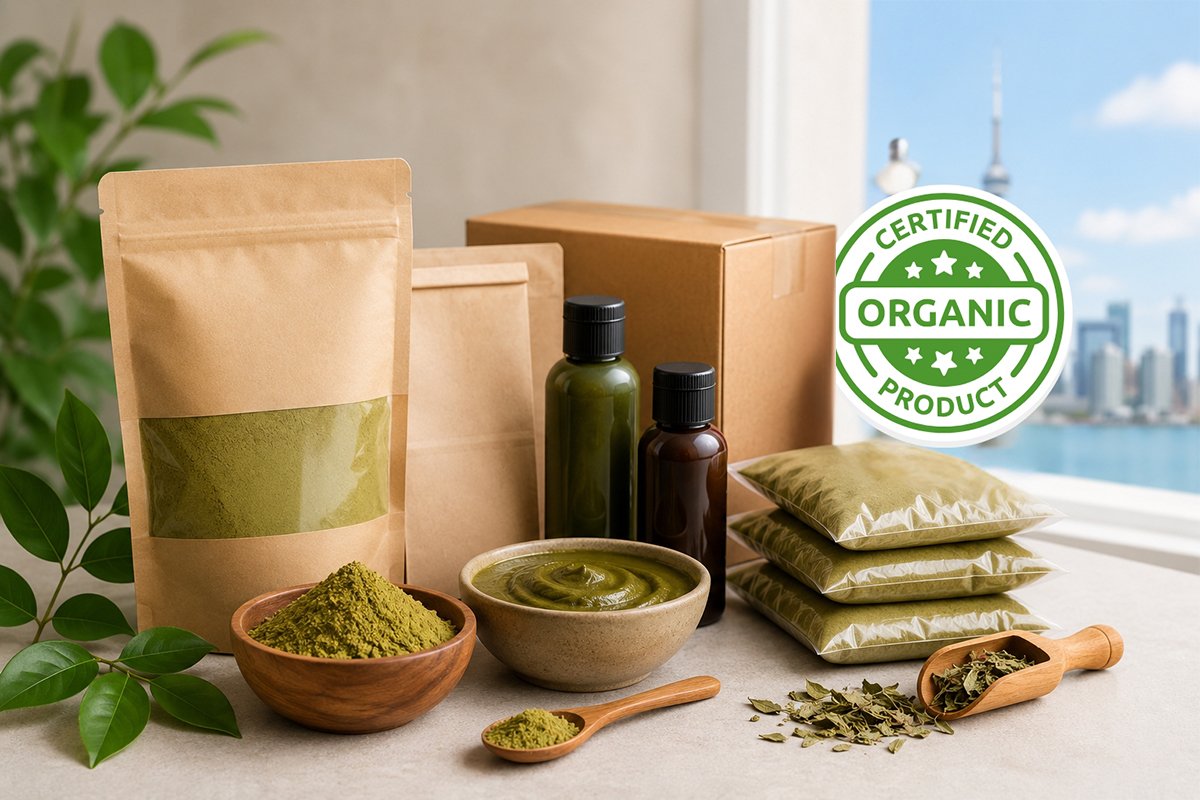
Buy Certified Organic Henna Products in Bulk for Canada: PPD-Free, Compliant, and Ready for Private Label
Answer Capsule
Canadian importers and private-label beauty brands sourcing henna manufacturers in India face a critical sourcing gap: most bulk suppliers cannot guarantee simultaneous compliance with Health Canada’s cosmetic import rules, PPD-free certification, and COSMOS/NATRUE organic standards. Certified organic henna powder from vertically integrated farms in India—tested for lawsone content, free of synthetic dyes or heavy metals, and backed by third-party laboratory reports—offers a compliance-ready alternative to untested imports. Bulk ordering directly from GI-tagged Sojat City producers eliminates middleman markups, guarantees batch traceability, and enables private-label positioning in Canada’s growing $1.2B natural hair care market.
The Canadian Market Opportunity for Organic Henna
Why Canadian Importers Are Moving to Bulk Direct Sourcing
The Canadian clean beauty market has shifted fundamentally in the past 18 months. Health Canada tightened enforcement of cosmetic ingredient declarations in 2024–2025, specifically targeting henna products with undisclosed PPD (paraphenylenediamine) contamination or synthetic colorants masquerading as “natural henna.”
Canadian distributors—particularly salon chains and private-label brands targeting the $680M+ natural hair care segment—now face a supply paradox:
- Retail suppliers offer minimal batch documentation and often cannot provide detailed CoA (Certificate of Analysis) reports
- Generic “henna wholesalers” source from multiple vendors without vertical integration, introducing batch inconsistency and contamination risk
- Imported henna from unregulated suppliers frequently fails Health Canada import compliance checks, resulting in port holds and delays
- Mislabeled “organic” henna lacks third-party certification, exposing distributors to regulatory liability
Direct sourcing from certified henna powder manufacturers in India solves this through farm-to-export traceability, eliminating intermediaries and regulatory uncertainty.
Market Demand Drivers in Canada
Three specific demand signals have emerged among Canadian importers:
- Private-label brands targeting demographics aged 25–45 seeking plant-based alternatives to synthetic box dyes. Organic positioning commands 25–40% price premiums.
- Professional salon networks requiring bulk supply of herbal hair color products to support in-salon treatments and retail product lines.
- E-commerce retailers needing compliance-vetted products with complete regulatory documentation to avoid Amazon/Shopify policy violations.
Understanding PPD Risks and Health Canada Compliance Requirements
The PPD Problem in Henna Imports
PPD (paraphenylenediamine) is a synthetic coal-tar dye historically mixed into henna to deepen color intensity. Health Canada classifies PPD-contaminated henna as a non-permitted cosmetic ingredient and has issued public health warnings since 2012 due to allergic sensitization and systemic toxicity risk.
The detection challenge: PPD contamination is invisible to the naked eye. Retailers cannot visually distinguish PPD-adulterated henna from pure lawsone-based henna. Laboratory testing (HPLC or GC-MS) is the only verification method.
Health Canada Hotlist and Import Requirements
Canadian importers must comply with Health Canada’s Natural and Non-Prescription Health Products Directorate (NNHPD) and Cosmetics regulations. Key requirements:
- Ingredient Disclosure: All henna products must declare lawsone content, colorant origin (plant-based vs. synthetic), and any processing aids
- Prohibited Substances: PPD, lead acetate, and synthetic azo dyes are explicitly banned
- CoA (Certificate of Analysis): Third-party testing reports must document:
- Lawsone % (minimum 1.0–1.5% indicates quality Sojat henna)
- PPD absence (non-detect at <5 ppm)
- Heavy metals screening (lead, cadmium, arsenic limits)
- Microbial load (aerobic count, E. coli, Salmonella non-detect)
Compliance failure consequences: Port seizure, product destruction, import bans, and distributor liability.
Organic Certification and COSMOS Standards
COSMOS-certified organic henna represents the highest standard for Canadian private-label positioning:
- COSMOS Standard: Mandates 95%+ organic ingredients, prohibits synthetic PPD or synthetic dyes, requires full traceability documentation
- NATRUE Certification: Similar standards with additional focus on natural ingredient purity
- HALAL Certification: Required for Middle Eastern export markets; increasingly valued by Canadian consumers aware of manufacturing ethics
Henna sourced from certified-organic farms in Sojat, Rajasthan (the geographic origin of premium henna, protected by GI status since 2017) comes from estates already COSMOS-audit-ready, simplifying Canadian import documentation.
Sourcing Certified Organic Henna From Indian Manufacturers
Why Sojat City Henna Dominates the Global Market
Sojat City, in western Rajasthan, produces 80% of the world’s commercial henna. The region holds Geographic Indication (GI) certification for henna quality, meaning henna labeled “Sojat” must meet minimum lawsone thresholds and origin verification.
Vertically integrated henna manufacturers in India based in Sojat control the full supply chain:
- Farm ownership: Direct control of planting, harvesting, and drying protocols ensures consistent alkaloid content
- In-house processing: Triple sifting, standardized drying temperatures (35–40°C), and storage protocols preserve lawsone potency
- Third-party testing: Regular HPLC testing during crop cycles and before export shipments
- Export logistics: Direct customs clearance, phytosanitary certification, and Health Canada pre-clearance capability
Price advantage of direct sourcing: Importing directly from farm-to-export manufacturers reduces per-kg cost by 30–50% compared to purchasing through Dubai-based or European trading houses.
Evaluating a Supplier’s Certifications and Documentation
When vetting herbal hair color manufacturers or natural hair color supplier candidates, Canadian importers should request and verify:
Essential Documentation:
| Documentation Type | What It Verifies | Red Flags |
| HALAL Certificate | Ethical production, no haram processing aids | Missing or expired; issued by non-accredited body |
| ISO 22000 (Food Safety) | GMP compliance, contamination controls | Issued >3 years ago; no recent audit records |
| COSMOS Organic Cert | Organic status, no synthetic dyes | Certificate does not list henna specifically; generic |
| Recent CoA (GC-MS) | PPD non-detect, lawsone %, heavy metals | >6 months old; missing specific analytes; generic results |
| Phytosanitary Certificate | Plant origin verification, pest/disease-free | Missing or post-dated |
| Export Permit / IEC | Legal export status | Not issued by Indian Export Promotion Council or customs |
Certification, Testing, and Compliance Documentation
Third-Party Testing Requirements for Canadian Import
Before placing a bulk order, demand that the supplier provide recent laboratory results from an ISO 17025–accredited lab. Canadian importers should specify testing parameters:
- Lawsone Content (HPLC): Minimum 1.2% for quality assurance; premium suppliers deliver 1.5–2.0%
- PPD Screening (GC-MS): Non-detect at <5 ppm sensitivity
- Heavy Metals (ICP-MS):
- Lead: <2 ppm
- Cadmium: <0.5 ppm
- Arsenic: <1 ppm
- Microbial Testing (Plate Count):
- Total aerobic count: <1,000 CFU/g
- E. coli: Non-detect
- Salmonella: Non-detect in 25g sample
- Moisture Content: 8–12% (optimal for shelf stability)
ProTip: Request that suppliers test against both Indian Pharmacopeial standards AND Health Canada cosmetic microbial limits. This dual compliance approach reduces import delays.
Building a Compliance File for Health Canada
When importing bulk certified organic henna powder, Canadian distributors must maintain an import dossier for Health Canada audits:
Dossier Contents:
- Original CoA from supplier, signed by lab director
- Supplier’s HALAL, ISO, COSMOS certificates (copies)
- Phytosanitary certificate from India’s Ministry of Agriculture
- Supplier’s export license (IEC registration)
- Invoice showing lawsone content declaration
- Internal received-goods testing results (optional but recommended for added protection)
- Photos of packaging showing ingredient declaration, batch number, expiry date
Storage Protocol: Retain for 6+ years (Health Canada’s standard audit lookback period).
Private Label Opportunities in the Canadian Henna Market
Why Canadian Brands Are Turning to Bulk Henna Imports
Private-label beauty brands in Canada face margin compression from direct-to-consumer D2C competitors. Sourcing bulk henna powder directly from Indian manufacturers unlocks:
Economics:
- Bulk MOQ (Minimum Order Quantity): Typically 500 kg–2 tons from certified suppliers
- Cost per kg: $8–14 for certified organic, PPD-free henna (vs. $25–45 retail/kg through distributors)
- Margin expansion: Brands can price retail at $35–55/100g while maintaining 60–70% gross margin
- Rebranding capability: Suppliers provide white-label, OEM (original equipment manufacturer) options with custom packaging
Strategic Positioning: Auburn, Brown, and Blonde Henna Blends
A competitive positioning gap exists in the Canadian market: auburn hair color and brown henna blends are undersupplied by private-label brands.
Market insight: Henna alone produces orange-red tones. To achieve darker auburn, rich brown, and ash-blonde results, private-label brands blend:
- Pure henna (for red/orange base, lawsone-rich)
- Indigo powder (reduces orange, shifts to brown/deep red; minimum 2.0% indigo content for quality)
- Shikakai powder (gentle cleanser, conditioning; adds brown depth in blends)
Canadian private-label brands sourcing from bulk indigo powder manufacturer and shikakai powder suppliers alongside henna can create premium blend kits positioned at $45–75 per multi-step application set, a pricing tier unavailable to retail brands relying on pre-made commercial products.
White-Label and OEM Manufacturing Models
Certified henna suppliers in India offer three partnership models for Canadian brands:
Model 1: Bulk Powder Supply + Your Packaging
- Supplier ships henna powder in bulk (500 kg bags or 25 kg boxes)
- Brand handles final packaging, labeling, compliance filing
- Lowest cost; highest compliance responsibility on buyer
Model 2: Private-Label Packaging (OEM)
- Supplier manufactures henna in branded packaging (bottles, pouches, boxes with brand logo)
- Supplier conducts final testing; brand receives pre-tested stock
- Medium cost; shared compliance responsibility; 6–8 week lead time
Model 3: Turnkey Formulation (OEM with Blends)
- Supplier creates custom henna-indigo-shikakai blends per brand specifications
- Custom packaging with ingredient labels and compliance declarations pre-printed
- Highest cost; fastest to market; minimal compliance burden on brand
Evaluating and Selecting the Right Bulk Supplier
10-Point Supplier Assessment Checklist
Before committing to a bulk order, Canadian importers should evaluate suppliers across these dimensions:
- Certification Depth
- HALAL certificate issued within 24 months
- ISO 22000 or equivalent food safety certification (not just ISO 9001)
- COSMOS organic or NATRUE certified (if positioning as organic)
- Testing Transparency
- Provides CoA for every batch (not generic/template results)
- CoA signed by accredited lab director with contact details
- Tests for PPD specifically (not just “dyes absence”)
- Will conduct split-sample testing (one sample to you, one retained for dispute resolution)
- Export Experience
- Minimum 5 years direct export to North America or EU
- Can provide customer references (other Canadian/US distributors)
- Familiar with Health Canada cosmetic import processes
- Has handled import holds/delays and knows remediation
- Supply Consistency
- Operates own farm or long-term contract farms (not spot-market sourcing)
- Guarantees lawsone content range (e.g., “1.5–1.8% per batch”)
- Maintains inventory buffer for Q2–Q3 orders (peak demand season)
- Can commit to delivery timeline (e.g., “30 days from payment”)
- Logistics Capability
- Arranges FCL (Full Container Load) shipping to Canadian ports
- Manages phytosanitary certification
- Coordinates with customs brokers familiar with cosmetic imports
- Provides tracking and ETAssistance through port clearance
- Pricing Transparency
- Provides itemized quote: product cost + packaging + testing + logistics + customs duty
- No hidden “handling fees” or “documentation charges”
- Offers volume discounts (e.g., 2–5% at 1+ ton; 5–8% at 2+ tons)
- Price valid for minimum 60 days (allows buyer time for approval/financing)
- Communication and Support
- Responds to inquiries within 24 hours (during business hours)
- Provides dedicated contact (not generic support email)
- Can communicate technical details in English with precision
- Willing to conduct video call with lab staff to discuss testing protocols
- Dispute Resolution
- Has clear policy for non-conforming shipments (e.g., PPD detection, low lawsone)
- Offers re-shipment or partial refund guarantee
- Insurance/warranty coverage available
- References available for customers who filed claims
- Scalability
- Can handle 10-ton annual order without straining supply chain
- Willing to grow relationship beyond first order
- Offers loyalty pricing (e.g., “2% discount on orders 3+”)
- Can customize labels, packaging if volume grows
- Regulatory Alignment
- Proactively informs buyer of Health Canada regulation changes
- Maintains updated ingredient declaration in line with regulations
- Can provide documentation in both English and French (for Quebec/bilingual packaging)
- Aware of specific Health Canada Natural Products Directorate requirements
Logistics, Pricing, and Partnership Models
Bulk Order Economics and MOQ Structure
Typical bulk henna supplier MOQ and pricing in 2025–2026:
| Order Volume | Per-kg Cost (USD) | Lead Time | Container Type | Shipping Cost (to Canada) |
| 500 kg | $12–14 | 35–40 days | Consolidation (LCL) | $2,500–3,500 |
| 1,000 kg (1 mt) | $10–12 | 30–35 days | FCL (partial) | $3,500–4,500 |
| 2,000 kg (2 mt) | $8–10 | 28–32 days | FCL (full) | $4,500–5,500 |
| 5,000+ kg (5+ mt) | $7–9 | 25–30 days | FCL multiple | $3,500–4,500 per mt |
Landed cost (duty + GST included): Add 10–12% to USD pricing for Canadian import tariffs and provincial sales tax.
Payment Terms and Risk Management
Standard supplier payment terms:
- 30% advance: Secures production slot and packaging materials
- 70% at shipment: Upon receipt of CoA and shipping documents (Bill of Lading)
Risk mitigation for Canadian importers:
- Use an import bank: Letter of Credit (LC) protects both buyer and supplier against payment disputes
- Split-sample testing: Request that supplier retain one sample of each batch for 6 months; buyer tests independently if quality issues arise
- Force majeure clause: Include language covering crop failure, logistics delays, port closures
Logistics Timeline and Port Clearance
Typical shipment timeline from India to Canada:
| Stage | Duration | Notes |
| Production + Testing | 10–15 days | Supplier manufactures, conducts CoA, prepares documentation |
| Port Clearance (Jawaharlal Nehru Port, Mumbai) | 5–7 days | Customs, phytosanitary, export license verification |
| Ocean Transit | 18–24 days | FCL to Vancouver, Toronto, or Montreal port |
| Canadian Customs Entry | 3–7 days | CBSA inspection, tariff classification, duty assessment |
| Port Release to Warehouse | 1–2 days | Customs broker clears goods; importer arranges transport |
| Total Timeline | 40–60 days | From order placement to warehouse receipt in Canada |
Pro tip: Work with a customs broker specializing in cosmetic imports before placing orders. They navigate Health Canada’s Cosmetics and Natural Health Products Directorate requirements and can pre-clear documentation, reducing port hold risk by 70–80%.
FAQ
Q: What’s the difference between “certified organic henna” and “natural henna”?
A: Certified organic henna powder meets specific standards (COSMOS, NATRUE, or national organic certification) requiring no synthetic pesticides, herbicides, or fertilizers during cultivation. “Natural henna” is unregulated marketing language; it may originate from non-organic farms sprayed with synthetic inputs. For Canadian importers, certified organic commands 15–25% price premiums but eliminates regulatory ambiguity and supports premium private-label positioning.
Q: Can I import henna if it’s labeled only in Hindi or French?
A: No. Health Canada requires English-language ingredient declarations on primary packaging. Bilingual (English/French) labeling is required for retail sale in Canada. Suppliers must either pre-label in English/French (OEM model) or buyer must relabel before distribution. Generic supplier shipments labeled only in Hindi will face customs rejection.
Q: How often should I re-test my supplier’s batches?
A: Minimum annually, or if you notice color/consistency changes batch-to-batch. Split-sample testing (you retain a sample) is recommended for first 2–3 orders. After establishing consistent quality over 12+ months, annual testing may suffice unless regulations tighten or supplier changes sourcing.
Q: What’s the shelf life of bulk henna powder?
A: Properly stored henna maintains 1.5–2% lawsone content for 18–24 months. Store in cool (15–20°C), dry (<65% humidity), dark conditions in sealed containers. After 24 months, potency declines 10–15% per year. For private-label retailers, rotation (FIFO: first-in, first-out) ensures product quality and customer satisfaction.
Q: Can I blend henna with indigo without regulatory approval from Health Canada?
A: Blended henna-indigo products are classified as cosmetics and must have accurate ingredient declarations. If you create a multi-step application kit (henna + indigo powder), you must declare both ingredients and ensure both meet Health Canada requirements independently. No additional “cosmetic formulation approval” is required, but labeling must be precise.
Q: What documentation do I need at Canadian customs?
A: Provide customs broker with: (1) Invoice showing product description, quantity, declared value in USD; (2) Bill of Lading (shipping receipt); (3) Packing List (how goods are packaged); (4) CoA from supplier; (5) Phytosanitary Certificate; (6) Supplier’s export license copy. CBSA (Canada Border Services Agency) classifies henna under tariff code 1302.19.90 (other natural gums/resins), which carries 0% duty when imported as cosmetic raw material.
Q: What’s the difference between PPD and henna’s natural lawsone dye?
A: Lawsone is henna’s natural orange-red dye; it is safe and approved by Health Canada. PPD is a synthetic coal-tar dye that deepens orange to brown/black artificially but causes allergic sensitization and is banned by Health Canada. Lab testing (GC-MS) distinguishes between them; buying from certified-organic suppliers minimizes PPD risk since organic standards prohibit synthetic dyes.
Q: Can I import henna as a “natural health product” instead of a cosmetic?
A: No. Health Canada classifies henna as a cosmetic (for external use on hair/skin), not a natural health product (internal ingestion). Cosmetic imports require less complex approval than NHP but still need proper ingredient declaration and testing documentation.