
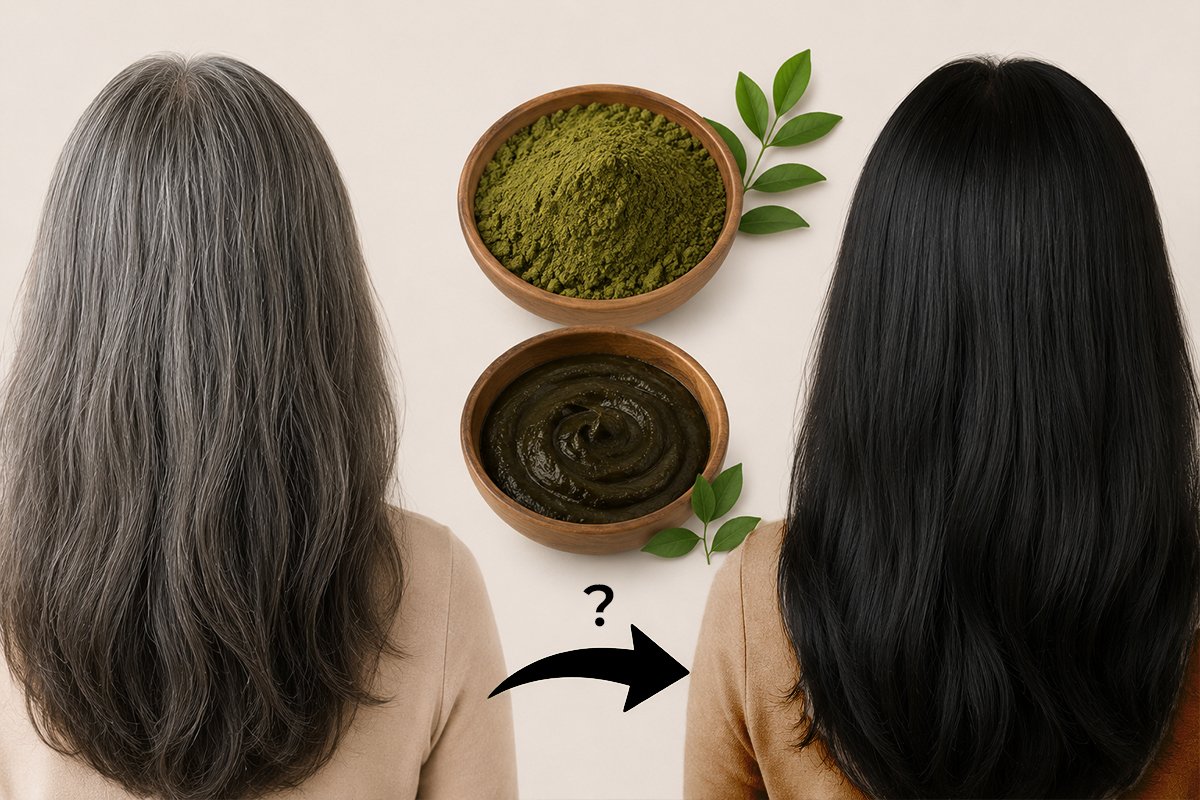
Does Indigo Powder Turn Grey Hair Black?
Indigo powder can turn grey hair black, but not on its own and not in a single mixed paste the way most product labels imply. Grey hair has no underlying pigment to react with, so pure indigo applied alone typically develops into navy, slate, or greenish tones rather than true black. The dependable method is a two-step process: apply henna based hair color first to lay down a reddish-orange base, rinse it out completely, then apply pure indigo powder hair color as a second, separate layer. The indigo pigment oxidizes over the red base and shifts it toward deep brown-black or black. Mixing henna and indigo into one paste and applying it in a single sitting is the single most common reason people report that indigo “doesn’t work” on grey — it’s not a failure of the ingredient, it’s a sequencing problem.
What Indigo Powder Is and How It Works on Hair
Indigo powder comes from the dried, milled leaves of Indigofera tinctoria. The leaves contain a colorless compound called indican, which converts into indigotin (the blue pigment) and indirubin (a reddish-purple pigment) once it’s exposed to water and oxygen. This is an oxidation reaction, not a chemical dye reaction the way synthetic hair color works — there’s no ammonia opening the hair shaft and no peroxide developing a permanent pigment inside the cortex.
On hair that already carries some warmth or red-brown undertone, indigo can deepen the color on its own because the blue pigment has something to combine with. Grey and white hair doesn’t have that undertone, which is exactly why suppliers and formulators who work with natural hair dye suppliers almost always recommend the two-step method specifically for grey coverage rather than a single indigo application.
Indigo Hair Dye: Does Indigo Make Hair More Gray?
No. Indigo hair dye does not turn hair grey. Natural indigo hair color comes from *Indigofera tinctoria* leaf powder, which deposits a deep blue pigment. On grey or light hair, indigo used alone can leave a blue or green-tinged result. That is why it is usually applied after henna in a two-step process: henna first for the warm red base, indigo second to deepen it to brown or black.
The final shade depends on your starting colour, how long each paste stays on, and the henna-to-indigo ratio. Salons and brands that buy indigo powder for hair in bulk usually want a finely milled, consistent batch so the result is repeatable.
Can Indigo Powder Really Turn Grey Hair Black?
Yes — with three honest caveats that most guides skip over:
- Grey percentage matters. Hair that’s 20–30% grey will take color faster and more evenly than hair that’s 70%+ grey, where resistant white strands (especially at the temples and crown) need longer contact time.
- One application rarely gives full black on heavily grey hair. Expect a dark brown-black after the first round, deepening to true black after two to three applications spaced a few days to a week apart, as oxidation continues and layers build.
- Porosity changes the outcome. Grey hair is frequently more resistant (lower porosity, glassier cuticle) than pigmented hair on the same head, which is why you’ll sometimes see uneven “salt and pepper” results after a single, rushed application.
Why Henna Is Usually Applied Before Indigo
Henna’s dye molecule, lawsone, needs time and mild acidity to release from the leaf powder — this is the “ripening” period, usually 6 to 12 hours at room temperature, where the paste gradually shifts from green to brownish-orange as the dye becomes bioavailable. Lawsone then bonds to the keratin in hair, creating a reddish-orange stain that acts as a canvas.
Indigo works on the opposite timeline. It doesn’t need ripening — in fact, it shouldn’t be pre-mixed and left to sit, because the indigotin pigment oxidizes and loses potency once exposed to air. It needs to be mixed with plain water and applied immediately.
Because henna wants acidity and rest time while indigo wants freshness and neutral pH, combining them in one paste forces a compromise that under-develops both pigments. Applied sequentially instead, each dye gets the conditions it needs, and the result is a stable brown-black to black rather than a muddy green-brown.
Best Henna and Indigo Mix Ratios for Different Shades
| Desired Shade | Method | Ratio | Best For |
| Warm chestnut/copper | Henna only | 100% henna | Under 20% grey, warm-tone preference |
| Medium brown | Single-step mix | 3 parts henna : 1 part indigo | Low-to-moderate grey, softer contrast |
| Dark brown | Single-step mix | 1 part henna : 1 part indigo | Moderate grey, less predictable above 50% |
| Deep brown-black | Two-step sequential | 100% henna, then 100% indigo | Significant grey coverage |
| True black | Two-step sequential, repeated | 100% henna, then 100% indigo, repeat indigo pass after 2–3 days if needed | Heavily grey or resistant hair |
Single-step mixed pastes work reasonably well when grey coverage isn’t the main goal — they’re faster and give a softer, more blended tone. Sequential application takes longer but is the more reliable route when the goal is specifically covering grey.
How to Use Indigo Powder for Grey Coverage: Step-by-Step
- Strand test first. Cut a small clipping of hair (ideally from a grey section) and run the full process on it before committing to your whole head.
- Start with clean, dry, product-free hair. Residue from conditioners or styling products can create a barrier that blocks even dye uptake.
- Mix the henna with warm (not hot) water and a splash of an acidic liquid such as lemon juice, to a consistency similar to yogurt. Let it ripen 6–12 hours at room temperature until the color shifts to brownish-orange.
- Apply the henna paste section by section, saturating fully, paying extra attention to resistant grey areas. Cover with a plastic cap.
- Process 1.5–3 hours, scaling up the time with higher grey percentage.
- Rinse with water only — no shampoo yet — until the water runs clear. Let hair air-dry or towel-dry.
- Mix the indigo powder fresh, with plain lukewarm water only, no acidic ingredient, no ripening. Use it within minutes of mixing.
- Apply the indigo paste immediately and evenly, cover, and process 45–60 minutes, checking a strand periodically — over-processing can pull color toward green rather than black.
- Rinse with water only. Avoid shampoo for 24–48 hours; the color continues to oxidize and darken during this window.
- Reassess after 2–3 days. If the result is more brown than black, repeat the indigo step alone — you don’t need to redo the henna layer each time.
How Long Indigo Hair Color Lasts
Henna and indigo coat the outside of the hair shaft rather than penetrating and altering it the way synthetic permanent color does. That has two practical effects: there’s no harsh, obvious root line as it grows out, but the color also doesn’t sit and then suddenly wash out — it fades slowly over 4–8 weeks depending on wash frequency, water hardness, and sun exposure. Most people touch up new grey regrowth every 4–6 weeks rather than recoloring the full length each time.
Common Mistakes That Prevent Good Grey Coverage
- Mixing henna and indigo into one paste when the goal is grey coverage, instead of applying them sequentially.
- Using hot water, which degrades both lawsone and indigotin and weakens the resulting color.
- Under-ripening the henna or skipping the rest period entirely, leaving the dye only partially released.
- Pre-mixing indigo and letting it sit, which causes the pigment to oxidize before it ever touches hair.
- Shampooing immediately after the indigo step, cutting the oxidation window short and leaving color duller than it would otherwise develop.
- Rushing resistant strands at the temples and crown, which need more saturation and contact time than the rest of the head.
- Expecting full black in one round on hair that’s more than half grey — this is a buildup process, not a one-shot dye.
- Using old or improperly stored powder. Indigo especially loses potency once a container has been open and exposed to humidity for months.
Does Indigo Work on All Hair Types and Textures?
Curl pattern itself — straight, wavy, curly, or coily — has little effect on how indigo performs. What actually matters is porosity and grey resistance. Low-porosity hair, which has a tighter, smoother cuticle, resists dye penetration and often needs longer processing times or a gentle pre-wash with a clarifying shampoo to allow the cuticle to lift slightly. Coarser, wiry grey hairs (common at the temples) are frequently the most resistant strands on the head and are the most likely spots to look under-covered after a single pass, regardless of the overall texture of the hair.
Is Indigo Safe for Chemically Treated or Bleached Hair?
Pure henna and indigo powder — with no additives — are generally considered gentler than ammonia or PPD-based dyes and are commonly used on chemically treated hair. Two caveats are worth taking seriously:
- Recently bleached or relaxed hair is more porous, so it can absorb both henna and indigo faster and more intensely than expected, sometimes resulting in patchier or darker-than-planned color. Waiting a couple of weeks after a chemical service and doing a strand test first reduces this risk.
- Prior “compound henna” products are the real hazard. Some drugstore or unmarked henna products contain metallic salts (like lead acetate or bismuth) to speed up or intensify color. If hair was previously treated with a product of unknown origin, applying pure henna or indigo on top — and later processing it with a peroxide-based product — can cause an unpredictable reaction, including heat damage or discoloration. A simple metal test (soaking a clipping in a mild peroxide solution and watching for heat, smoke, or color change) is a cheap safeguard when the history of a previous dye is unknown. This is one of the areas most consumer guides don’t mention, and it’s the single biggest safety gap in casual “is henna safe” content online.
How to Maintain Color Between Touch-Ups
- Use a sulfate-free shampoo and wash less frequently — every wash gradually strips surface pigment.
- Rinse with cool water rather than hot, which helps the cuticle lie flatter and slows fading.
- Apply an oil treatment (amla or coconut oil work well) between sessions to add shine and reduce dryness at the ends, where color fades fastest.
- Limit direct sun exposure on freshly colored hair, since UV accelerates fading in the same way it does with synthetic color.
- If brown undertones start showing through as the black fades, a short indigo-only “refresh” rinse (shorter processing time than a full application) can restore depth without redoing the whole process.
Natural Alternatives for People Who Want Black or Dark Brown Hair
- Cassia obovata — often called “neutral henna,” it has no red pigment and is mainly used as a conditioning base or to lighten, not darken.
- Katam powder — used in some regions as a regional substitute for indigo, with a similar though generally milder blue-black effect.
- Walnut hull powder — deposits warm brown tones and is sometimes used as a rinse between full henna-indigo sessions.
- Amla (Indian gooseberry) powder — adds shine and a cooler undertone, frequently blended into henna or indigo pastes rather than used alone.
- Black tea or coffee rinses — a mild way to deepen tone slightly between full applications, though the effect is subtle and short-lived compared to indigo.
Sourcing consistency matters more than most people expect here — batch-to-batch variation in lawsone or indigotin content between suppliers is one of the biggest reasons the same “recipe” gives different results for different people. Working with an established indigo powder manufacturer and hair color manufacturer that tests lawsone content and provides a Certificate of Analysis on each batch removes a lot of the guesswork that home users otherwise run into through trial and error.
FAQs About Henna, Indigo, and Grey Hair Coloring
Q. Can I mix henna and indigo together instead of doing two separate steps?
Ans. You can, and it’s faster, but it’s less reliable specifically for grey coverage. A single mixed paste tends to give softer, more blended brown tones rather than true black.
Q. How many applications does it take to get fully black hair?
Ans. Typically two to three applications on significantly grey hair, with color deepening each time as oxidation builds.
Q. Does indigo stain the skin or scalp?
Ans. Temporarily, yes, similar to henna. A thin layer of petroleum jelly or oil along the hairline before application helps prevent staining, and any residual stain fades within a few days.
Q.Can I use indigo without henna at all?
Ans. On hair that already has some natural red-brown undertone, yes. On significantly grey hair, using indigo alone usually produces greenish or ashy results rather than black.
Q. Is the indigo powder used for hair the same as industrial indigo dye?
Ans. No. Cosmetic-grade indigo powder is processed from Indigofera tinctoria leaves specifically for topical use, distinct from the synthetic indigo dye used in textiles like denim. When buying in bulk, look for cosmetic-grade sourcing with a Certificate of Analysis.
Q. Will the color transfer onto pillowcases or clothing afterward?
Ans. Minimal transfer once the color has fully oxidized, but using a dark towel or pillowcase for the first night is a reasonable precaution.
Q. Is henna and indigo safe during pregnancy?
Ans. They’re generally viewed as a lower-chemical alternative to synthetic dyes, but individual sensitivities vary, and this isn’t a substitute for medical advice — a patch test and a conversation with a doctor are worth the extra step.