
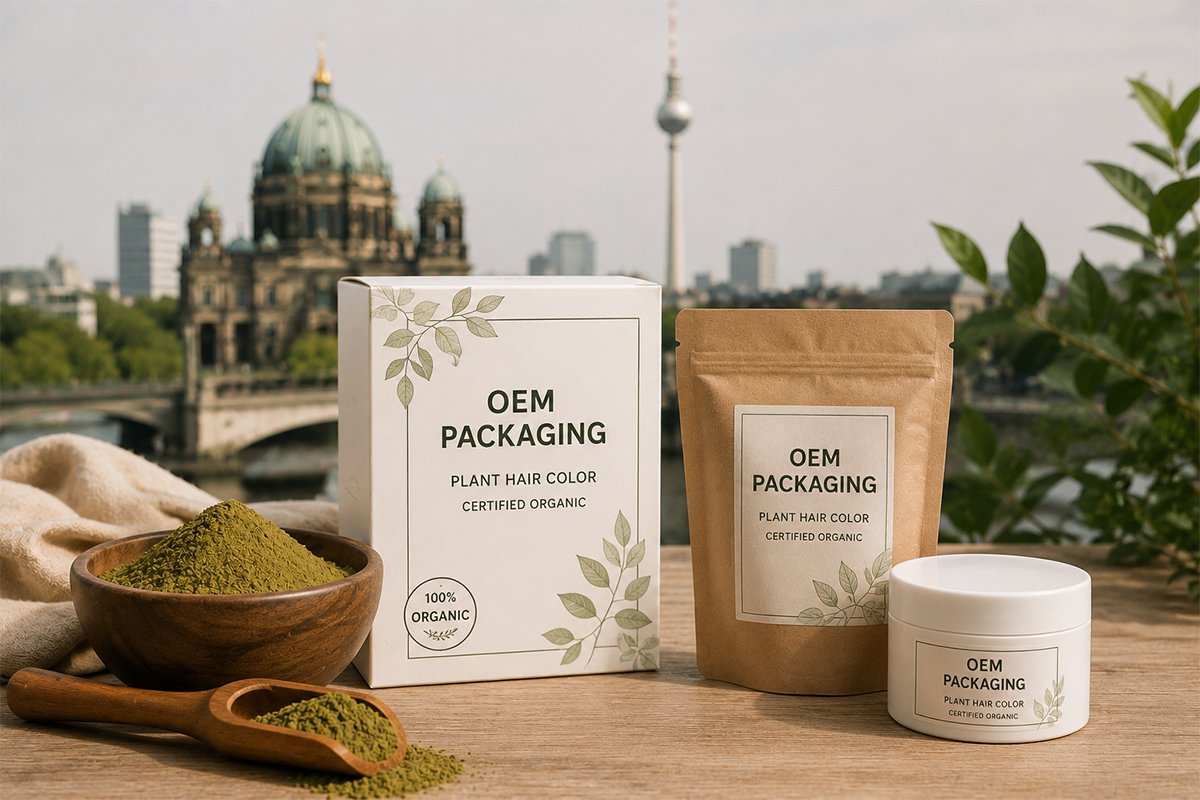
Why German Beauty Brands Are Switching to Certified Organic Plant Hair Color Manufacturers for Private Label Growth
Answer Capsule: German beauty brands, salons, and drugstore chains are shifting private label sourcing toward certified organic henna manufacturers in india because EU cosmetic law keeps narrowing what synthetic oxidative dyes are allowed to contain, while plant-based colorants sit largely outside that pressure. Four EU Omnibus regulations since 2022 have added dozens of newly classified CMR substances to the cosmetics prohibition list — including hair dye intermediates and colorants. A certified organic hair color manufacturer with ISO, GMP, and HALAL certification, HPLC-verified lawsone content, and farm-to-factory traceability gives German buyers a compliant, retail-ready OEM hair color manufacturer partner without carrying the reformulation risk themselves.
Why German Beauty Brands Are Abandoning Conventional Chemical Dyes
This isn’t a branding decision. It’s a compliance and margin decision that happens to also be good marketing.
The EU’s Regulatory Ratchet Against Synthetic Dye Chemistry
The EU Cosmetics Regulation (EC) No. 1223/2009 bans any ingredient classified as carcinogenic, mutagenic, or toxic for reproduction (CMR) under Article 15. What most sourcing managers underestimate is how often that prohibited list grows, and how directly it now touches hair dye chemistry:
- Omnibus IV (Regulation (EU) 2021/1902), effective March 1, 2022 — added 23 newly classified CMR substances to Annex II, including the fragrance allergen Lilial (Butylphenyl Methylpropional). Cosmeservice
- Omnibus V (Regulation (EU) 2022/1531), effective December 17, 2022 — introduced new entries to Annex II and III and revised an Annex V entry.
- Omnibus VI (Regulation (EU) 2023/1490), effective December 1, 2023 — added 30 more CMR substances to the prohibited list. Global Cosmetic Regs
- Omnibus VII (Regulation (EU) 2025/877), effective September 1, 2025 — added 21 substances, including multiple colorants and hair dye intermediates, to Annex II. Global Cosmetic Regs
That’s four rounds of prohibition in under four years, and the most recent one landed directly on hair dye chemistry. Paraphenylenediamine (PPD) hasn’t been banned outright — EU rules currently cap it at a maximum 6% concentration in oxidative hair dye — but it remains one of the most-cited contact allergens in cosmetic dermatology, and unregulated black-market versions have been found at concentrations up to nearly 30% in unregulated tattoo and dye products. Every Omnibus cycle raises the odds that PPD, resorcinol, or another oxidative-system intermediate gets reclassified next. JaadJaad
For a brand that built its hair color line on synthetic oxidative chemistry, each Omnibus act means reformulation, relabeling, and re-notification through the EU’s Cosmetic Products Notification Portal (CPNP). For a brand sourcing plant hair color — where the active colorant is lawsone from Lawsonia inermis leaf, not a synthesized aromatic amine — that compliance target barely moves. That structural stability, not just consumer sentiment, is what’s pulling German OEM buyers toward herbal hair dye sourcing.
What German Buyers Are Actually Purchasing — The Market Numbers
This shift shows up in the transaction data, not just survey sentiment:
- Germany’s natural cosmetics market was valued at $4,085.1 million in 2024 and is projected to reach $6,785.5 million by 2033, growing at a 5.8% CAGR. Custom Market Insights
- Over 70% of German consumers now factor sustainability into cosmetics purchasing decisions. Accio
- Germany’s hair colour category specifically is forecast to exceed $2.24 billion by 2033 at a 6.26% CAGR, with consumer preference for natural, ammonia-free, and vegan formulations cited as a direct growth driver. Spherical Insights
- The German hair salon service market — the professional channel most private label plant hair color brands sell into — was worth $2.5 billion in 2024 and is projected to reach $4.4 billion by 2032, a 7.4% CAGR. Credence Research
- German household spending on personal care hit €63.78 billion in 2024, according to Statistisches Bundesamt data. Mordor Intelligence
None of this is a niche segment chasing a trend. It’s the center of gravity for where the entire German hair color category is heading.
Certified Organic Hair Color, Decoded
Most competitor content uses “organic” as an adjective. German regulators and German consumers treat it as a legal claim that needs a certificate behind it.
COSMOS Organic vs. NATRUE vs. Unverified “Natural” Claims
Two certification frameworks actually carry weight in the German market:
- COSMOS Organic, maintained by COSMOS-standard AISBL and built from five founding European certifiers — BDIH in Germany, Cosmebio and Ecocert in France, ICEA in Italy, and the Soil Association in the UK — requires at least 95% of processed agro-ingredients to be certified organic, with a minimum of 20% organic content across the total formula (10% for rinse-off products). Global FormulationKarethic
- NATRUE is a German-origin standard operating on three tiers — Natural Cosmetic, Natural Cosmetic with Organic Portion, and Organic Cosmetic — and carries particular weight in the German and Swiss markets specifically. Cosmetic Lab
A package that says “natural” or “clean” with no certifier logo is making an unverifiable marketing claim, and German retailers increasingly know the difference. A certified manufacturer producing to COSMOS or NATRUE thresholds gives a private label brand a defensible claim on packaging — which matters directly under the EU’s rules against misleading environmental claims.
Why Henna-Based Formulations Clear These Thresholds More Easily
A single-ingredient plant colorant starts closer to the finish line. Henna leaf powder doesn’t require synthesizing an aromatic amine intermediate, an oxidizing agent, and a stabilizer system the way conventional oxidative dye does — it’s the ground leaf itself, standardized by lawsone content. That structural simplicity is why plant-based OEM formulations reach COSMOS Organic or NATRUE thresholds with far less reformulation than a synthetic dye base fighting to remove ammonia, resorcinol, or PPD while keeping performance intact.
The Legal Gap Most Sourcing Guides Skip: Responsible Person, PIF, and CPNP
This is where most “how to source henna from India” content stops short, and it’s exactly where private label launches stall.
Under EU Cosmetics Regulation 1223/2009, no cosmetic product — including a plant-based hair color manufactured in Sojat City and shipped to Hamburg — can legally reach a German shelf without three things in place:
- A Responsible Person (RP) established in the EU or EEA, who takes legal accountability for the product’s compliance.
- A completed Product Information File (PIF), including a Cosmetic Product Safety Report.
- CPNP notification before the product is placed on the market.
A henna manufacturer can be ISO, GMP, and HALAL certified and still leave a German buyer stuck if nobody addresses RP status. Before signing an OEM agreement, ask directly: does the manufacturer maintain an EU-based RP partner network, or is that entirely the buyer’s responsibility? That single question determines whether a private label launch takes ten weeks or six months.
What to Vet in an Henna Manufacturer in India: The Buyer Checklist
Certifications — What Each One Actually Verifies
A common buyer mistake: treating “ISO certified” as one undifferentiated stamp of approval.
| Certification | What It Actually Verifies | Why It Matters for German Buyers |
| ISO 9001 | General quality management system | Confirms process discipline, not cosmetics-specific manufacturing |
| ISO 22716 (Cosmetic GMP) | Cosmetics-specific good manufacturing practice | The credential EU buyers should specifically ask for, not assume |
| GMP audit | Batch consistency, hygiene, facility standards | Baseline for any bulk manufacturing relationship |
| HALAL | No animal-derived or non-compliant ingredients in formulation | Increasingly requested by German retailers with Gulf-linked or Muslim-consumer retail lines |
Lawsone Content, HPLC Testing, and Batch-Level CoAs
Lawsone (2-hydroxy-1,4-naphthoquinone) is the compound that actually produces henna’s color, and its concentration varies by crop, soil, and harvest — typically in the low single-digit percentage range in quality BAQ (Body Art Quality) henna. HPLC testing is what confirms the actual percentage rather than a supplier’s stated average. Ask for a CoA (Certificate of Analysis) per production batch, not an annual spec sheet — annual documentation tells a buyer nothing about the shipment currently in transit.
Metallic Salt Contamination — The Silent Deal-Breaker
Cheaper henna is sometimes cut with metallic salts to intensify or stabilize color output. It’s invisible to the eye and to a casual smell test, and it becomes dangerous when combined with peroxide-based treatments later in a customer’s hair color routine — a reaction most competitor content never mentions. This is a lab test, not a visual inspection: request a heavy-metal contamination panel alongside the CoA, not instead of it.
Plant Hair Color vs. Conventional Dye vs. Semi-Natural Hybrid
| Attribute | Plant-Based (Henna/Indigo) | Conventional Oxidative Dye | Semi-Natural Hybrid |
| PPD / ammonia content | None | Present (PPD capped at 6%) | Often reduced but not eliminated |
| EU CMR regulatory exposure | Low — not subject to the Omnibus reclassification cycle | High — directly targeted by recent Omnibus acts | Moderate |
| Patch test typically required | Rarely (allergy risk still exists, always advise one) | Yes, standard practice | Usually yes |
| Grey coverage speed | Slower without the two-step method | Fast, single application | Fast |
| Scalp sensitivity profile | Generally gentler, still requires patch testing | Higher irritation/sensitization risk | Variable |
| Certification pathway | Naturally aligned with COSMOS/NATRUE thresholds | Requires significant reformulation | Partial alignment |
| Retail positioning | Clean beauty, vegan cosmetics, premium | Mass-market, commodity pricing | Mid-tier “better-for-you” |
How OEM and Private Label Manufacturing Actually Works
- Formulation brief — buyer specifies shade range, texture (powder, cream, gel), and certification target (COSMOS, NATRUE, or conventional GMP-only).
- Sample formulation and lab testing — manufacturer produces trial batches with lawsone HPLC results and heavy-metal panel.
- Documentation exchange — CoA, safety data sheet, INCI listing, and RP arrangement confirmed before packaging design starts.
- Packaging and compliance labeling — retail-ready packaging built to the target retail channel (salon-exclusive vs. drugstore shelf have different labeling expectations).
- Production run at agreed MOQ — full-batch manufacture begins once samples are approved.
- QC on the finished batch — final CoA issued against the actual shipped lot, not the sample lot.
- Export logistics and customs clearance — sea freight to Hamburg or Rotterdam for standard volumes, air freight for smaller or time-sensitive private label launches.
MOQs, Lead Times, and Logistics to Germany
Private label starter runs for a single-SKU henna or henna-indigo line typically move in the low-hundreds-of-kilograms range for a first order, scaling up substantially once a retail chain or salon distributor commits to reorders. Realistic lead time from confirmed formulation to goods landed at a German port runs several weeks to a few months, depending on whether it’s a first-time formulation or a repeat order against an existing spec. Buyers underestimate this timeline constantly, then find themselves promising a retail buyer a launch date the supply chain can’t actually hit.
Grey Coverage Without Compromise: The Henna-Indigo Two-Step Method
The most common objection German buyers raise about natural hair color is grey coverage. Pure henna alone produces orange-to-red tones — it can’t get to brown or black on its own. The answer isn’t a compromise formula with hidden PPD; it’s a two-step process: henna applied first, followed by natural indigo (Indigofera tinctoria), which oxidizes on contact with air to deepen the tone toward brown and black. Done correctly, this method delivers full grey coverage through a plant-based process, without introducing an oxidative synthetic dye system. It’s the single strongest technical answer to the “does natural actually work” objection salons raise.
Why Sojat City, Rajasthan Matters for Sourcing Decisions
Sojat City carries a GI (Geographical Indication) tag for henna cultivation, and the region’s soil and climate produce leaf with consistently higher lawsone content than henna grown elsewhere. A farm-to-factory supply chain based directly in Sojat — rather than a multi-broker import chain routed through several intermediaries — cuts the adulteration risk that shows up later as inconsistent lawsone percentages or undisclosed metallic salt contamination. Sourcing from the region isn’t a marketing detail; it’s a traceability and quality-control decision.
Common Mistakes German Private Label Brands Make When Vetting Manufacturers
- Accepting “organic” on packaging or a pitch deck without requesting the COSMOS or NATRUE certificate number
- Assuming an ISO 9001 certificate covers cosmetics-specific GMP (it doesn’t — ask for ISO 22716 or equivalent)
- Signing an OEM agreement without clarifying who handles the Responsible Person role
- Relying on an annual specification sheet instead of batch-level HPLC and CoA documentation
- Skipping heavy-metal contamination testing entirely
- Promising retail buyers full grey coverage without confirming the manufacturer supports the henna-indigo two-step process
- Ordering below realistic MOQ thresholds, then facing per-unit costs that erase the private label margin
Kirpal Export Overseas: Built for This Shift
Kirpal Export Overseas (KEO), founded by Sunil Walia and based in Sojat City, Rajasthan, operates as an export manufacturer and contract manufacturing partner for exactly this transition — ISO, GMP, and HALAL certified, with a farm-to-factory supply chain and HPLC-verified lawsone testing on every batch. KEO’s OEM and white label hair color programs cover the full path from formulation brief to retail-ready packaging, including the henna-indigo two-step system for grey coverage, for buyers across MENA, Europe, North America, and beyond. Sourcing details on certification scope are outlined on KEO’s ISO, GMP, and HALAL certification page, and the bulk supply and henna powder specifications used across private label programs are documented at Henna Supplier. For a deeper look at OEM structuring specifically, see Henna Manufacturers’ private label manufacturing guide, and for PPD-free formulation detail, Herbal Hair Colors’ safety resource. Background on the founder’s approach to farm-direct sourcing is available at sunilwalia.net.
FAQ
Q. Is henna hair color really PPD-free?
Ans. Genuine henna and henna-indigo formulations contain no paraphenylenediamine. “Black henna” products that claim instant dark color and fast results are the exception — those typically contain added PPD and aren’t true plant-based formula products.
Q. Can plant-based hair color fully cover grey hair?
Ans. Yes, through the henna-indigo two-step method — pure henna alone won’t get to brown or black tones on its own.
Q. What certifications should a German private label brand require from an Indian henna manufacturer?
Ans. At minimum: ISO 22716 (cosmetics GMP), a current GMP audit, HALAL certification if targeting MENA-adjacent retail, and COSMOS or NATRUE certification if marketing the product as certified organic.
Q. What’s a realistic MOQ for a private label henna hair color launch?
Ans. Starter runs typically begin in the low-hundreds-of-kilograms range per SKU, scaling with confirmed retail or salon distribution commitments.
Q. Does henna hair color meet COSMOS or NATRUE organic standards?
Ans. Single-ingredient plant colorants like henna and indigo are structurally closer to COSMOS and NATRUE thresholds than synthetic oxidative dye systems, though the finished formulation still needs to be certified against the specific standard to carry the claim on packaging.