
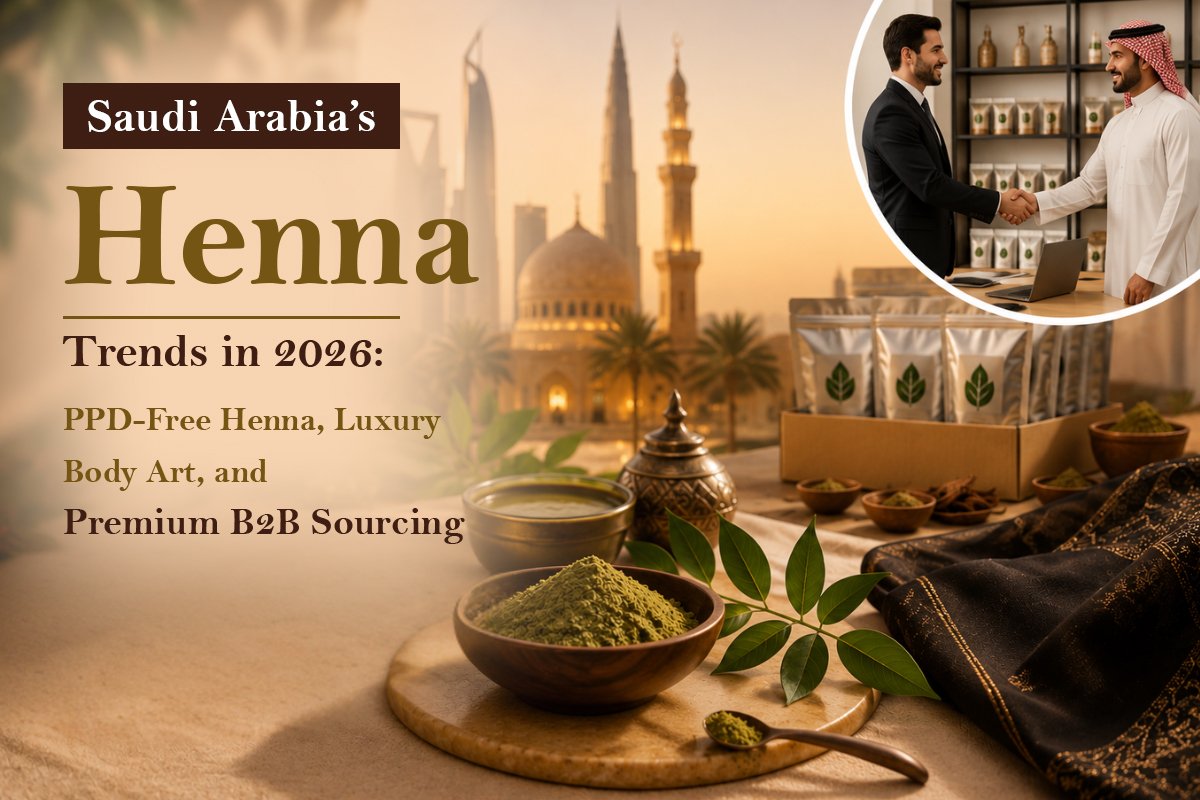
Saudi Arabia’s Henna Trends in 2026: Organic Henna Powder, Luxury Body Art, and B2B Sourcing from Sojat
Saudi Arabia’s henna market in 2026 is consolidating around one requirement: organic henna powder that is lawsone-rich, genuinely PPD-free, and traceable to its source. Saudi cosmetic rules cap PPD at 2% free base and restrict it to oxidative hair dye only, which is pushing paste, cones, and hair-color powders toward real plant-based formulations. Demand is simultaneously moving upmarket — luxury bridal body art, salon-ready paste, indigo-blended herbal hair color, minimalist Khaleeji design work — while B2B buyers bypass layers of middlemen to buy henna wholesale directly from Sojat, Rajasthan, the town that supplies most of the world’s henna.
Why PPD-Free Henna Is Becoming the Standard in Saudi Arabia
Para-phenylenediamine (PPD) is the chemical behind almost every “instant black henna” complaint you’ve ever read. Pure henna cannot produce a black stain — it physically doesn’t contain the right pigment. When a paste turns skin near-black within an hour, a supplier has added PPD or a similar coal-tar derivative to force a faster, darker result. The trade-off is well documented: PPD is a potent skin sensitizer, and repeated or high-concentration exposure is linked to severe contact dermatitis, blistering, and permanent scarring in reactive individuals.
Saudi Arabia hasn’t left this to chance. The Saudi Food and Drug Authority (SFDA) regulates cosmetics under Gulf-wide technical standards — principally GSO 1943, GSO 2528, and GSO 2020 — and requires every cosmetic product to be notified through the GHAD electronic system before it can carry a Certificate of Conformity issued via the FASEH platform. Within that framework, PPD and its salts are restricted to oxidative (permanent) hair dye formulations only, capped at 2% as free base after mixing. That single rule is the real reason organic henna powder is becoming the default rather than a premium add-on: a product formulated for direct skin application, like a body-art paste or cone, has no approved path to legally contain PPD in the first place.
| Rule | Requirement in Saudi Arabia |
| Where PPD is permitted | Oxidative (permanent) hair dye formulations only |
| Maximum PPD concentration | 2% as free base, measured after mixing |
| PPD in skin-applied products (e.g., “black henna” paste) | Outside the approved use category |
| Cosmetic product notification | Filed through the GHAD electronic system |
| Import clearance | Certificate of Conformity (CoC) issued via FASEH |
| Governing standards | GSO 1943, GSO 2528, GSO 2020, enforced by the SFDA |
Regulations are updated periodically — confirm current requirements with the SFDA or a customs compliance partner before finalizing an import or listing decision.
How to Verify a Genuinely PPD-Free Organic Henna Powder
A label is not a lab result. Before trusting a claim, check:
- The Certificate of Analysis (COA) explicitly tests for PPD — a generic “chemical-free” statement is not the same as a tested result
- The registration category matches the use case — a product sold for body art should be filed as such, not repurposed from a hair-dye registration
- The stain develops gradually. Genuine henna darkens over 24–48 hours, moving from orange to a deep red-brown or maroon as it oxidizes on skin. An instant, uniformly dark stain is the clearest field warning sign of adulteration
- The batch’s lawsone percentage is disclosed, not just an unquantified “premium quality” claim
- A patch test is done on any new formulation before full application, regardless of how the product is marketed
The Rise of Luxury Body Art in Saudi Beauty Culture
Henna’s status in the Kingdom is shifting from a wedding-week tradition to a year-round premium beauty category. That shift is riding on top of a much bigger structural move: Saudi Arabia’s beauty and personal care market is on track to grow from roughly USD 8 billion in 2026 to nearly USD 11 billion by 2031, expanding at just over 6% a year. Vision 2030 is a direct driver — female workforce participation has climbed from around 17% in 2017 to over 36% by 2023, well past the government’s original target, and that has translated into rising disposable income and a fast-normalizing culture of professional grooming and self-care spending.
Henna is riding that wave in a specific way: it’s moving out of casual street sessions and into scheduled appointments at dedicated body-art studios and beauty lounges, priced and presented the way a gel manicure or lash service would be. Bridal and event henna has become a status marker in its own right — brides are booking artists the way they’d book a photographer, and event henna is increasingly sold as a packaged experience (design consultation, premium organic henna powder, aftercare) rather than a walk-up service.
Minimalist Khaleeji and Jewellery-Style Henna Designs
The dominant design shift of 2026 is restraint. Full-hand, wrist-to-elbow coverage hasn’t disappeared, but the fastest-growing category is minimalist work: a single fine-line motif on one finger, one round mandala centered on the wrist, or a scattering of micro dots and delicate florals covering roughly a third to half of the hand. Jewellery-inspired patterns are doing a lot of the heavy lifting here — the hathphool, a traditional hand ornament connecting a wrist bracelet to finger rings via fine chains, has become a recurring template for henna artists to trace directly onto skin, effectively standing in for the piece of jewelry itself in some bridal looks.
This matters commercially, not just aesthetically. When a design covers less skin, the quality of the stain has nowhere to hide — every line has to be crisp, and the color has to be consistent, because there’s no dense fill to mask an uneven batch. Minimalist demand quietly raises the bar on paste smoothness and dye consistency at the manufacturing level.
Arabic + Mandala Fusion as a Trending Artistic Style
Where minimalism strips henna down, fusion work builds it back up. The strongest 2026 pattern combines the bold florals, curved vines, and generous negative space that define classic Arabic mehndi with the radial symmetry of mandala work and the architectural geometry of Mughal jali lattice screens. The result reads as more structured and intentional than either style alone — oversized rose motifs anchored by a centered mandala, or a jali-inspired mesh used as a background fill instead of a flat block of color.
For brands and salons, fusion work is also a positioning tool: it signals an artist — or a product line — that understands both traditions well enough to blend them deliberately, rather than defaulting to one generic template. It rewards a fine, lump-free paste that can hold both broad curved strokes and tight geometric detail in the same design.
Ready-to-Apply Henna Pastes and Instant Beauty Convenience
Time-poor urban consumers and salons that need repeatable results are driving demand for pre-soaked, ready-to-use formats. But “ready-to-apply” covers several genuinely different products, and they don’t behave the same way once they leave a climate-controlled factory.
| Format | Typical Shelf Life | Best Suited For | Gulf-Climate Notes |
| Dry organic henna powder | 12–24 months, sealed and dry | Bulk import, private label, salons that mix fresh | The most stable option for ocean freight and long-term retail storage |
| Frozen pre-mixed paste | Weeks to several months frozen; days once thawed | Retailers and artists with reliable cold-chain access | Requires an unbroken freezer chain from factory to shop shelf |
| Henna cones | Days to a couple of weeks unrefrigerated | Walk-in sessions, gifting, events | Fast and familiar to artists, but the most heat-sensitive format |
| Henna tubes | Somewhat longer than cones due to tighter sealing | Retail and export SKUs, salon backup stock | Better seal reduces moisture and air exposure in transit |
The Gulf Climate Problem Most Suppliers Don’t Mention
Pre-mixed paste is perishable by nature — it has no preservatives, and even under good conditions it holds its quality for roughly a week at room temperature. Gulf summers routinely push past 40°C, and warehouses, delivery vans, and last-mile shop storage aren’t always climate-controlled. That mismatch is the real reason so many serious Saudi B2B buyers still import bulk henna powder rather than pre-mixed paste: powder tolerates ocean freight and ambient storage far better, and salons or private-label brands mix fresh batches locally, closer to the point of sale. Buyers who do commit to imported paste or cones should insist on moisture-barrier packaging, storage below 25°C wherever possible, first-in-first-out stock rotation, and clear manufacture and expiry dates on both the retail unit and the shipping documentation — the last of these can determine whether a shipment clears customs smoothly or gets held up at the port.
Henna-Based Hair Dyes for Premium Consumer Markets
Herbal hair color has outgrown its reputation as a flat, orange-only option. The mechanism is straightforward once you separate the two plants doing the work. Henna leaves carry lawsone, which binds to keratin and produces a red-orange stain — raw leaves typically test around 1–1.4% lawsone content, and this is the figure serious buyers should be asking processors to disclose per batch. Indigo (Indigofera tinctoria) carries a different compound, indican, which oxidizes into indigotin, a blue-black pigment. Henna alone never produces brown or black; that range only appears when indigo is layered on top, and the ratio and sequence of the two powders determines the final shade:
- Burgundy and auburn tones come from a henna-dominant mix with little to no indigo, sometimes complemented with hibiscus or other reddish botanicals for a deeper wine cast
- Chestnut and medium brown shades generally come from a roughly balanced henna-to-indigo blend, applied either as a one-step combined paste or a two-step sequence
- Deeper, near-black tones require the full two-step method — henna applied and rinsed first, indigo applied separately afterward — because indigo needs the lawsone-keratin bond already in place to deposit a stable, dark tone
- Lighter, golden-brown finishes typically dilute the henna itself, blending in a lower-dye-content or neutral henna base, rather than relying on indigo at all, since indigo only pushes color darker and cooler, never lighter
| Attribute | Henna + Indigo (Herbal) | Oxidative Chemical Dye |
| Core dye molecules | Lawsone (red-orange) + indigotin (blue-black) | Synthetic precursors, including PPD, developed with peroxide |
| PPD content | None, in a genuinely pure formulation | Permitted up to 2% free base in Saudi Arabia |
| Application | Two-step process for darker shades | Single mix-and-apply step |
| Grey coverage | Reliable, though grey strands take pigment more slowly | Fast and uniform |
| Regrowth line | Soft and gradual | Visible demarcation as hair grows out |
| Typical allergy profile | Low, though patch testing is still advised | Higher — PPD is a recognized potent sensitizer |
Complementary herbal powders round out a premium hair-color range. Shikakai powder, made from dried Acacia concinna pods, is a mild, saponin-based cleanser traditionally used to prep the scalp ahead of a henna or indigo application, and it’s increasingly bundled alongside henna and indigo as part of a single herbal hair-care line rather than sold as a standalone item.
The Growth of Henna Nail Art and Luxury Henna Lounges
Henna’s visual language — fine linework, florals, geometric fills — has migrated onto nails. Gulf nail art increasingly borrows henna-inspired motifs, often finished with gold or metallic accents that echo the region’s broader preference for bold, jewel-toned nail work, alongside a competing minimalist strand that favors a single delicate design over a full set. The two aesthetics coexist on the same salon menus, mirroring the split between maximalist and minimalist henna itself.
More significant than the crossover motif is the format shift underneath it: multi-branch beauty-lounge chains already operate at scale across the Gulf, and henna is increasingly booked as a menu item inside that structure — alongside nails, hair, and skincare — rather than sourced from a home artist or a seasonal market tent. That format change raises the bar for suppliers. A lounge running back-to-back appointments needs a consistent, easy-to-batch henna powder it can trust to perform the same way every time, not an informally sourced paste with batch-to-batch variation.
White and Metallic Henna for Bridal and Event Styling
Here’s a distinction most content on this topic gets wrong: white henna and metallic henna aren’t henna at all. There is no natural pigment that stains skin white, gold, or silver — Lawsonia inermis only ever produces shades of red-brown. What’s marketed as “white henna” is a cosmetic-grade adhesive combined with white body paint, often titanium-dioxide-based, applied with the same fine-tip technique as real henna paste. “Metallic henna” is typically that same white base finished with cosmetic-grade glitter or mica dusted over the wet design, or a specialty metallic body-paint pen used the same way.
The appeal for bridal and event styling is genuine: these products photograph cleanly against skin and jewelry, don’t compete visually with a bride’s diamonds the way a dark natural stain can, and work well for daytime or editorial shoots. The trade-off is longevity — they sit on top of the skin rather than staining it, and typically last one to four days versus the one to three weeks of a genuine henna stain.
For exporters and manufacturers, the practical takeaway is a labeling one: because these are a different product category entirely — a cosmetic body paint, not a Lawsonia-derived dye — they should be formulated, registered, and sold as a distinct SKU rather than marketed as a color variant of henna. Blurring that line creates both a consumer-confusion problem and a regulatory-filing problem.
B2B Bulk Sourcing from Sojat, India
Almost every trend above depends on the same upstream decision: where the organic henna powder actually comes from. For Saudi buyers, that increasingly means Sojat, a town in Rajasthan’s Pali district that has become the de facto center of the world’s henna trade.
The reason is agronomic before it’s commercial. Sojat’s semi-arid climate, sandy loam soil, and intense dry heat — summer temperatures regularly cross 45°C — happen to be close to ideal growing conditions for Lawsonia inermis. Plants grown under that stress develop a noticeably higher lawsone concentration than henna grown in cooler or more humid regions, which is what translates into a darker, longer-lasting stain. Sojat and the surrounding Pali district are widely cited as producing roughly 80% of India’s henna, and since India itself supplies the large majority of the world’s henna, Sojat alone effectively underpins most of the global trade. The Indian government recognized this with a Geographical Indication (GI) tag for Sojat henna in 2010, legally protecting the regional name in domestic and international trade. Decades of buyer relationships have also built a mature processing and export ecosystem around the town — cleaning units, grinding mills, moisture-controlled packaging, in-house testing labs, and export staff experienced with the documentation international buyers expect.
Because henna and indigo are almost always bought together for two-step herbal color systems, most established Sojat organic henna powder manufacturers also function as indigo powder manufacturers, processing and offering both crops as a matched pair rather than forcing buyers to source them separately.
What Saudi Buyers Should Verify Before Placing a Bulk Order
- Request a current Certificate of Analysis covering lawsone percentage, moisture content, mesh/sieve size, and microbial load — fine hair-color-grade powder is commonly sieved to roughly 100–200 mesh
- Verify organic certification independently. Contact the issuing body directly with the certificate number rather than accepting a scanned image at face value
- Confirm full export documentation: phytosanitary certificate, certificate of origin, commercial invoice, and packing list, aligned with the SFDA’s GHAD notification and FASEH clearance process
- Order a trial batch before a full container. A small sample lets you run an independent patch and stain test before committing to volume
- Ask for traceability to specific farms or harvest batches, not just a generic “Sojat origin” claim on the label
- Clarify Incoterms up front — FOB pricing covers goods to the port of loading, CIF includes freight and insurance to the destination port, and the difference materially affects landed cost
- Match packaging to your actual storage conditions, not the exporter’s default — moisture-barrier, multi-layer packaging is the export standard for a reason
Working With Established Sojat Exporters
Sojat’s ecosystem includes hundreds of processors of varying scale, which makes supplier selection the single highest-leverage decision a Saudi buyer makes. Kirpal Export Overseas (KEO) is one of the Sojat-based manufacturers and exporters built around this model — processing in its own facility rather than through third-party job-work, with a stated focus on organic, chemical-free (including PPD-free) henna powder, alongside henna-indigo herbal hair color formulated for burgundy, brown, and black shade ranges. Whichever supplier a buyer ultimately chooses, the diligence checklist above applies equally: documentation first, superlatives second.
What Saudi Arabia’s Henna Trends Mean for Exporters and Manufacturers
Put the trends together and the Saudi 2026 buyer — whether a salon, a retailer, or a private-label brand — is optimizing for three things at once: verified safety and compliance, credible premium positioning, and format flexibility. That’s a different competitive game than winning on raw bulk price alone, and it changes what exporters need to lead with.
A five-point positioning checklist for exporters entering this market:
- Lead with documentation, not adjectives. Have COAs, organic certificate numbers, and phytosanitary paperwork ready before a buyer has to ask for them
- Offer format flexibility. Stock both 25kg bulk bags for established distributors and smaller private-label trial runs for salons and emerging brands testing the market
- Solve the Gulf heat problem in your packaging, not just your marketing copy. Moisture-barrier packaging and clear expiry dating reduce disputes and returns far more than another “100% natural” label claim
- Sell a coordinated herbal range, not a single SKU. Pairing organic henna powder with indigo, shikakai powder, amla, and other complementary herbs matches how salons and hair-color brands are actually buying in 2026
- Invest in direct relationships with Saudi salons, distributors, and beauty brands rather than relying solely on multi-layer intermediary chains — the buyers driving this shift are the ones asking the most detailed sourcing questions, and they reward suppliers who can answer them without hesitation