
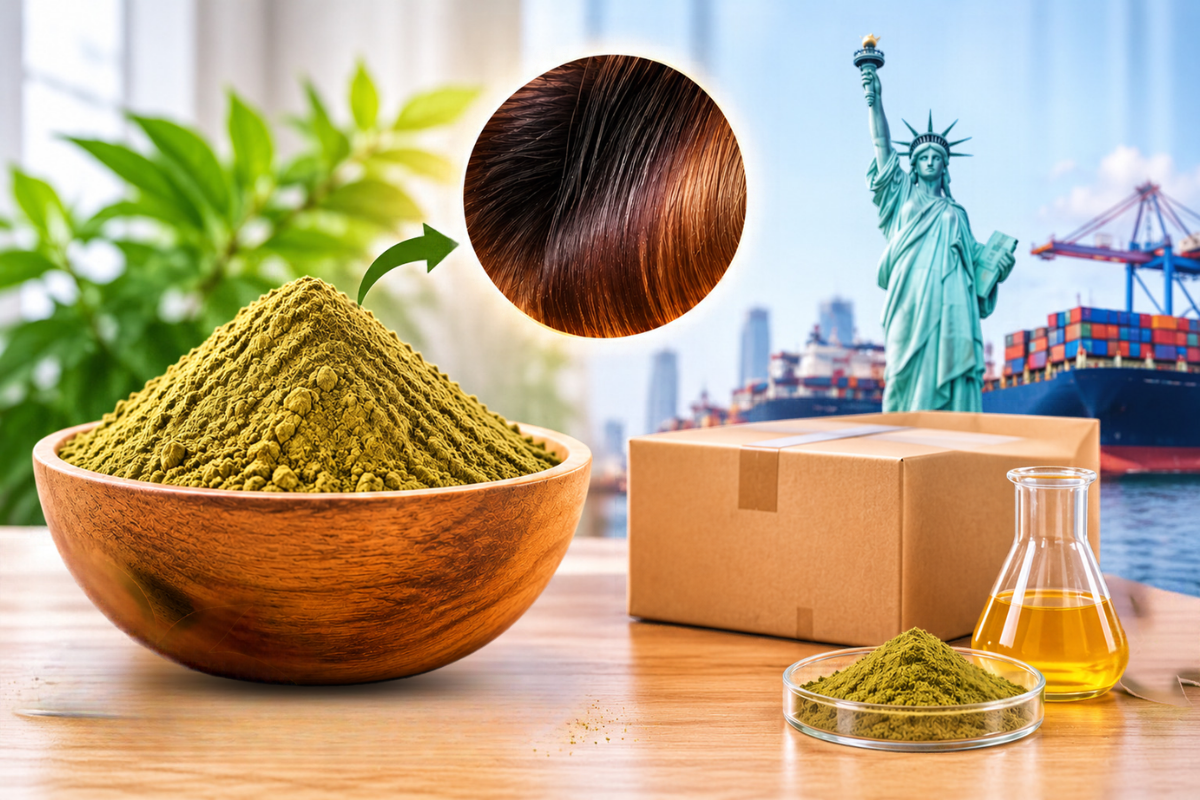
How do you know what is really inside a bag of henna powder? In 1976 the mummy of Ramesses II travelled to Paris for conservation work, and French researchers examined strands of his hair. According to published accounts, they linked its reddish-yellow colour to henna. Three thousand years on, nobody is surprised that henna colours hair. What still surprises buyers is how rarely anyone checks what else arrived in the same bag.
Today the question is the same and the instrument has changed. A modern importer answers it with one page: the henna powder certificate of analysis, usually shortened to henna COA. Read well, it tells you what the powder is, which limits it meets and which lab says so. Read badly, it is a decorative PDF with a green tick.
A henna powder certificate of analysis is a batch-specific lab report that lists what one lot of henna powder contains and compares each result with a limit. For US hair-colour use, the limits FDA lists include lead at 20 ppm or less, arsenic at 3 ppm or less and acid-insoluble ash at 5% or less. In simple terms, the COA is the paper that says this exact batch passed. A trustworthy one names the lab, the batch, the method and the date.
What Does a Henna Powder Certificate of Analysis Actually Prove, and What Doesn’t It?
A COA proves one narrow thing: a sample from one batch was tested for the listed parameters and gave the listed results. That is genuinely useful. It is not a safety certificate, a licence to sell or a promise about the next shipment.
Three limits are worth keeping in mind:
- One batch only. A report for last spring’s lot says nothing about the lot on your pallet.
- Only what was tested. A henna COA that leaves out a PPD screen cannot tell you the powder is PPD-free.
- Only as honest as its source. A report written by the supplier is self-reported. A report from an independent lab adds a second pair of eyes.
There is also a quiet gap people miss. The FDA henna regulation exempts henna batches from FDA batch certification, so no government stamp travels with your lot. The COA, plus your own checks, is the evidence you will have if anyone asks questions later.
What Should a Henna COA Show Before You Read a Single Number?
Check the identity and paperwork first. A table of impressive results on a document with no batch number is a table about nothing.
Does it name the plant correctly?
The botanical name should read Lawsonia inermis (also written Lawsonia alba), and the part should be the dried leaf. Anything vague, such as “herbal powder” or “natural colour”, is a reason to ask for a corrected report before you ask anything else.
Does it carry a batch number, dates and a lab?
Look for a batch or lot number that also appears on the packing list and the carton label. Look for a manufacturing date and a separate test date. The lab’s name and address should be there, with an authorised signature. Some buyers also prefer labs accredited to ISO/IEC 17025, the international standard for testing laboratories, though that is buyer preference, not a legal requirement.
Does it state methods and units?
Each result needs a method, a unit and, for trace metals, a detection limit. Lead and arsenic are usually measured by atomic spectroscopy or ICP-MS. Ash and moisture are weighed. Units of ppm and mg/kg mean the same thing, so do not let a change of unit confuse a comparison.
Which Henna Powder Specifications Does FDA List?
The core henna powder specifications sit in 21 CFR 73.2190, the section of US federal regulations that lists henna as a colour additive for cosmetics. Under paragraph (b), henna must meet the limits below. Regulations can be amended, so confirm the current wording before you copy a limit into a contract.
| Parameter | Limit in 21 CFR 73.2190(b) |
| Plant material from other parts of Lawsonia | Not more than 10%, and free of material from any other plant species |
| Moisture | Not more than 10% |
| Total ash | Not more than 15% |
| Acid-insoluble ash | Not more than 5% |
| Lead (as Pb) | Not more than 20 ppm |
| Arsenic (as As) | Not more than 3 ppm |
What Is the Henna Lead Limit?
The henna lead limit is 20 parts per million, and the arsenic limit is 3 ppm. Both are trace-metal limits, and they matter because a powder made from a plant that grows in soil can pick up metals from that soil, or from the way it is dried and ground.
What Do the Ash and Moisture Numbers Tell You?
Total ash is what remains after the powder is burned. Acid-insoluble ash is the part that will not dissolve in acid, which in practice points to sand and soil. Henna grows in dirt; it should not arrive with a share of it. A high acid-insoluble figure suggests poor cleaning or dilution with something cheap.
Moisture is the quiet one. Damp powder spoils faster and clumps in storage, so a result near the 10% ceiling deserves a follow-up question about drying and packing.
Which Extra Tests Do Buyers Add Beyond FDA’s List?
Here is where a good henna powder certificate of analysis earns its keep. FDA’s list covers identity, plant purity, moisture, ash and two metals. It says nothing about several things buyers actually worry about. The tests below are buyer practice, not legal requirements, and you should write them into your own specification.
- PPD screen. PPD (para-phenylenediamine) is a coal-tar hair-dye ingredient. FDA has warned that products sold as “black henna” can contain it. Natural henna does not, so ask for a separate PPD test report with the method named.
- Lawsone content. Lawsone is the dye molecule in henna. Some buyers use it as a potency marker.
- Microbial limits. Typical checks cover total plate count, yeast and mould, and named pathogens. FDA’s henna section sets no microbial figure, so your spec has to.
- Other heavy metals. Cadmium and mercury are common additions to the lead and arsenic pair.
- Pesticide residues and particle size, if your formula or shade depends on them.
If you are comparing suppliers, look at how openly each one publishes its grade details. A published page for organic henna powder is a fair starting point for the questions you should ask, even if you end up buying elsewhere.
How Do You Read the Numbers on a Henna Powder Certificate of Analysis?
Results are only as good as the way they are reported. A few habits separate a careful reader from a hopeful one.
A line that says “complies” with no value is not a result. Ask for the number. A line that says “nil” or “absent” for lead is also weak, because no instrument measures true zero. A result such as “below 0.5 ppm, detection limit 0.5 ppm” tells you what was actually looked for.
Compare reports across batches. Henna is a plant, so small natural variation is normal. If every lot over a year shows the same moisture, the same ash and the same lead to the last decimal, that is a reason to ask questions. It is not proof of anything, but real batches rarely behave like photocopies.
Finally, check that every result sits against its limit, not just near it. A result a hair below the ceiling on three tests at once is worth a polite conversation about process control.
What Are the Red Flags on a Henna COA?
None of these proves a problem alone. Two or three together should slow you down.
- No batch number, or one that does not match your shipping documents
- No lab name, no address or no signature
- A date that predates the production of the lot
- Results shown as “pass” or “complies” with no figures
- Missing methods or units
- Botanical name missing or wrong
- Metals reported as “nil” with no detection limit
- A report that covers “henna” in general and names no product, grade or batch
- Results that never change between lots
Why Does “Hair Only” Matter for the COA and Your Label?
Paragraph (c) of 21 CFR 73.2190 says henna may be safely used for colouring hair only, and not for eyelashes, eyebrows or generally in the eye area. Paragraph (d) requires label statements equivalent to “Do not use in the area of the eye” and “Do not use on cut or abraded scalp.”
Why bring that up in an article about lab reports? Because a clean COA does not widen the permitted use. A henna powder lot can pass every test above and still be unsuitable for a product marketed for brows. If you plan a brow product, treat the intended use as a separate regulatory question and ask a qualified adviser before you print a label.
What Does MoCRA Mean for Importers of Henna-Based Products?
The Modernization of Cosmetics Regulation Act of 2022, known as MoCRA, expanded FDA’s oversight of cosmetics. In general terms, it introduced facility registration and product listing, safety substantiation records, adverse-event reporting and labelling duties, and it expects foreign facilities to name a US agent. The “responsible person”, the company whose name appears on the label, must keep records that support the safety of each product.
A COA is one input into that file, not the whole file. Exemptions exist for some small businesses, and the details change as FDA issues guidance. Treat this section as orientation, not legal advice, and confirm what applies to your company with a regulatory consultant.
Does the Same COA Work for the US and the EU?
Not entirely. The test results may overlap, but the document set around them does not. European buyers usually expect a safety data sheet and REACH-related information alongside the henna COA, and their cosmetic rules sit on a different framework from the US one. The separate EU guide to henna CoA, SDS and REACH documents covers that side in detail, so you can keep the two markets apart instead of blending them into one vague “export-ready” claim.
What Does a Useful COA Layout Look Like?
The layout below is a template for your own specification. It contains no real batch data, and the result column is blank on purpose: the lab fills it in, and you compare it against the limit.
| Parameter | Specification | Result (lab fills in) | Method (lab states) |
| Botanical identity | Lawsonia inermis leaf and petiole | ||
| Other Lawsonia plant parts | 10% or less | ||
| Moisture | 10% or less | ||
| Total ash | 15% or less | ||
| Acid-insoluble ash | 5% or less | ||
| Lead | 20 ppm or less | ||
| Arsenic | 3 ppm or less | ||
| PPD screen (buyer-added) | Your own specification | ||
| Microbial limits (buyer-added) | Your own specification |
Add the batch number, production date, test date, lab details and a signature line at the top and bottom, and ask every supplier to report against the same template so you can compare like with like.
How Do You Check a COA Before You Place an Order?
Follow the same sequence every time. Habit beats inspiration here.
- Ask for the COA for the actual lot, not a sample report from last year.
- Match the batch number across the COA, the packing list and the carton label.
- Check every result against your specification, including the buyer-added tests, and ask for missing ones.
- Check the lab, the methods and the detection limits. Ask whether the lab is independent of the supplier.
- Ask for the PPD report separately if it is not on the COA.
- Keep a sealed retained sample from each lot, and send one to an independent lab now and then.
A broader supplier checklist for US buyers, including questions about facilities, packing and documents, is set out in the henna powder manufacturer checklist for US buyers. Use it alongside the COA, not instead of it. A checklist tells you what to ask; the report shows what the supplier answered, and the two together catch far more than either one alone.
Planning a Private-Label Line? Put the COA in the Contract
If you are building your own brand, the COA stops being a courtesy and becomes a contract term. Write the specification into the supply agreement, require a lot-specific report with every shipment and state what happens when a result falls outside the limit: reject, re-test or credit.
Ask, too, who tests the finished product, since a clean raw-material report does not cover the final shade or the packaging. If you are still weighing what a programme involves, the page on private-label hair colour manufacturing from India outlines how projects move from sample to shipment.
Frequently Asked Questions About Henna Powder COAs
Q: What is a henna powder certificate of analysis?
A: It is a lab report for one batch of henna powder that lists test results and compares them with limits. It should name the lab, the batch, the methods and the date.
Q: Does FDA require a henna COA?
A: The henna regulation sets specifications and exempts batches from FDA certification. It does not prescribe a COA format. Under MoCRA, the responsible person must keep safety substantiation records, and buyers commonly use a COA as part of that file.
Q: What is the henna lead limit in the US?
A: Under 21 CFR 73.2190, lead must not exceed 20 ppm, and arsenic must not exceed 3 ppm.
Q: Can a COA prove that henna is PPD-free?
A: Only if it includes a PPD test with the method named. A COA with only ash, moisture and metals says nothing about PPD.
Q: How often should I ask for a COA?
A: For every lot. A report is tied to a batch number and does not carry over to the next shipment.
Q: Can henna powder be used on eyebrows in the US?
A: Under 21 CFR 73.2190, henna is listed for hair only and not for eyelashes, eyebrows or the eye area. Ask a regulatory adviser before marketing a brow product.
Q: What is acid-insoluble ash?
A: It is the part of the ash that does not dissolve in acid, which usually points to sand or soil. FDA’s limit for henna is 5% or less.
Q: Should the COA come from the supplier’s lab or a third party?
A: Either can work. A third-party lab adds independence, and many buyers also run occasional checks on retained samples.
Final Thoughts on Reading a Henna Powder Certificate of Analysis
A henna powder certificate of analysis will not make a supplier honest, and it will not make a product legal. What it does is turn a promise into a document with a batch number, a lab and a set of numbers you can challenge. Check the identity first, compare each result with the henna powder specifications, add the buyer tests FDA’s list leaves out and keep a retained sample of every lot.
If you would like to see how a supplier presents its documents, you can request a sample and COA through the contact page and compare it with the checklist above.