
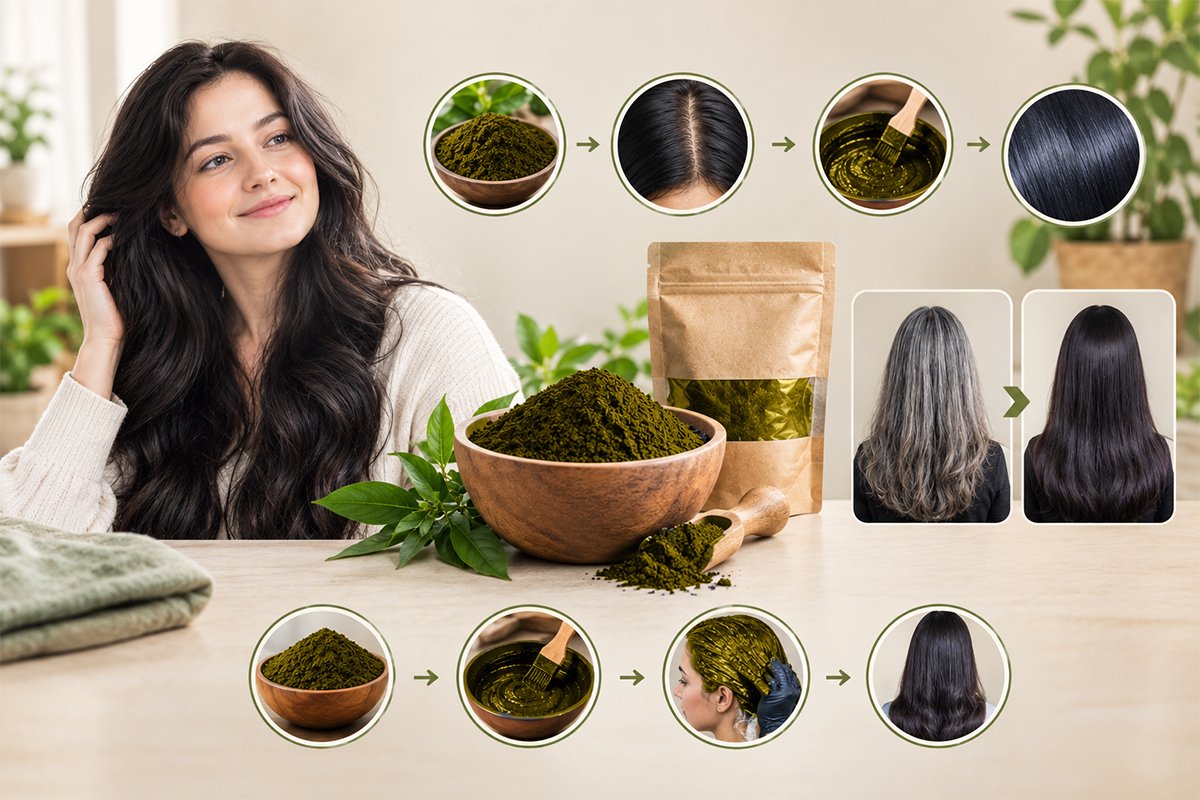
Is indigo powder good for grey hair? Used correctly, yes — indigo from the Indigofera tinctoria plant can darken grey strands and blend them into surrounding hair, though it rarely produces true black on its own. The most reliable results come from applying henna first and indigo second, rather than mixing the two into one paste. How dark the final colour turns out depends on your starting hair colour, how much grey you’re covering, and how closely you follow the steps below.
What Is Indigo Powder?
Indigo powder is made by drying and grinding the leaves of Indigofera tinctoria, a small flowering shrub grown across parts of India and other warm climates, and has been used as a plant-based dye for cloth and hair for centuries. As a hair colourant, indigo powder dye works by oxidation: the leaf powder is mixed into a paste and applied directly to hair, where colour develops naturally rather than through heat or a chemical fixing agent.
Is Indigo Powder Good for Grey Hair?
Indigo powder can be a genuinely useful option for grey hair, but the honest answer sits between “yes” and “it depends.” Pure indigo applied on its own tends to shift grey hair toward navy or slate-blue rather than deep black, since grey hair lacks the reddish undertone indigo pigment needs for a true black or brown-black result.
The outcome depends on several factors:
- Natural hair colour — darker hair blends more easily with indigo’s blue-black pigment
- Percentage of grey — lightly grey hair colours faster and more evenly than heavily grey hair
- Use of henna beforehand — gives indigo something to oxidise over
- Application method — a single mixed paste versus a sequential two-step
- Processing time — under-processing can leave colour patchy
- Hair condition and porosity — coarser, resistant grey hairs, often at the temples, take longer to colour evenly
Results vary from person to person, and indigo powder does not guarantee complete grey coverage in a single application.
Benefits of Indigo Powder for Hair
Used as part of a plant-based hair colour routine, indigo powder offers a few practical advantages:
- Plant-based colouring — a single leaf ingredient rather than a formulated chemical dye
- Darker, natural-looking shades — brown-black and black tones when paired with henna
- Works well with henna — the two-step method is standard for grey coverage
- No ammonia or chemical developer — the traditional two-step method skips conventional oxidative dye chemistry
- Fits herbal hair colour routines — suited to ingredient-led, plant-based preferences
Indigo powder isn’t presented here as a treatment for hair growth or scalp conditions — those are separate claims worth treating cautiously.
How Does Indigo Powder Work on Grey Hair?
Indigo leaves contain indican, a colourless compound that breaks down into indoxyl on contact with water and air, then oxidises into indigotin — the blue pigment behind indigo’s colour. It’s the same basic oxidation chemistry used in fabric dyeing, not the oxidative chemistry behind synthetic permanent hair dye.
Henna works on a different timeline: its dye molecule, lawsone, needs a rest period of several hours to become active before it bonds to the hair shaft, leaving a reddish-orange stain that gives indigo something to build on.
| Method | Typical result on grey hair |
| Henna alone | Warm copper to reddish-orange |
| Indigo alone | Navy, slate, or greenish-blue — rarely true black |
| Henna, then indigo (two-step) | Brown-black to black, more even coverage |
| Henna and indigo mixed into one paste | Softer brown tones, less reliable on grey |
Because henna needs rest time and mild acidity while indigo needs to be used fresh with plain water, combining them into one paste tends to under-develop both pigments — a common reason people report disappointing results.
How to Use Indigo Powder for Grey Hair
A typical two-step application looks like this:
- Prepare the hair. Start with clean, product-free hair so the dye can absorb evenly.
- Prepare the henna paste, if using the two-step method, and let it rest as directed on the product packaging.
- Apply the henna section by section, covering resistant grey areas thoroughly, then rinse it out completely before moving to indigo.
- Prepare the indigo powder by mixing it with plain water to a smooth, even paste — indigo should be used fresh rather than left to sit.
- Apply the indigo mixture evenly, paying extra attention to areas with dense or coarse grey.
- Leave it on for the processing time recommended in the product instructions.
- Rinse thoroughly with water; many instructions suggest avoiding shampoo for a day or two afterward so the colour can keep developing.
Always follow the specific instructions on the product you buy, since formulations and timings vary between suppliers. A patch test and strand test, done at least 48 hours beforehand, are worth doing every time — especially for anyone with sensitive skin or a history of reacting to hair colour products. For a closer look at the full sequencing, Kirpal Export Overseas’ guide on turning grey hair black with indigo powder covers the process step by step.
What Colour Does Indigo Give Grey Hair?
On its own, indigo powder tends to produce blue, blue-black, or occasionally greenish tones on grey hair rather than true black, since grey hair lacks the underlying warmth indigo pigment needs to shift toward black. Used after henna, the combination more reliably produces dark brown or black shades, because the reddish henna base gives indigo pigment something to react against.
Realistically, indigo alone may not deliver the black result shown on some product packaging, particularly on heavily or fully grey hair. A henna-first approach, sometimes repeated over two or three applications, remains the more dependable route to a deeper, even result.
How Long Does Indigo Powder Last on Hair?
Colour longevity varies and depends on:
- Hair type and porosity
- How often you wash your hair
- The shampoo and haircare products used
- Overall hair condition
- Whether you used the two-step or single-step application
- Your starting hair colour
Because indigo and henna coat the outside of the hair shaft rather than altering it permanently, colour tends to fade gradually rather than wash out all at once, with no harsh root line as new grey grows in. There’s no fixed number of weeks that applies to everyone — most people judge by how their own hair responds and touch up regrowth as needed.
Indigo Powder vs Chemical Hair Dye
Indigo powder and conventional oxidative hair dye work on fundamentally different principles, and neither is automatically the safer choice for every person.
| Indigo powder (two-step with henna) | Chemical hair dye | |
| Main ingredient | Indigofera tinctoria leaf powder | Oxidation dye precursors, commonly including PPD |
| How it colours hair | Coats the hair shaft through natural oxidation | Opens the cuticle and deposits colour inside the shaft |
| Ammonia / PPD | None in pure indigo powder | PPD is the most common allergen in permanent dye |
| Colour consistency | Can vary with hair porosity and technique | Generally more predictable and uniform |
| Grow-out | Gradual fade, softer root line | More visible root line as hair grows |
Para-phenylenediamine (PPD) is the ingredient most closely linked to allergic reactions from permanent hair dye, and it’s recognised as the most common contact allergen associated with hair dye. A patch-test study from an Australian dermatology department found a PPD allergy rate of around 2% among tested patients — a reminder that reactions, while not universal, are worth considering regardless of which dye you choose. Cosmetic hair-colour products sold in Australia also fall under mandatory ingredient labelling requirements, so checking the label is a reasonable habit either way.
Indigo powder isn’t automatically risk-free either: strand and patch testing still matter, and previously chemically treated hair needs extra care before applying any plant-based dye.
How to Choose an Indigo Powder Manufacturer or Supplier
Choosing the right supplier matters as much as the formulation itself. Worth checking before committing to an indigo powder manufacturer:
- Raw material sourcing — where and how the indigo leaves are grown and processed
- Manufacturing standards — ISO or GMP certification points to a controlled process
- Batch testing and consistency — pigment strength varies between harvests
- Packaging options — from small retail packs to bulk industrial sizes
- Export capability — relevant for buyers sourcing indigo powder wholesale
- OEM and private-label support — for buyers building their own branded product
- Documentation, such as a Certificate of Analysis, where applicable
A reliable indigo powder supplier should be able to answer questions about sourcing and testing directly, rather than leaving buyers to guess.
Indigo Powder Wholesale for Businesses
Salons, distributors, retailers, and private-label brands often buy indigo powder in bulk rather than retail packs, for practical reasons: consistent supply across a growing customer base, the option to customise packaging and branding, and access to OEM manufacturing for a finished, ready-to-sell product rather than raw powder.
Buyers sourcing indigo powder wholesale typically weigh bulk quantities and minimum order requirements, private-label and custom packaging options, international shipping capability, and whether a supplier can hold consistent supply over time. Manufacturers experienced in exporting — such as Kirpal Export Overseas, which has built its henna and indigo supply chain around international B2B buyers — are generally better positioned to handle these requirements than smaller, domestic-only producers.
Why Choose Kirpal Export Overseas?
Kirpal Export Overseas (KEO) manufactures and exports natural henna, indigo powder, and herbal hair colour products from India. The company was founded in 2000 by Sunil Walia, with his wife Payal Walia serving as Vice-President, and has grown over more than two decades into a supplier working with buyers across multiple continents. According to KEO, the idea to adapt indigo — until then used mainly as a textile dye — for hair colouring grew out of an early collaboration between the founders and a Japanese agricultural scientist.
KEO’s relevant capabilities include:
- In-house manufacturing in India, rather than trading third-party stock
- Sourcing from its own henna and indigo farms
- Bulk supply and export to international B2B buyers
- OEM and private-label services, including formulation, packaging, and labelling
- Batch testing and documentation such as a Certificate of Analysis
More detail on the company’s indigo powder for hair and its organic henna powder range is available on its website.
What Should Buyers Check Before Purchasing Indigo Powder?
For individual consumers:
- Product origin and ingredient list (pure indigo vs. a blended formulation)
- Whether the product is genuinely ammonia- and PPD-free
- Recommended processing time and application method
- Evidence of consistent quality between batches
For wholesale and private-label buyers:
- Supplier experience and manufacturing standards
- Minimum order quantity and available packaging sizes
- Shipping options and export documentation
- Private-label and OEM capabilities, if building a branded product
- Customer support and responsiveness during sourcing
Consumers and commercial buyers are looking for different things from the same product, so it helps to be clear about which category applies to you before comparing suppliers.
Conclusion
So, is indigo powder good for grey hair? Used with the right method — henna applied first, indigo second — it can be a genuinely useful, plant-based option for darkening grey hair, though results depend on your starting colour, how much grey you’re covering, and how closely you follow the steps above. It isn’t a guaranteed one-step fix, and outcomes vary from person to person.
For businesses evaluating suppliers, the same variability applies to sourcing: batch consistency, documentation, and export experience matter as much as the raw ingredient itself.
Looking for an experienced indigo powder manufacturer or supplier for bulk, wholesale, OEM, or private-label requirements? Explore Kirpal Export Overseas to learn more about its natural hair colour and herbal product manufacturing capabilities.
FAQ
Q. Is indigo powder good for grey hair?
Ans. It can be, particularly when used after henna in a two-step process. Results vary with hair type, grey percentage, and application method, and indigo alone often shifts toward blue rather than black.
Q. Can indigo powder cover grey hair?
Ans. It can help darken grey hair, but full coverage typically depends on applying henna first and indigo second, rather than expecting one mixed paste to do the job.
Q. Can I use indigo powder without henna?
Ans. Yes, it’s possible, but the result on grey or very light hair is usually a blue or navy tone rather than black, since grey hair lacks the reddish undertone indigo needs to darken fully.
Q. How do I use indigo powder for grey hair?
Ans. The common method is to apply henna first, rinse it out, then apply a fresh indigo paste as a separate second step, following the processing times on the product instructions.
Q. How long does indigo powder stay on grey hair?
Ans. It varies by hair type, wash frequency, and application method. Because the colour sits on the outside of the hair shaft, it tends to fade gradually rather than wash out abruptly.
Q. What is the difference between indigo powder and indigo hair dye?
Ans. Pure indigo powder is a single-ingredient leaf powder. Finished “indigo hair dye” products may blend indigo with other ingredients, so it’s worth checking the ingredient list.
Q. What should I look for in an indigo powder supplier?
Ans. Sourcing, manufacturing standards, batch testing, packaging options, bulk availability, and OEM or private-label support, especially if you’re buying for commercial rather than personal use.
Q. Where can businesses buy indigo powder wholesale?
Ans. From qualified manufacturers and suppliers experienced in bulk and export orders, such as Kirpal Export Overseas, depending on quantity, packaging, and private-label requirements.