
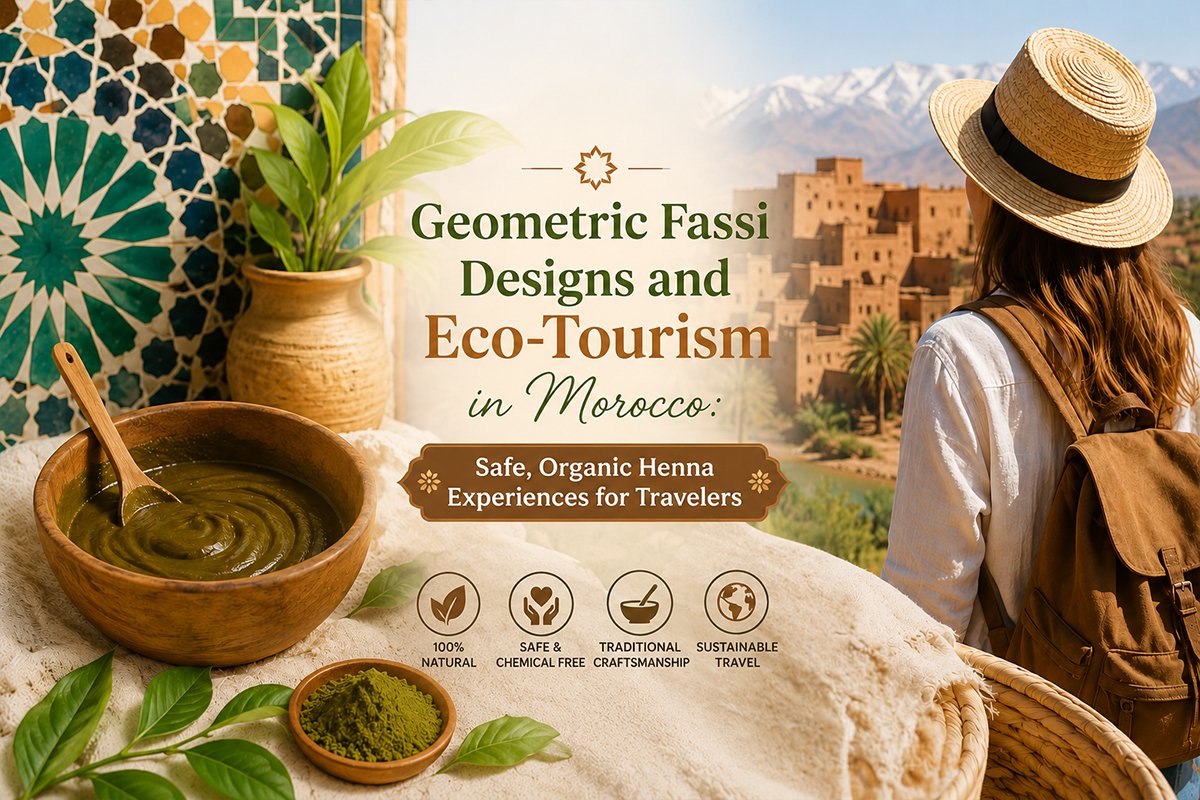
Geometric Fassi and Amazigh Henna: A Traveler’s Guide to Safe, Organic Henna Tourism in Morocco
Answer Capsule: Fassi and Amazigh henna designs are Morocco’s signature body art style — dense triangles,
diamonds, zigzags, and linear grids applied to hands and feet, standing apart from South Asia’s floral mehndi tradition. UNESCO added henna’s rituals and social practices to its Intangible Cultural Heritage list in December 2024, formally recognizing what Moroccan artisans have practiced for centuries. Today, that heritage intersects with eco-tourism: certified henna cafés, women’s cooperatives, and licensed hennayas in Fez, Marrakech, and the Souss-Draa region give travelers organic, chemical-free henna application, an alternative to unregulated street “black henna” made with para-phenylenediamine (PPD).
What Makes Fassi and Amazigh Henna Designs Unique
History of Moroccan henna art
Henna arrived in North Africa along trade routes connecting Africa, the Middle East, and Asia, and Amazigh (Berber) tribes were using it as tribal identification centuries before it became a beauty product. Amazigh women mixed crushed leaves from the henna plant, Lawsonia inermis, into a paste and used it to mark skin with symbols distinguishing one tribe from another. That tribal-marking function is the root of Morocco’s geometric visual language — it developed as identity, not decoration.
By the medieval period, cities like Fez had entire souks built around the trade. The Souk el-Henna in the Fes medina still operates today, selling raw henna powder alongside kohl, indigo, and other traditional beauty staples.
Difference between geometric and floral styles
South Asian mehndi builds outward from a floral or paisley motif, filling negative space with vines and blossoms. Moroccan henna does the opposite in its northern and central traditions: it builds a geometric grid — usually triangles, diamonds, and straight lines — and covers the hand almost completely, with very little repetition. The Fassi style, originating in the imperial city of Fez, is the most recognizable and least free-form of Morocco’s regional henna traditions, using geometric shapes that cover the whole area being hennaed.
Marrakech’s tradition runs closer to floral work, and a third “bridge” style exists between them. The Meknessi style simplifies heavy floral shapes and inserts them into an otherwise geometric design, rounding off edges that are usually sharp while keeping the geometric fill inside intact.
Common shapes used in Moroccan patterns
Five regional traditions dominate the country, and most general-audience articles collapse them into a simple “geometric vs. floral” binary. The reality is more layered:
| Style | Region | Visual Signature | Common Motifs |
| Amazighi (Berber) | High, Middle & Anti-Atlas Mountains | Tribal geometric, symbol-dense | Amazigh Fibula, Tifinagh script, Amazigh Cross, Khamsa |
| Fassi | Fez & Meknes | Dense geometric grid, sharp lines, full coverage | Triangles, diamonds, linear fills |
| Meknessi (Mixed) | Meknes | Bridge style — florals softened into geometry | Rounded triangles, floral-geometric blend |
| Marrakechi | Marrakech | Flowing florals, deliberate bare-skin contrast | Vines, leaves, floral clusters |
| Sahrawi | South of Marrakech into the Sahara edge | Bold geometric, symbolic | Eye, Khamsa (hand), desert-inspired motifs |
| Chamali | Tangier, Tetouan, Al Hoceima | Thin lines and dots, light floral-geometric mix | Dots, delicate linework |
Amazigh-henna designs specifically draw on Berber geometric patterns like the Amazigh Fibula (Aketi), Tifinagh script signs, the Amazigh Cross, and the Hand of Fatima (Khemissa), unique to Tamazight-speaking communities of the High, Middle, and Anti-Atlas Mountains.
The Cultural Meaning Behind Geometric Henna
Symbolism of triangles, diamonds, and lines
Moroccan henna motifs aren’t decorative flourishes; each shape carries an inherited meaning. Diamonds represent the eye and are believed to ward off the evil eye, triangles symbolize femininity and fertility, zigzag lines represent water and life, and cross patterns mark the four cardinal directions. A naqqacha (henna artist) selecting a pattern for a bride is choosing protective symbols as much as an aesthetic.
Connection to Moroccan identity and heritage
Regional variation in henna design maps almost directly onto Morocco’s ethnic and linguistic geography — Amazigh mountain communities, Arab-influenced imperial cities, and Saharan populations each carry distinct visual signatures. That’s part of why UNESCO’s recognition matters beyond ceremony. UNESCO’s Intangible Cultural Heritage Committee, meeting in Asunción, Paraguay in December 2024, added henna to its list of elements requiring urgent safeguarding, following a joint submission from sixteen Arab countries including Morocco. The listing formally acknowledges henna as a living marker of North African and Arab-Berber identity, not a folkloric relic.
Traditional use in weddings and celebrations
The pre-wedding henna night, or Laylat al-Henna, remains the most elaborate application context. Female relatives gather the evening before the ceremony; older married women share advice with the bride while her hands and feet are decorated, sometimes with the groom’s name worked discreetly into the pattern. Henna also marks Eid, births, circumcisions, and homecomings — Moroccan mothers still apply a small henna dot to a newborn’s forehead for protection during the child’s first week.
Why Moroccan Henna Is Trending in Modern Travel
Social media influence on henna tourism
Geometric henna photographs well — sharp lines and high contrast translate cleanly to a phone screen in a way that dense floral mehndi sometimes doesn’t. Travel content built around Fez medina alleys, Marrakech riads, and Sahara-edge kasbahs has pushed Fassi and Sahrawi-style henna into travel-planning searches alongside argan oil and Moroccan textiles.
Demand for authentic cultural experiences
The shift among travelers away from staged “photo-op” activities toward participatory cultural experiences plays directly into henna’s strengths: it’s hands-on, regionally specific, and impossible to fully replicate outside Morocco. Travelers increasingly want to understand why a pattern looks the way it does, not just wear it.
Interest from global travelers in local art forms
Morocco’s 2026 tourism numbers reflect this broader cultural-travel pull. Morocco welcomed 7.7 million international visitors in the first five months of 2026, a 7% year-on-year increase, building on a record 19.8 million visitors in 2025 that cemented its status as Africa’s most-visited country. Heritage-driven activities — cooperative visits, henna workshops, artisan medina tours — are a consistent piece of that growth story, not a side note to beach and desert tourism.
Eco-Tourism and Safe Henna Experiences in Morocco
What eco-tourism means in this context
Applied to henna specifically, eco-tourism means three things working together: the henna itself is a plant-derived, biodegradable dye rather than a synthetic chemical; the income from the experience stays with local artisans and cooperatives rather than flowing to intermediaries; and the craft knowledge behind the pattern is preserved and taught rather than replaced by faster, cheaper, chemical shortcuts. Morocco’s Vision 2023-2026 tourism roadmap prioritizes rural tourism and ecotourism development, supported by the World Bank’s Sustainable Tourism Diversification Program, which funds infrastructure and training in underserved regions.
Why tourists prefer organic and chemical-free henna
The demand for organic henna in Morocco isn’t an abstract wellness preference — it’s a direct response to a well-documented safety problem. Street vendors in high-traffic tourist zones, most notoriously around Marrakech’s Jemaa el-Fnaa, sometimes offer “black henna” that isn’t henna at all, or is henna cut with para-phenylenediamine (PPD) and solvents to darken and speed up the stain. Research estimates roughly 2.5% of people who receive a black henna tattoo experience an allergic reaction, which can include chemical burns, blistering, and permanent scarring. Once sensitized to PPD, a person can react to hair dyes, certain sunscreens, local anesthetics, and other everyday products for years afterward — which is the real argument for organic henna: it isn’t a purity preference, it’s risk avoidance with lasting consequences.
Importance of safe, certified body art
Serious henna cafés and cooperatives increasingly formalize their safety claims rather than just asserting them. Genuine natural henna paste contains only dried, powdered henna leaves, lemon juice, and sugar — no added chemicals — and reputable providers mix it fresh daily. Certification bodies like the International Certification for Natural Henna Arts (ICNHA) exist precisely to give tourists a verifiable standard rather than a verbal assurance. On the regulatory side, natural henna is classified as a cosmetic product under Moroccan standards body IMANOR, while adulterated black henna sold in tourist markets exists in something closer to a regulatory gray zone — legal to sell in practice, not approved under any EU-aligned cosmetic standard, and effectively unpoliced at street level.
This is also where the sourcing side of henna tourism gets interesting, and where most travel content stops short. Cooperatives and professional hennayas who want a consistent, PPD-free product with documented lawsone content (the compound responsible for henna’s stain) often supplement local harvest with powder from established henna manufacturers, particularly Indian hair dye manufacturers and hair color manufacturers who can provide a Certificate of Analysis showing lawsone percentage, heavy metal testing, and microbiological screening. It’s the same due-diligence standard that governs shikakai powder — a natural cleansing agent frequently sold in the same herbalist stalls as henna and used in traditional Moroccan and South Asian hair care alike. A closer look at how that sourcing intelligence plays out for Morocco specifically is covered in this breakdown of the business side of Moroccan henna traditions.
The Role of Women’s Cooperatives in Morocco
How local women support henna traditions
Morocco’s cooperative model — most visible in argan oil production but extending into weaving, herbal products, and henna — gives rural women a formal structure for turning inherited craft knowledge into income. Cooperatives are designed to provide income and financial security for women, particularly widows, while also expanding access to education and training, and they serve as a means of preserving traditional crafts and agricultural knowledge in a rapidly globalizing world.
Community-based tourism and income generation
The scale of this movement is substantial. By 2023, Morocco counted 60,000 cooperatives nationwide, including 7,730 that were entirely female-run, with the country’s tourism minister describing the cooperative model as a proven engine for job creation, particularly for young people and women. Most documented cooperative case studies center on argan oil, since that supply chain is larger and better mapped internationally — but the underlying structure (collective production, shared equipment, direct sale to visitors, reinvestment in literacy and healthcare programs) is the same model emerging around henna and herbal products in the Souss-Draa region, where henna is actually grown.Preserving craft while serving modern visitors
The Draa Valley, Morocco’s longest oasis, supports terraced agriculture where henna is cultivated alongside dates, cereals, and vegetables, with women historically grinding the leaves using stone grindstones as part of the harvest process. That’s the physical source of much of the country’s raw henna — a detail almost entirely missing from travel content that treats “Moroccan henna” as if it materializes only in Marrakech’s medina. Cooperative-run henna experiences that source locally and involve travelers in the paste-making process, not just the application, are the clearest expression of eco-tourism in this niche: the visitor’s spending supports both the artisan applying the design and the farming community growing the plant.
Henna Art Cafes and Tourist-Friendly Henna Spaces
Rise of henna cafés in Marrakech and other cities
The henna café is a fairly recent hybrid business model — part restaurant, part gallery, part certified henna studio — built specifically to give tourists a controlled, transparent alternative to street application. Marrakech Henna Art Café, located in the old medina, operates as the city’s only ICNHA-certified provider of 100% natural henna, pairing henna artists on site daily with two art galleries and a nonprofit arts program. It’s a useful reference point for what a legitimate henna café actually offers, rather than a generic promise of “authentic” service.
What tourists can expect from these experiences
A typical certified henna café visit runs through a predictable sequence: viewing or selecting a design (often regional — Fassi geometric, Sahrawi symbolic, or a custom mix), watching the artist mix fresh paste from henna powder, lemon juice, and sugar, application taking anywhere from 15 minutes for a simple design to several hours for full bridal-style coverage, and a drying period before the paste is sealed with a lemon-sugar solution or wrapped for a few hours to deepen the stain.
How these places combine culture, beauty, and hospitality
The café format works because it solves three tourist frictions simultaneously: language (staff are used to explaining process to non-Arabic and non-French speakers), safety (fresh paste made on premises, visible to the customer), and context (many pair the henna experience with food, art, or a short explanation of what the pattern means). That combination is why the model is spreading beyond Marrakech into Fez and coastal cities like Essaouira, where henna artists set up along the beach promenade and near Moulay Hassan Square, working at a more relaxed pace with less aggressive touting than the main tourist squares, and often incorporating nautical motifs reflecting the coastal setting.
Tips for Travelers Looking for Authentic Moroccan Henna
How to choose a safe henna artist
- Ask to see the paste before it touches your skin. Natural henna paste is a dark olive-brown color and smells earthy, not chemical.
- Ask how long the paste needs to stay on. This is the single most reliable field test available to a non-expert.
- Check the texture once it’s applied and drying. Natural henna sits slightly raised on the skin; adulterated black henna lies flat.
- Ask about certification. ICNHA or an equivalent local credential is a concrete signal, not a marketing claim.
- Book through your riad, hotel, or a known cooperative/café rather than accepting an unsolicited approach in a crowded square.
- Request a small patch test first if you have sensitive skin or a known dye allergy.
Questions to ask before getting henna
- What’s in this paste, specifically?
- How many hours should I leave it on before removing it?
- Is your henna sourced locally, and do you know where it’s grown or milled?
- Are you certified, and by whom?
- Will the stain darken naturally over the next 24–48 hours, or is it already at full color?
Signs of natural versus chemical-based products
| Signal | Natural Henna | “Black Henna” (PPD) |
| Texture on skin | Raised, slightly bumpy | Flat, smooth |
| Initial stain color | Orange, deepening to reddish-brown over 1–2 days | Near-black immediately |
| Required leave-on time | 6–12+ hours | 20–60 minutes |
| Smell | Earthy, herbal | Solvent-like, chemical |
| Reaction risk | Rare, generally mild | Documented burns, blistering, scarring |
The most common way chemical additives are caught is by asking how long the paste needs to stay on skin — true natural henna needs at least six hours to develop a good stain, and any artist promising a finished result in thirty minutes or an hour is almost certainly using a chemical additive.
Moroccan Henna as a Blend of Tradition and Sustainability
How old art forms adapt to modern travel trends
Fassi and Amazigh henna haven’t changed much technically — the plant, the grinding process, and the core geometric vocabulary are largely what they were generations ago. What’s changed is the delivery model: cooperative visits, certified cafés, and workshop-style experiences now sit alongside the traditional wedding-night application, giving the same craft a second economic channel that didn’t exist a generation ago.
Why this matters for cultural preservation
UNESCO recognition and certified-café models both push in the same direction: they create economic and reputational incentive to keep henna practice authentic rather than let it get diluted into a fast, chemical-shortcut tourist souvenir. Every traveler who asks about leave-on time and ingredients before sitting down for a design reinforces that incentive; every traveler who accepts a rushed street application does the opposite.
Future potential for eco-friendly beauty tourism
The infrastructure is already pointed this way. Morocco has positioned itself as an international advocate for ecotourism as a poverty-reduction tool, and its national tourism strategy explicitly funds rural and community-based hospitality development. Henna — cheap to produce, tied to a specific growing region, requiring skilled human labor that can’t be automated, and now formally recognized as heritage — is close to an ideal case study for that strategy, provided the certification and sourcing standards keep pace with tourist demand. For a deeper look at how three decades of sourcing standards inform that supply chain, see Sunil Walia’s perspective on the global henna trade.
Frequently Asked Questions
Q: What’s the actual difference between Fassi and Amazigh henna designs?
A: Fassi henna is a specific regional style from Fez and Meknes — dense geometric coverage with very little repetition. Amazigh (Berber) henna is a broader ethnic tradition from the Atlas Mountain regions, drawing on tribal symbols like the Amazigh Cross and Tifinagh script. Fassi is one expression within the wider Amazigh geometric tradition, not a separate category from it.
Q: Is henna safe for tourists in Morocco?
A: Natural henna is safe for the vast majority of people, including children, with a low rate of mild irritation. The risk comes from PPD-adulterated “black henna,” which causes documented allergic reactions in an estimated 2.5% of recipients. The safety question is really about sourcing, not the plant itself.
Q: How can I tell if henna is natural or contains PPD (“black henna”)?
A: Ask how long the paste needs to stay on your skin. Natural henna needs 6–12 hours minimum; anything promising a fast result in under an hour is very likely chemically altered. Texture is the second signal — natural paste sits raised on skin, chemical black henna lies flat.
Q: What is a henna café, and where can I find one?
A: A henna café is a hybrid restaurant, gallery, and certified henna studio designed for tourists who want a transparent, controlled application experience. Marrakech has the best-documented example; similar tourist-friendly henna spaces are emerging in Fez and coastal cities like Essaouira.
Q: How do women’s cooperatives support henna traditions in Morocco?
A: Cooperatives give rural women, particularly in henna-growing regions like the Draa Valley, a formal structure to turn cultivation and artisan skill into direct income, while reinvesting profits into education and healthcare programs within their communities.
Q: Is Moroccan henna officially recognized as cultural heritage?
A: Yes. UNESCO added henna’s rituals, aesthetics, and social practices to its Intangible Cultural Heritage list in December 2024, based on a joint submission from sixteen Arab countries including Morocco.