
Inside Indonesia’s Henna Manufacturing Trends: Halal, BPOM, and Private Label Growth
If you’ve tried sourcing henna for the Indonesian market lately, you’ve probably noticed something: the rules just got a lot stricter, and a lot of suppliers aren’t ready for it.
That’s not an accident. Indonesia’s beauty and personal care sector is in the middle of a fairly dramatic shift, and henna powder manufacturers sit right at the center of it. Two forces are converging here. On one side, Indonesian consumers — especially younger ones — are pulling away from synthetic hair dye and reaching for natural alternatives. On the other, the government is tightening exactly the kind of documentation that lets a product legally reach a shelf. For anyone trying to sell wholesale henna powder into this market, both of those forces matter, and they don’t always move at the same speed.
The numbers behind the shift
Indonesia’s hair care market isn’t small. It was valued at roughly USD 1.17 billion in 2024, and most forecasts put it climbing toward USD 1.6 billion or more by the early 2030s. That growth isn’t being driven by chemical dyes getting cheaper. It’s coming from somewhere else entirely — a young, increasingly grooming-conscious population that’s actively avoiding parabens, sulfates, and synthetic colorants in favor of plant-based options like coconut oil, turmeric, and yes, henna.
Globally, the henna powder category itself has been growing at somewhere between 5% and 6% a year, depending on which market report you read. None of that growth happens in a vacuum, though. It’s running straight into a regulatory environment that’s becoming one of the toughest in Southeast Asia for cosmetic imports.
Why halal certification just became non-negotiable
Here’s the part a lot of overseas suppliers still haven’t fully absorbed. Starting October 17, 2026, every single cosmetic product sold in Indonesia — local or imported, it doesn’t matter — has to carry halal certification. Not “should.” Has to.
This isn’t a minor labeling tweak you can bolt on at the end. The certification process, run through BPJPH, audits the entire production chain. Raw material sourcing, the facility itself, packaging, storage — all of it gets checked. For a henna or herbal hair color brand, that means you need to be able to prove, with paper trails, that nothing in the process touches anything non-halal. Lip products in particular face stricter scrutiny, since BPJPH’s draft guidelines explicitly ban non-halal slaughter ingredients in that category, though hair color manufacturers will feel the ripple effects of the same documentation standards.
Why does this matter so much commercially? Indonesia is home to over 270 million people, and the country’s own data suggests something north of 85% of women specifically look for halal-certified products before buying skincare or cosmetics. That’s not a niche preference anymore. It’s closer to a baseline expectation. A product without the halal mark isn’t competing on a level field — it’s starting from a deficit before a single customer even picks it up.
If your henna already carries international halal certification, there’s actually a shortcut worth knowing about. Indonesia allows recognized foreign certifiers to register through BPJPH’s SIHALAL portal rather than redoing a full local audit from scratch. It’s not automatic, and it depends on which certifying body you used, but it can save months.
BPOM is the other half of this — and enforcement is real
Halal gets you trust. BPOM gets you legally on the shelf in the first place.
BPOM, Indonesia’s food and drug authority, has to approve any cosmetic before it can be sold or distributed in the country. And this isn’t a rubber-stamp process. Through 2026, BPOM has been pushing for more detailed safety documentation, paying particular attention to microbial limits, heavy metal content, and — this one’s easy to overlook — how a product actually holds up in tropical humidity.
That last point sounds minor until you think about what henna powder is. It’s a plant-derived dye sensitive to moisture. Ship a batch with inadequate packaging into a Jakarta warehouse during rainy season, and you may find the color performance has shifted by the time it reaches a salon or a retail shelf. Suppliers who’ve never had to think about this for European or Gulf markets sometimes get caught off guard the first time they ship to Southeast Asia.
The enforcement side isn’t theoretical, either. BPOM recently seized over two million unregistered cosmetic products — most of them imported informally, many sold through e-commerce platforms without proper distribution permits. One enforcement action traced back to a single warehouse in Tangerang holding roughly 890 unregistered product lines, totaling over 1.8 million units. That’s the scale we’re talking about. Authorities aren’t quietly tolerating gray-market imports anymore; they’re actively hunting them down, and online sellers are clearly the ones most exposed right now.
What this opens up for private label and OEM buyers
Here’s the upside in all of this, because there is one.
Every new compliance requirement raises the cost of entry — and that tends to push smaller, undercapitalized suppliers out of the market. For a serious private label brand, that’s not a threat. It’s an opening.
A manufacturer that already holds ISO 22716, GMP, and halal certification removes most of the audit burden from the buyer’s side before a contract is even signed. Add a documented Certificate of Analysis (CoA) for each batch, and the BPOM registration process moves noticeably faster, because the paperwork buyers need to submit is already sitting there, ready to go.
This is roughly the order things tend to play out in practice:
-
A buyer identifies a supplier with current certifications already in place — not promised, in place.
-
Samples get pulled and tested, often specifically for how they hold up in humid storage.
-
Private label packaging and labeling get finalized, ideally with INCI-compliant ingredient names baked in from the start.
-
A trial production run ships, and only after that does the buyer commit to volume.
Skipping step two is, anecdotally, where a lot of import headaches start. It’s tempting to go straight from sample approval to a large order, but tropical-climate testing catches problems a temperate-climate buyer would never think to check for.
What actually separates one henna supplier from another
Not all henna is interchangeable, even among suppliers who all claim “pure” and “natural” on their packaging. A few things are worth checking before signing anything.
Lawsone content is the real marker of quality — it’s the natural dye molecule responsible for henna’s color, and consistent levels mean consistent results from one production batch to the next. Ask for lab data, not a marketing claim, because “high lawsone content” without a number behind it doesn’t mean much.
Then there’s the PPD question. Para-phenylenediamine shows up in a huge share of commercial synthetic dyes, and it’s a known allergen for a meaningful slice of the population. Genuinely PPD-free henna isn’t just a marketing checkbox in this market — it’s often the actual reason a customer picked the natural option over a chemical dye in the first place.
Origin matters too, more than people sometimes assume. Sojat City in Rajasthan has built its reputation on henna cultivation over decades, and the local soil and harvest timing genuinely affect the dye strength of the finished powder. It’s the difference between henna that delivers and henna that disappoints after one wash.
Processing quality is the last big variable. Triple-sifted henna has been through three rounds of fine filtering to strip out coarse plant material, and it mixes far more smoothly than a single-sift product — something any salon professional will notice immediately. For brands working in the body art space rather than hair color, Body Art Quality (BAQ) henna goes even further, with a finer grind and higher dye concentration than standard hair-color grades.
A look at how this plays out for one exporter
It helps to ground all this in a concrete example rather than keep things abstract.
Kirpal Export Overseas, based in Sojat City, has built its model around the idea that traceability isn’t optional anymore — it’s the product. The company runs its own henna and indigo farms, which means a buyer isn’t relying on a supplier’s word about where the raw material came from; there’s a direct line back to the field.
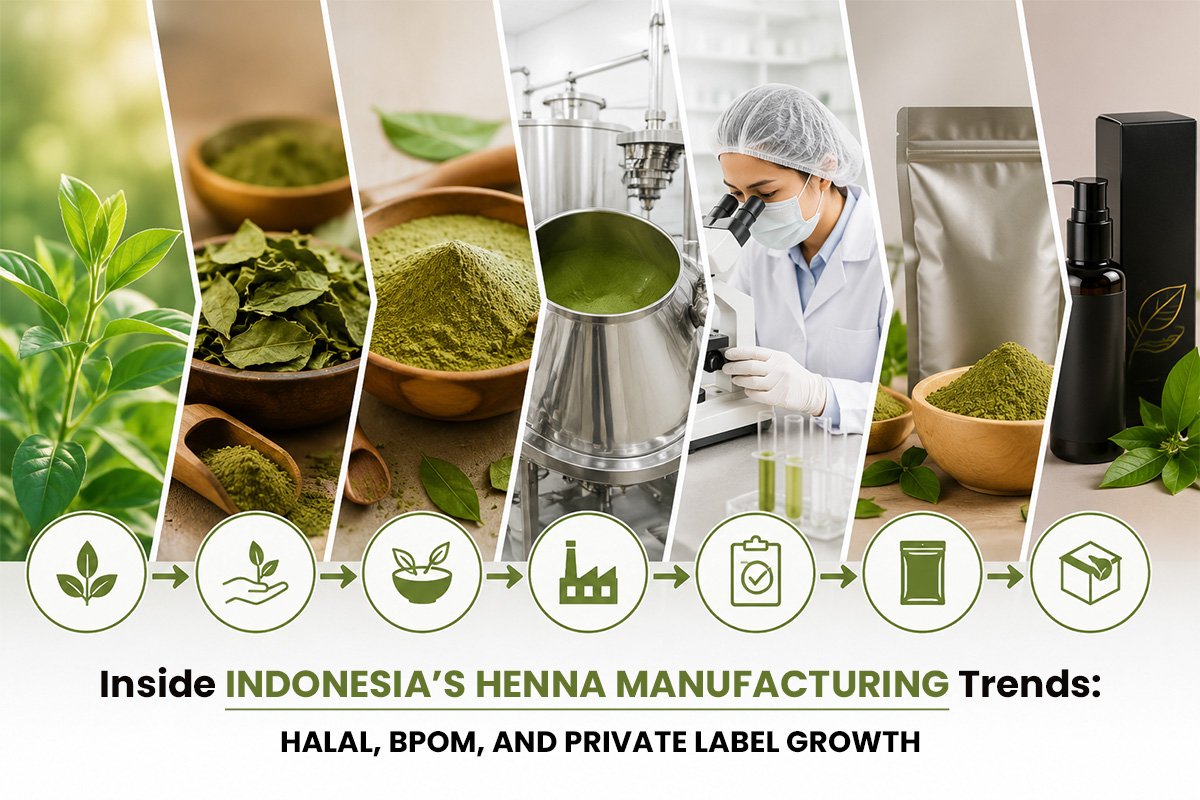
From there, the process generally runs through a few stages: sourcing and farm-level verification, in-house formulation for herbal hair color blends, then ISO and GMP quality checks before halal documentation gets finalized. OEM clients typically move through design, a sample shipment, and a buyer sign-off before full production starts. None of this is unique to one company — but it’s a reasonably representative picture of what a compliant, export-ready operation actually looks like in 2026, versus one that’s still catching up to where the regulations now sit.
Indigo, multi-shade lines, and why pairing matters
Henna by itself gives you reds and auburns. If a brand wants deeper shades — browns, blacks — indigo powder is usually the answer, blended alongside or applied after the henna.
This combination has particular relevance in Indonesia, where consumer preference tends to lean toward darker, more natural-looking results rather than the brighter red tones henna alone produces. A supplier who already offers both ingredients under one roof simplifies things considerably for a private label brand trying to build a multi-shade line, since both materials can typically move through the same compliance and documentation process together rather than as two separate sourcing relationships.
Labeling: the detail that quietly kills applications
INCI naming — the standardized international system for listing cosmetic ingredients — sounds like a bureaucratic afterthought until it’s the reason a BPOM application gets bounced back.
Vague or inconsistent ingredient names are a recurring, almost mundane reason applications stall. A manufacturer who already provides clean, standardized INCI documentation, alongside a clear Responsible Person structure for compliance accountability, saves real time during registration. It’s not glamorous, but it’s often the difference between a product launching on schedule and one sitting in regulatory limbo for an extra quarter.
A short checklist before signing with a supplier
A few things worth confirming before any contract gets finalized:
-
Halal certification is current, and either BPJPH-recognized directly or eligible for fast-track recognition through SIHALAL.
-
ISO 22716 and GMP certifications exist as documents, not just claims on a website.
-
A Certificate of Analysis is available per batch, not just per product line.
-
INCI listings already match what needs to appear on Indonesian packaging.
-
The supplier has actual prior experience exporting into humid, tropical markets — not just temperate ones.
-
Sampling happens before any full production commitment, every time.
Frequently Asked Questions
Q. Is henna powder automatically halal?
A. Mostly, yes, in the sense that pure henna is plant-based. But Indonesia’s certification requirement covers the whole production chain — equipment, packaging, storage — not just the raw leaf. You still need a formal certificate from BPJPH or a recognized body to sell legally.
Q. When does halal certification become mandatory for cosmetics in Indonesia?
A. October 17, 2026, for every cosmetic sold in the country, whether it’s made locally or imported.
Q. What is BPOM actually checking during registration?
A. Product safety, ingredient compliance, labeling accuracy, and manufacturing standards — with added scrutiny in 2026 on microbial limits, heavy metal content, and how products perform in tropical conditions.
Q. How do hair color manufacturers in India compare to those in the USA for this market?
A. They tend to play different roles. Indian manufacturers, particularly around Sojat, are typically the raw henna and formulation source, while US-based players more often handle distribution or finished-product branding. A lot of buyers end up blending both into their sourcing strategy rather than picking one.
Q. Can one supplier handle both raw henna and finished herbal hair color products?
A. Often, yes. Many manufacturers offer both under a single OEM relationship, which cuts down on the number of separate compliance checks and supplier relationships a private label brand has to manage.
Q. Does triple-sifted henna actually make a difference, or is it marketing?
A. It’s real. Three rounds of fine filtering remove coarse plant material that would otherwise make the powder grittier and harder to mix evenly. Salon professionals notice the difference almost immediately.