
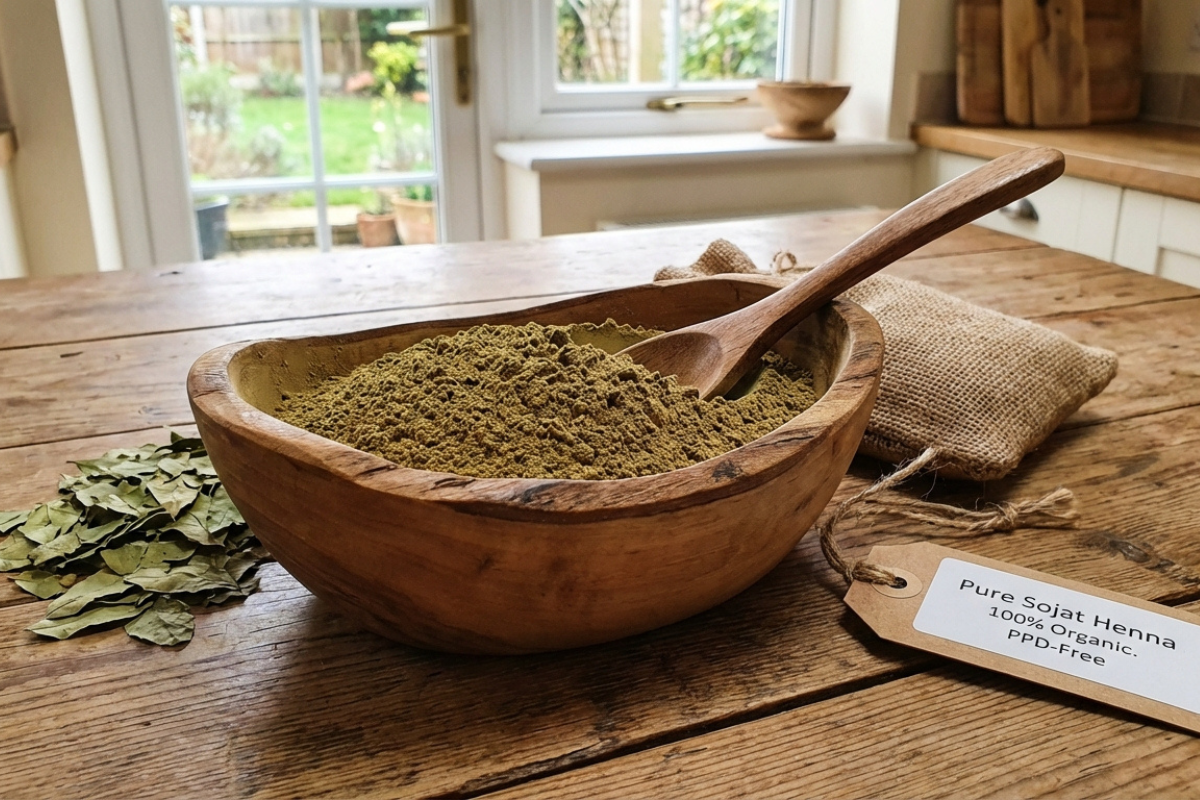
Sojat Henna Powder: 5 Shocking Truths About PPD-Free Claims Every US Buyer Must Know in 2026
Last year, a woman in New Jersey bought a henna hair color from a local beauty store. The box said “100% natural.” Two days later, she was in the emergency room with chemical burns on her scalp.
The culprit? PPD — a hidden chemical inside her so-called “natural” henna powder.
This is not a rare story. It happens more often than people realize, especially in the US market where labeling rules are sometimes ignored by unverified importers. So if you are using or selling organic henna, this guide is going to help you check what is really inside that packet before it touches anyone’s hair.
Why “Natural” on a Henna Label Means Almost Nothing
Walk into any beauty supply store in the US today. You will find dozens of henna products screaming “herbal,” “organic,” and “chemical-free” on their packaging.
But here is the uncomfortable truth — these words are not legally protected in the cosmetics world. Any brand can print them.
What actually matters is what is inside the product. And the only way to know that is to dig deeper than the front label.
The biggest danger hiding in many commercial henna products is PPD (para-phenylenediamine). It is a coal-tar based chemical used in conventional hair dyes. It makes color darker and faster. But it is also a well-documented skin sensitizer and allergen.
The FDA has issued warnings specifically about “black henna” products containing PPD used in temporary tattoos and hair color. The problem is that once you develop a PPD allergy, even tiny amounts — from any hair dye, not just henna — can trigger a severe reaction for the rest of your life.
So now the real question is: how do you actually check?
First, Understand What Real Sojat Henna Powder Looks Like
Before you can spot a fake, you need to know what the real thing looks like.
Sojat is a city in Rajasthan, India. It grows roughly 80% of the world’s henna. The henna leaves from this region have a naturally high lawsone content — that is the compound responsible for the reddish-orange dye.
Genuine Rajasthani henna powder has these characteristics:
- Color is earthy green to olive when dry
- Produces a reddish-orange stain — never gray or black
- Has a mild, grassy, slightly earthy smell
- Texture is fine and smooth after triple sifting
- No metallic smell or chemical odor whatsoever
If your henna powder is dark brown or black, smells sharp or chemical, or produces a very dark black stain within minutes — it almost certainly contains PPD or metallic salts. Real Sojat henna powder takes time to develop color and never goes black.
Check 1 — The Ingredient List Is Your First Line of Defense
Flip the product over. Find the ingredient list. Now look for any of these:
- Para-phenylenediamine (PPD)
- Resorcinol
- Aminophenol
- Silver nitrate
- Lead acetate
- Any “coal tar” derivative
These should not be anywhere near a natural hair color product. If you spot even one of them, that product does not belong in your bathroom cabinet or your salon.
A genuinely clean henna-based hair color will only list plant-based ingredients. Think Lawsonia inermis, Indigofera tinctoria for indigo powder, amla, brahmi, shikakai, or bacopa monnieri — these are all Ayurvedic herbs with a long history of safe use. For a deeper read on how bacopa specifically supports hair health, this page on bacopa monnieri breaks it down well.
No synthetic dye. No metallic salt. No PPD. That is the standard for real herbal color.
Check 2 — Ask for a COA Before You Buy in Bulk
If you are a salon owner, a beauty brand, or someone importing wholesale henna powder into the US, you cannot afford to skip this step.
A Certificate of Analysis (COA) is a document from a third-party lab. It tells you exactly what is in the product — lawsone percentage, heavy metal levels, microbial counts, and whether PPD is present or absent.
Any serious henna powder manufacturer will have this ready. If they hesitate, make excuses, or say it is “not available right now” — that is your answer right there.
Reputable henna manufacturers who supply US buyers regularly maintain COAs from NABL-accredited labs in India or internationally recognized testing facilities. This is standard practice. Do not treat it as an unusual request.
Check 3 — GMP, ISO, and FDA Registration Are Not Optional
Here is something a lot of US buyers do not realize. Under the Modernization of Cosmetics Regulation Act (MoCRA), which came into effect in 2023, cosmetic manufacturers — including those exporting to the USA — now have additional compliance obligations.
This includes:
- Facility registration with the FDA
- Adverse event reporting
- Safety substantiation for each product
- Proper labeling with full ingredient disclosure in INCI format
When you are sourcing from an Indian henna supplier, ask them directly: Are you MoCRA-compliant? Do you hold GMP certification? Is your facility ISO-registered?
A trustworthy henna supplier who exports seriously to the US will have clear answers. They will send you certification documents without a second thought. Manufacturers in Sojat who work with global buyers — especially in the USA, EU, and Gulf — know these requirements well and invest in maintaining them.
If a supplier fumbles this question, move on.
Check 4 — Do a Patch Test. Always. No Exceptions.
This one applies whether you are a consumer or a professional. Even with a verified clean product, patch testing is just good practice.
Here is the simple process:
- Mix a tiny amount of the henna powder with warm water into a paste
- Apply a small amount on your inner forearm or behind your ear
- Leave it on for 30 minutes, then wash off
- Wait 24 hours and observe the skin
Pure henna will leave a reddish-orange mark. The skin will feel completely normal — no burning, no itching, no swelling.
If you notice redness, a burning sensation, or any unusual reaction — stop immediately. Do not proceed with a full application. This reaction suggests the presence of PPD, metallic salts, or another sensitizing agent.
For salon professionals in the US who offer herbal hair color services, making this patch test a mandatory step for every new client protects both them and your business from liability.
Check 5 — Trace Where Your Henna Actually Comes From
This is the step that separates smart buyers from everyone else.
Anyone can print “Made with Sojat Henna” on a packet. But can they prove it?
Before placing any order — especially a large wholesale one — ask these questions:
- Where exactly are the henna farms located?
- Can you share farm photos or videos?
- Do you allow buyer visits to the production facility?
- Can you provide batch-specific traceability from farm to final packaging?
Sojat henna manufacturers who are serious about quality will welcome these questions. Some, like Kirpal Export Overseas (KEO), actually publish farm photos and buyer visit galleries on their website. That kind of transparency is rare and genuinely valuable.
If you are thinking about launching your own private-label henna brand, this first-hand account of starting a henna brand gives you a real sense of what that sourcing journey looks like — and what questions to ask your manufacturer before you commit.
A Real Story: Austin Brand Gets It Right
In early 2024, a natural beauty startup based in Austin, Texas was trying to build a PPD-free herbal hair color line. Their first two suppliers could not produce a single COA. One of them could not even confirm where their henna was sourced.
They eventually connected with a verified sojat henna powder manufacturer in Rajasthan — one with GMP, ISO, and HALAL certifications — and requested the full documentation package upfront. COA, INCI labels, sample batches, factory audit clearance. Everything.
Six months later, their product launched across 40 specialty stores in Texas and California. Not one allergic reaction complaint in the first year.
Their founder later said the most important decision they made was refusing to skip the verification steps — even when a cheaper, faster option was tempting.
That is a lesson worth keeping.
What About Shikakai and Other Herbal Blends?
Many US buyers are now looking beyond pure henna. They want full herbal hair care systems — shampoos, conditioners, and hair color blends made from Indian plants.
Shikakai powder is one of the most popular add-ons. It cleanses the scalp gently and adds shine. But the same quality rules apply — you need a clean COA, verified sourcing, and proper labeling before it goes into any product you sell.
Finding reliable shikakai powder manufacturers who also supply henna and indigo under one roof simplifies your supply chain significantly. It also reduces the number of compliance checks you need to run.
For anyone choosing hair color based on skin tone — which is a smarter approach than most people use — this guide by hair color manufacturers is one of the more practical resources available.
Your Pre-Purchase Checklist
Save this for the next time you shop for henna powder — retail or wholesale:
- Ingredient list has zero PPD, resorcinol, or metallic salts
- COA available from an accredited third-party lab
- GMP and ISO certifications confirmed
- FDA cosmetic registration or MoCRA compliance documentation in place
- Patch test done with no adverse skin reaction
- Origin traceable to Sojat or verified Rajasthan farm
- INCI ingredient list on packaging with country of origin
Frequently Asked Questions
Is henna FDA-approved for hair use? The FDA does not approve cosmetics the same way it does drugs. But henna-based hair color must still comply with the FD&C Act and MoCRA labeling and safety requirements to be legally sold in the US.
Why does black henna exist if it is dangerous? Black color in henna comes from added PPD. Pure Sojat henna is never black. The demand for darker shades pushed manufacturers to add PPD, but the health risks are serious and well-documented.
Can I mix henna and indigo powder for darker shades without chemicals? Yes. A two-step process — henna first, then indigo powder — gives deep brown to near-black results with zero PPD. This is the safest approach for dark natural color.
What is the best way to find a trustworthy henna supplier in India? Look for henna powder manufacturers in Rajasthan with GMP, ISO, and HALAL certifications, active COA documentation, and verifiable export history to the USA or EU.
How do I know if a henna product has PPD without lab testing? Check the label for any coal-tar derived ingredient names, do a 24-hour patch test, and if the color produced is gray or black rather than reddish-orange — that is a strong warning sign.
The Bottom Line
Buying organic henna in the US today requires more than reading the front of a box. It requires asking harder questions, checking certifications, requesting lab reports, and knowing what your product is made of before it touches a single strand of hair.
The five checks in this guide are not complicated. They just require you to care enough to ask. And in a market full of mislabeled “herbal” products, that extra minute of checking can make all the difference — for your customers, your clients, and yourself.