
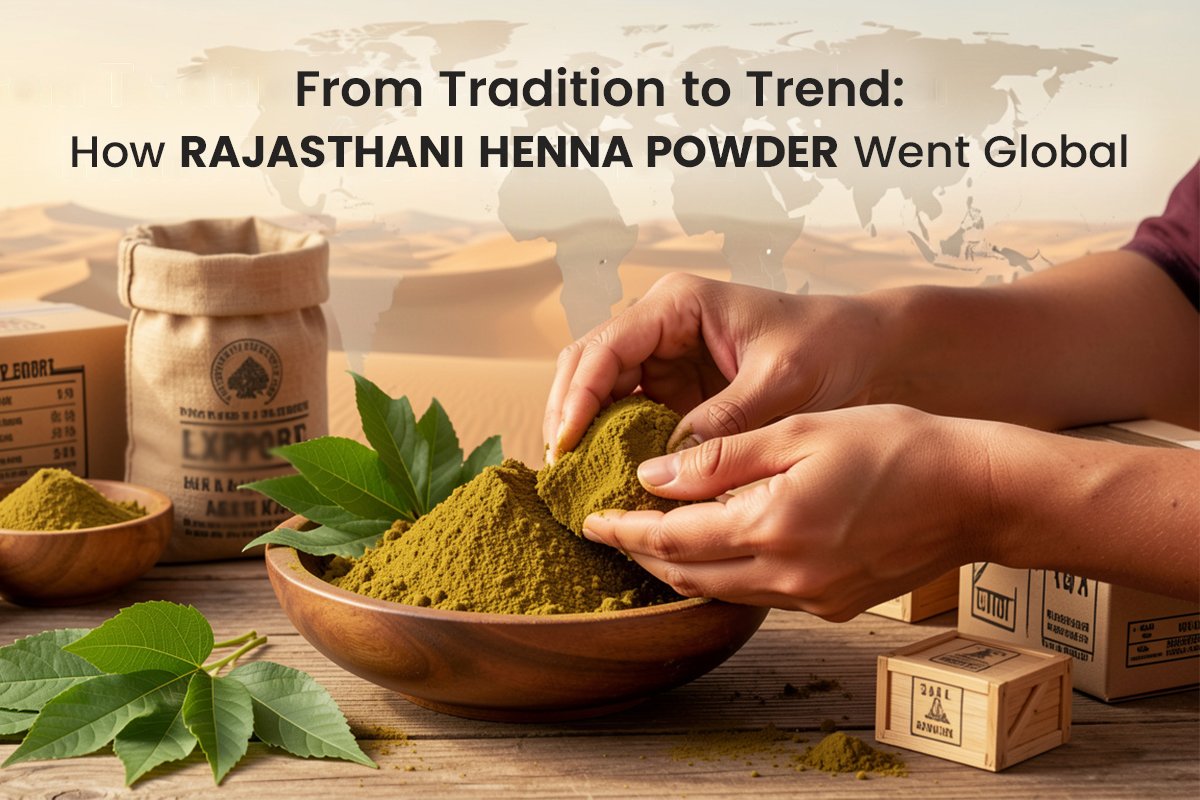
From Traditions to Trends: How Rajasthani Henna Powder Went Global
My aunt mixed henna paste every Thursday evening. She sat cross-legged on a cotton durree, ground dried leaves with a heavy stone, squeezed in lemon juice, and covered the bowl with plastic wrap overnight. By Friday, her palms were a deep burnt-orange — the color that meant a celebration was coming. That ritual played out in millions of Rajasthani homes for generations. Nobody called it a “trend.” It was just Thursday.
Fast forward to today. That same organic henna powder — grown in the same cracked, alkaline fields of Sojat — is now stocked in beauty stores across the USA. Salons in Houston, Portland, and Brooklyn offer henna hair treatments. American women are leaving five-star reviews about gray coverage. Mehndi artists in Chicago are booking out months in advance. Something that was purely a Thursday evening kitchen ritual in Rajasthan quietly crossed an ocean and became a legitimate global beauty movement. This is that story.
Sojat: The Tiny Town Behind a Billion-Dollar Ingredient
Most people have never heard of Sojat. It sits inthe Pali district, deep inside Rajasthan, where the land is hot, dry, and not particularly generous with most crops. The soil is rocky and alkaline. Rainfall is unreliable. Farmers there grow henna not because the land is ideal, but because henna is one of the few things that actually thrives under that kind of stress.
Here is the interesting part: that stress is exactly what makes Sojat henna exceptional. When the Lawsonia inermis plant is pushed hard — too much sun, too little water — it produces more lawsone, the natural orange-red dye compound in its leaves. Sojat-grown henna routinely tests between 2.5% and 3.2% lawsone content. Varieties grown in Egypt or Sudan often fall under 1.8%. That difference sounds technical, but what it means for your hair or skin is dramatic: deeper color, faster dye release, and stains that hold for three weeks instead of four days.
Sojat’s farmers have also developed their own processing knowledge over generations — knowing exactly when to harvest (just before the monsoon), how long to sun-dry the leaves, and when the powder smells right versus when it has gone stale. That is knowledge you cannot replicate in a lab. It is passed from parent to child in the fields.
If you want to understand why this powder specifically, and not just generic henna, read what separates Sojat henna from everything else on the market. The details matter more than most buyers realize.
What Does ‘Triple Sifted’ Actually Mean — and Why Should You Care?
You see the phrase “triple sifted” on a lot of henna packaging now. Some brands use it as a marketing word without it meaning much. But when it is done properly, it genuinely changes the product.
After the dried leaves are crushed, the raw powder still contains stems, coarse leaf fibers, grit from harvesting, and particles of varying sizes. Single-sifted henna gets one pass through a mesh screen. That removes the largest debris but leaves the powder uneven — some fine, some grainy.
Triple sifting runs the powder through three progressively finer screens. Each pass removes a finer layer of inconsistency. What comes out at the end feels almost silky between your fingers. You can barely detect individual granules. For hair use, that fineness meansan even coating on every strand. For body art, it means a mehndi artist can draw a line as thin as a human hair without the cone tip clogging halfway through a design.
A professional mehndi artist in Dallas once told me she switched suppliers three times before finding one whose powder never clogged. A clogged cone mid-design on a bridal client is not just inconvenient — it can ruin work that took forty minutes to reach. Fine powder is not a luxury for her. It is the difference between a good job and a disaster.
How Did This Ever-So-Local Tradition Cross the Ocean?
Honestly, it happened in slow layers. There was no single campaign or viral moment.
Layer one was the diaspora. Starting in the 1980s and accelerating through the 2000s, large Indian and Pakistani communities settled in US cities — Houston, Fremont, Edison, Chicago, Atlanta. They kept their henna traditions. Their neighbors noticed. Bridal mehndi artists started getting bookings from non-South-Asian clients. Word spread person to person, the oldest kind of marketing.
Layer two was the clean beauty backlash. Around 2017-2019, something shifted in how American consumers thought about boxed hair dye. PPD — para-phenylenediamine, the main synthetic dye agent in most permanent hair colors — started appearing in dermatology conversations about scalp burns, contact dermatitis, and allergic reactions. Women who had dyed their hair for years suddenly found their scalps itching, flaking, and burning. They went looking for alternatives. Henna kept coming up.
Layer three was supply chain trust. For years, buying authentic Sojat henna in the USA was unreliable. Batches varied. Documentation was incomplete. Products sitting in US warehouses lost potency from improper storage. Then manufacturers started investing in proper export infrastructure — lab testing, active packaging that locks in freshness, and full certifications. See what quality-focused wholesale manufacturing looks like when it is done right. Once that supply trust was established, US buyers — both retail consumers and B2B businesses — started ordering with confidence.
The Hair Color Conversation Americans Are Having Right Now
If you spend any time in online beauty forums — Reddit’s r/femalehairadvice, NaturalHair Facebook groups, YouTube comment sections on gray-blending videos — you notice a pattern. Somewhere in almost every thread about hair color, someone asks: “Has anyone actually tried henna for gray coverage?”
And the answers that come back are rarely neutral. People either had a mediocre experience with cheap powder and gave up, or they found the real thing and never went back to chemical dye.
The people who stuck with it talk about a few things consistently. First, the conditioning effect. Unlike synthetic dye, which opens the hair cuticle with peroxide and deposits color inside the shaft, henna does the opposite — it coats the outside of each strand with lawsone molecules that bond to keratin. Hair that went through years of chemical processing often comes out of a henna treatment feeling heavier, fuller, and shinier. For women with fine or thinning hair, that physical thickening effect is sometimes reason enough to switch, completely separate from the color.
Second, the scalp relief. Women who developed sensitivities to synthetic dyes after years of use find that they can color their hair again without burning or itching. That is not a small thing. When your scalp is reactive,e and you have been covering gray every four weeks for a decade, finding something that works without pain feels like a genuine solution.
Third — and this takes some adjusting — the color itself. Henna on dark brown hair gives a reddish tint in sunlight that reads as “highlights” to most people who see it. On gray hair, the result is a warm copper-orange that many women find they actually prefer to flat synthetic brown. It looks natural because it is.
What to Look for When Buying Hair Use
- Lawsone content above 2.5%: Ask for the Certificate of Analysis. Any reputable supplier has one.
- Single-ingredient label: Lawsonia inermis leaf powder only. No fillers, no additives, no mystery “herbal blends” unless you specifically want a pre-mixed formula.
- Origin stated explicitly: Sojat, Rajasthan. Not just “India” or “imported from India.” Provenance matters.
- Powder color: Fresh, high-quality powder is deep forest green, almost khaki. Not bright lime green. Not brownish-yellow. If it looks off, it probably is.
- Smell: Grassy, earthy, faintly vegetal. Like dried cut grass with a hint of tea. Chemical smell or no smell at all — skip it.
Mehndi Body Art: From South Asian Weddings to American Festivals
Ten years ago, henna body art in the USA was almost exclusively a South Asian cultural practice. You saw it at Indian weddings, Eid celebrations, and Diwali events. Mehndi artists were almost entirely from the community, doing it as a cultural connection as much as a business.
That is genuinely not the case anymore. Today, mehndi artists of every background run booths at Coachella, book tables at boho barn weddings in Vermont, and fill calendars at bachelorette parties in Nashville. The artform has spread beyond any single community and become part of the broader American celebration landscape.
What drove that expansion? A few things. YouTube tutorials made the technical skills accessible. Pinterest boards full of intricate floral hand patterns went viral. And — importantly — the artform is temporary. That appeals to Americans who want body decoration without the permanence of a tattoo.
Professional artists working this expanded market have gotten very specific about their sourcing. They want powder so fine that it flows through a 0.5mm cone tip without resistance. They want consistent dye release so every client’s stain develops to a similar depth. And they want to buy in bulk — enough for a full festival season — knowing every bag will perform the same way.
That demand is a direct driver of why trusted henna manufacturers have invested so heavily in consistency and packaging. One bad batch can end a repeat relationship with a professional buyer who goes through ten kilos a month.
Inside Kirpal Export Overseas: What 25 Years of Henna Export Actually Looks Like
Kirpal Export Overseas — KEO — started around the year 2000. Founder Sunil Walia and VP Payal Walia built the business during a period when Indian henna exports were, frankly, a mess. Quality varied from shipment to shipment. Suppliers would blend Sojat leaf with cheaper raw material, and nobody outside India could verify the difference. US importers who got burned — literally received low-lawsone powder after paying a premium — simply stopped ordering from India.
KEO took a different approach. Instead of just selling powder, they built a traceable system.
The Farm-First Model
KEO maintains its own henna and indigo farms. Not partner farms — their own. And they photograph them. The company publishes buyer-visit galleries showing international clients walking through the fields. That sounds simple, but in an industry where provenance fraud is common, putting your actual farm on camera is a significant trust signal.
When a buyer in New Jersey or California can see the specific field their product comes from, the relationship changes. It stops being an anonymous commodity transaction and becomes something with a face, a location, and accountability attached to it.
Certifications That Actually Mean Something for USImportst
KEO holds ISO, GMP, and HALAL certifications. For businesses importing into the USA, those are not just stickers — they translate into cleaner documentation at customs, easier retail distribution, and confidence when a large buyer’s compliance team asks for paperwork.
GMP (Good Manufacturing Practice) certification in particular signals that the processing facility meets internationally recognized hygiene and quality standards. For a natural hair color product that goes on people’s scalps, that matters.
What OEM Actually Means for US Brands
A growing number of American beauty brands want to sell henna under their own label — their own packaging, their own brand name, their own formula specifications. KEO’s OEM workflow handles the full chain: formula development, sampling, approval, production, custom packaging design, and export-ready documentation.
This is a meaningful capability. Building a private-label henna product from scratch — finding a raw material source, then a separate formulator, then a packager, then an exporter — involves four or five relationships, each one a potential failure point. A manufacturer who does all of it under one roof simplifies everything.
Beyond henna, KEO supplies indigo powder, herbal color blends, beard and eyebrow color, shampoos, and conditioners. Buyers who start with one product tend to expand their orders over time — which is exactly the kind of supplier relationship that works for both sides.
What US Buyers Actually Say — The Patterns Behind the Reviews
Spend an hour reading buyer reviews across Amazon, Etsy, and beauty wholesaler platforms, ms and certain things come up again and again. Not the language you’d see in a press release. The raw, specific stuff.
- “I left it on overnight ,and the color was completely different.” This comes up constantly. First-time users try henna for two hours, get a light result, and assume the product is weak. Then they try four or six hours — or an overnight wrap — and the stain depth shocks them. Application time is the most underestimated variable in henna results.
- “My scalp finally stopped itching.” Women who switched from synthetic dyes because of scalp reactions write this one with real relief. It is the most emotionally charged category of review — people who had given up on coloring their hair because the process hurt, finding a way back.
- “The second application was way better than the first.” Henna builds on itself. Many experienced users say results deepen noticeably after the second or third application because the lawsone has more previous bonding sites to attach to. First-timers who judge the product by application one are missing half the picture.
- “The smell takes getting used to.” Honest feedback. Natural henna smells like a field, not a perfume. Some people find the earthy scent comforting. Others need a few uses to adjust. Worth knowing going in.
Buying Smart: What to Check Before You Order
The American market has a flooding problem right now. Since henna went mainstream, dozens of repackagers — no farms, no lab testing, often blending inferior material with genuine Sojat powder — have listed products online with “Rajasthani” or “Sojat” in the name. Here is how to separate the real from the repackaged.
For Personal Buyers
- Ask for the Certificate of Analysis, or look for it in the product listing. It should state lawsone percentage from a third-party lab — not the seller’s own estimate.
- Check the ingredient list. For pure henna, it should read: Lawsonia inermis leaf powder. One ingredient. Full stop.
- Look at the ship’s origin. Products that ship directly from India via the manufacturer tend to be fresher than products sitting in a US warehouse for months before reaching you.
- Read the negative reviews specifically. Complaints about weak stain, inconsistent color, or grainy texture often point to quality control problems the seller won’t advertise.
For Wholesale and B2B Buyers
- Request samples before committing to bulk. A legitimate manufacturer will not hesitate. Hesitation here is a red flag.
- Ask for ISO/GMP certificate copies, MSDS documentation, and export compliance paperwork upfront. Sorting this out after a large order creates problems.
- Confirm the supplier’s OEM capability if you are building a private label. Find out minimum order quantities per SKU, lead times for custom packaging, and whether they handle export documentation themselves or outsource it.
For a vetted starting point, the wholesale henna manufacturer guide for 2026 lays out what to look for in practical terms. And this external resource on henna sourcing is worth a read before you finalize any supplier.
Frequently Asked Questions
Q1: What makes henna from this region better than other varieties?
Sojat’s climate — extreme heat, alkaline soil, low rainfall — forces the plant to produce unusually high concentrations of lawsone, the natural dye compound. Higher lawsone means deeper, longer-lasting color. Most other growing regions do not match those stress conditions, so the lawsone levels are lower. The difference shows clearly in the results.
Q2: Is natural henna safe to use on previously color-treated hair?
Generally yes. Henna bonds to hair protein without opening the cuticle, so it lies over chemically dyed hair without most of the conflict people fear. The important caveat: if you plan to go back to chemical dye later, understand that henna creates a semi-permanent coating that can interact unpredictably with peroxide. Many women who switch to natural henna find they no longer want to go back — but know going in that the transition can be one-way.
Q3: How long do results typically last?
With proper application — paste on clean hair for at least four hours, ideally six — color typically holds well for five to six weeks. Coarser, thicker hair tends to hold longer. Fine hair may fade a week earlier. Results also deepen with repeated applications over time.
Q4: What certifications should I ask a supplier for?
For importing into the USA, the most relevant are ISO (quality management), GMP (Good Manufacturing Practice, which covers facility hygiene and production standards), and HALAL certification if your target market includes Muslim consumers. Also, ask for a third-party Certificate of Analysis showing the lawsone percentage from that specific batch.
Q5: What does the triple sifting process actually change?
It removes the coarser particles left after initial grinding — stems, fiber fragments, dust of uneven size. Each of the three passes uses a finer screen. The result is a powder with much more consistent particle size. For hair use, that uniformity means the paste spreads evenly. For body art, it means the artist’s cone flows without clogging. It is not a marketing term when done properly — it genuinely changes the product’s performance.
One Thursday Evening Ritual — Now a Global Movement
My aunt never thought her Thursday paste ritual was anything special. It was just what you did before a wedding, a festival, an Eid. The henna came from the same market stall her mother had bought from. The stone she used to grind it was older than she was.
But that same leaf — grown in those same dry Sojat fields, processed with the same care, shipped now in proper certified packaging to buyers in California, Texas, and New York — is changing how Americans think about hair color. Not through advertising. Through results. Through word of mouth between women who found something that worked when everything else was either hurting their scalp or failing to last.
If you are curious about trying natural henna for the first time, start with a product you can trace back to the source. Ask for the lab report. Buy from a manufacturer who will show you their farm. Give the paste more time than you think it needs. The results will probably surprise you.
And if you are building a business in this space — whether retail, salon, or private label — the supply is there. The manufacturers who can deliver consistency and documentation are identifiable. Start by exploring what Kirpal Export Overseas has built over 25 years, and go from there.