
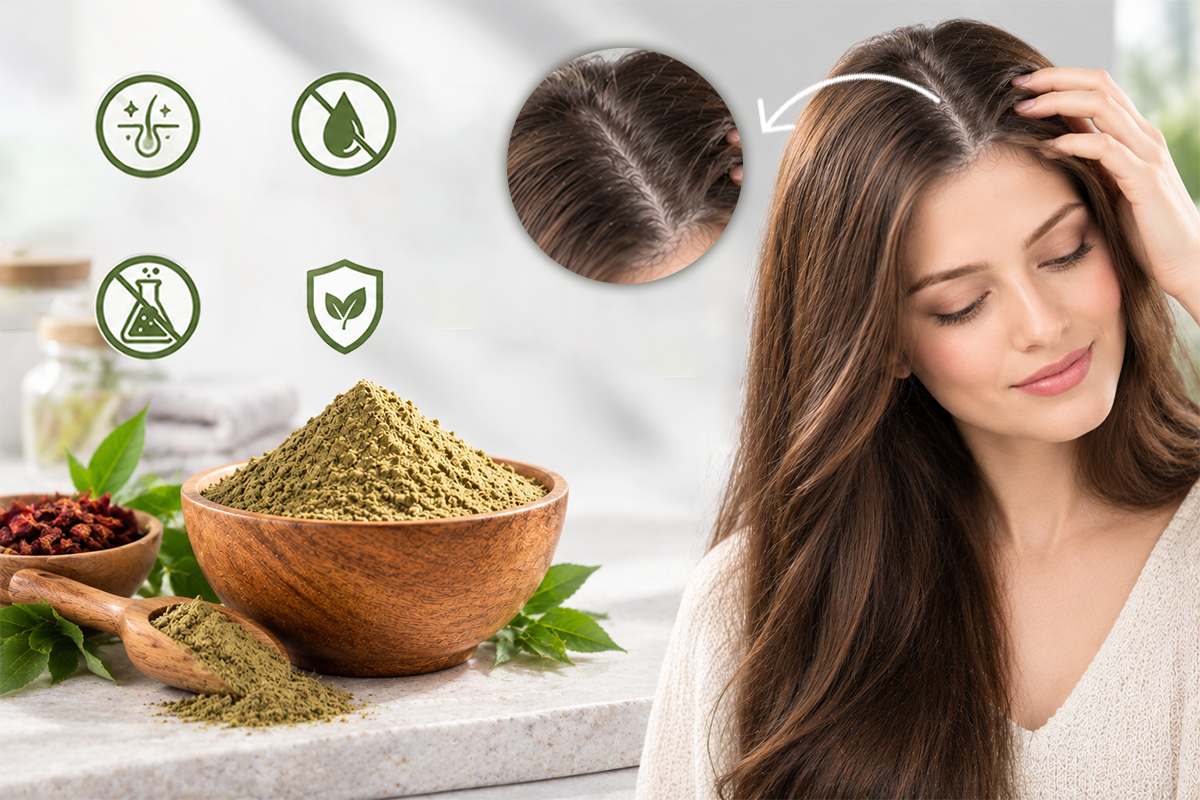
100% Organic Henna Powder for Sensitive Scalps: What “Safe” and “Chemical-Free” Should Really Mean
What would a hair dye look like if a dermatologist’s brief were simply “colour the hair, but never reach the skin”? A clinician put that puzzle to a pharmacy research team at the National University of Singapore, people who normally work on getting molecules into the body. The team spent nearly a decade on it, designed more than 20 new dye compounds, and shared its progress on 17 April 2026. The detail worth pausing on is that many existing “alternative” dyes still cross-react in up to 30 per cent of people who are already allergic to PPD. So where does that leave the leaf that has coloured hair for thousands of years?
Organic henna powder is the dried, finely milled leaf of Lawsonia inermis, and when it is genuinely pure, it contains no PPD. That is why it is so often suggested to people who react to conventional dye. Reliable henna powder manufacturers earn that trust with documents rather than adjectives: an ingredient declaration, batch testing and honest labels. “Safe” is never absolute, and the rest of this guide shows why.
Why Do Conventional Dyes Trouble a Sensitive Scalp?
PPD (para-phenylenediamine) is a dye ingredient used in many permanent hair colours. In simple terms, it is what makes dark colour last, and it is also one of the most common cosmetic allergens. The researchers in Singapore note that it penetrates skin easily and binds strongly to skin proteins, which can set up a lifelong allergy.
Reactions range from stinging, itching, and a swollen scalp to facial swelling in severe cases. Black and dark brown shades tend to carry the highest PPD levels, and a front-of-box word like “herbal” tells you very little about what is inside.
Regulators are still tidying this aisle. Commission Regulation (EU) 2026/909, adopted on 27 April 2026 and in force from 18 May 2026, adds new limits and warnings for several hair dye ingredients. One PPD-related compound is capped at 2% with allergy-aware labelling, and transition dates run into 2027 and 2028. For anyone buying from hair dye manufacturers, the direction of travel is clear: ingredient lists matter more every year.
What Makes Pure Henna Different?
Henna powder means the dried, ground leaves of Lawsonia inermis. In simple terms, it is a leaf, not a formula. Its colouring molecule, lawsone, binds to the keratin in hair and gives red, orange and brown shades depending on the starting hair colour and how it is applied.
The European Commission’s Scientific Committee on Consumer Safety looked at this in an opinion adopted on 19 September 2013. It judged the data sufficient to assess henna as a hair dye and considered it safe for the consumer in the tested preparation, 100 g of powder mixed with 300 ml of boiling water. The committee was careful about scope. The assessment rested on specific batches; other henna extracts were not covered, and body-paint use was not assessed. Regulators rarely write love letters, and “safe in this defined use” is about as close as they come.
Is “100% Organic” or “Chemical-Free” Henna Safe for Everyone?
No ingredient is, and honest suppliers say so. Four caveats matter for a sensitive scalp:
- “Chemical-free” is a marketing phrase, not a chemistry one. Lawsone is a chemical, and so is water. The claim that actually matters is that nothing synthetic has been added.
- Allergy to pure henna is rare but documented. A published case report from Canada confirmed it by patch testing, and clinicians still recommend a patch test.
- Most severe henna reactions trace back to additives. The usual culprit is PPD in so-called black henna. Natural henna stains in the red-to-brown range, so a “henna” that promises jet black deserves suspicion.
- G6PD deficiency is a real exception. Doctors have reported haemolytic crises and jaundice in infants and young children with this enzyme deficiency after henna exposure. The usual advice is to avoid henna or ask a doctor first.
“Organic” is a certification claim, too. If a label says it, ask which independent scheme stands behind it. Industry bodies have warned that vague wording such as “natural” or “eco-friendly” needs proof under the EU’s anti-greenwashing directive, which applies in full from 27 September 2026. Even a leaf needs paperwork.
How Do You Patch Test Henna?
A patch test is a small trial on a limited patch of skin before the product goes anywhere near your scalp. A common approach:
- Mix a small amount exactly as the pack instructs.
- Apply a coin-sized dab behind the ear or on the inner elbow.
- Leave it for the time the instructions give, then rinse.
- Wait 48 hours and watch for redness, itching, swelling,g or blisters.
- If anything appears, stop and speak to a doctor or dermatologist before going further.
Anyone who has reacted to hair dye before should check with a dermatologist first.
What Should Buyers Ask Henna Powder Manufacturers Before Ordering?
If you buy for a salon, an import business, ss or a brand, your due diligence is the safety net. These questions work with any supplier:
| Ask for | Why it matters | A good answer looks like |
| Ingredient declaration | Confirms the powder is a single plant ingredient | Lawsonia inermis leaf, nothing added |
| Evidence of no added dyes | Rules out PPD-boosted “black henna” | Test results, not a promise |
| Certificate of Analysis (COA) | Batch-level proof of quality | A document that matches your batch |
| Heavy metal and microbiological tests | Plant powders can pick up contaminants | Recent reports for the specific product |
| Intended grade | Hair-colour and body-art uses differ. | A stated application per grade |
| Packaging and storage | Protects colour quality in transit | Sealed inner pouch plus outer layer |
One supplier’s product page for organic henna powder from Sojat shows what a specification can look like. It names the botanical source, says the leaves come from the Sojat region of Rajasthan, and describes a triple-sifted powder in retail pouches of 100 g, 500 g and 1 kg and bulk packs of 20 to 25 kg. It adds that testing, a COA, and a specification sheet can be provided according to the product and the buyer’s requirements, and it tells buyers to request current documentation before ordering. Read that last line as an invitation to ask.
Sourcing from henna manufacturers in India is common because Sojat is one of the country’s established henna-growing areas. A few questions help whichever exporter you choose. Which destination rules apply to your market? Which documents travel with each shipment? Can you test a sample first? Established henna suppliers in India will be used to those questions.
Where Do Hair Color Manufacturers Fit In?
Pure henna powder is one product. Hair color manufacturers also make blends, and the label word “henna” can cover very different things:
| Type | What it is | Sensitive-scalp note |
| Pure henna powder | Single plant ingredient | Rare reactions, patch test, G6PD caution |
| Henna and indigo botanical blends | Plant ingredients combined for deeper shades | Substitute dyes can still provoke reactions in some PPD-allergic people. |
| Henna-based, lower-chemical colours | A wider shade range with a small share of other ingredients | Read the declaration; check PPD status |
| Conventional permanent dye | Oxidative colour, often PPD-containing in dark shades | The group most linked to PPD allergy |
The front-of-pack word does not decide the sensitive scalp question. The ingredient list does.
If you are building a range rather than buying one SKU, look for private label hair color manufacturers who can show their testing and paperwork. In the United States, under MoCRA, the brand owner is the “responsible person” for product listing, safety substantiation,n and adverse-event reporting. So you will need ingredient declarations and batch records from whoever makes the product. The supplier behind the linked pages states ISO, GMP, and HALAL certifications and says batches can be supported with a Certificate of Analysis. Ask for current copies before you place an order, as you would with any partner.
Frequently Asked Questions
Q: Is organic henna powder safe for a sensitive scalp?
A: Pure henna powder is widely seen as a lower-risk plant option for people who react to PPD, but it is not risk-free. Rare allergies exist, so do a patch test. Avoid “black henna” and check the ingredient list.
Q: Can you be allergic to pure henna?
A: Yes, though it is rare. A published case report documented allergic contact dermatitis to pure henna confirmed by patch testing. Most severe reactions come from additives such as PPD.
Q: What is the difference between natural henna and black henna?
A: Natural henna comes from Lawsonia inermis leaves and stains in the red-to-brown range. “Black henna” can refer to products containing other ingredients, which is why the declaration matters more than the name.
Q: Does PPD-free mean organic?
A: No. PPD-free describes one ingredient being absent. “Organic” is a certification claim that needs its own independent evidence.
Q: Is henna safe for babies and children?
A: Be cautious. Doctors have reported haemolytic crises and jaundice in infants and young children with G6PD deficiency after henna exposure. Ask a paediatrician first.
Q: What documents should I request from henna powder manufacturers?
A: Ask for a specification sheet, a Certificate of Analysis, heavy metal and microbiological test results, ingredient information,n and batch documentation. A supplier’s product page may say which are available, so confirm that current copies match your order.
Q: Why do buyers source from henna suppliers in India?
A: Sojat in Rajasthan is described as an established henna-growing area, and exporters there supply retail, wholesale, and bulk formats. Confirm destination-specific export documentation before ordering.
Q: Can I launch a sensitive-scalp henna range under my own brand?
A: Yes, through private label production with custom packaging and branding. The claims you print, such as “sensitive scalp”, must be backed by your own safety substantiation, so avoid absolute words like “safe” or “chemical-free”.
The Bottom Line
Organic henna powder is a strong candidate for people who cannot tolerate conventional dye. It earns that place through purity, testing, and plain-spoken labels, and “safe for everyone” is not a promise any honest source can make. A sensible next step is to request a specification sheet and a sample, run a patch test, and confirm every claim against a document. You can compare available options through the resources linked above. This article is educational and not medical advice.