
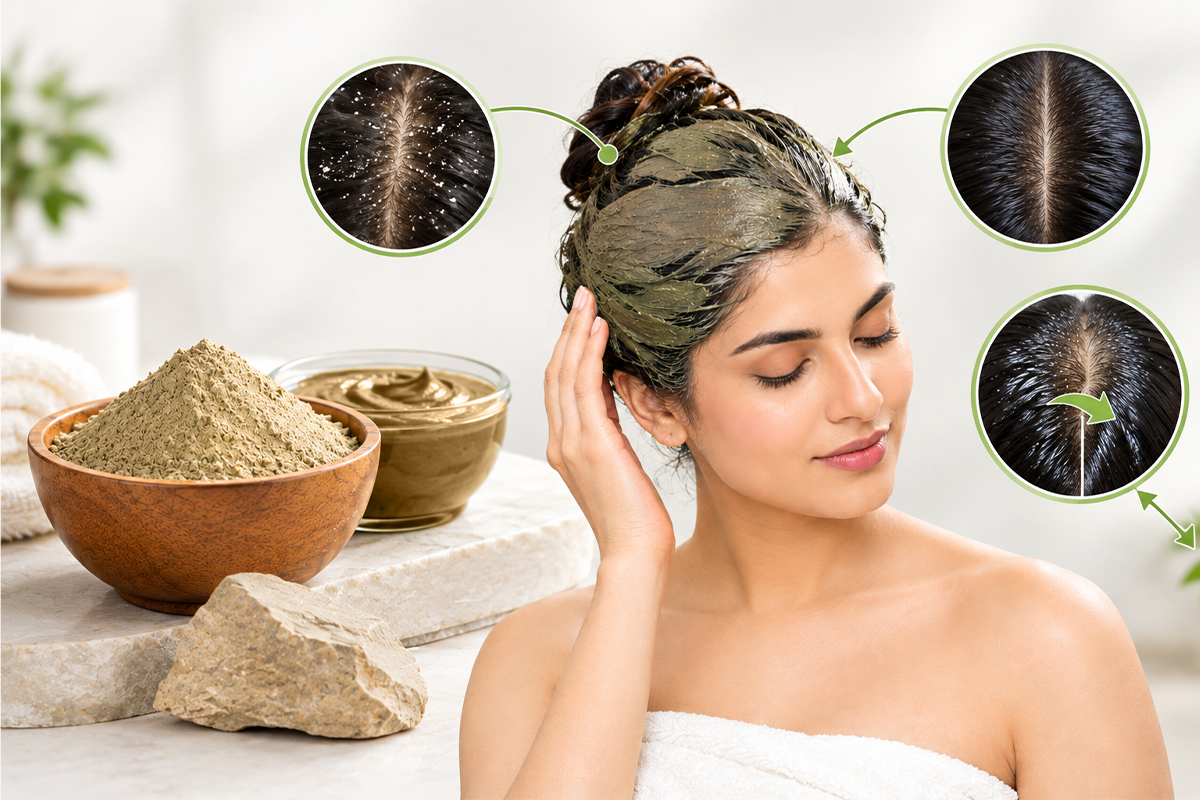
How did a clay that once scrubbed grease out of woollen cloth end up in a bowl on the bathroom counter, whisked with yogurt? It began with fullers, the cloth workers who pressed absorbent clay into freshly woven wool to pull out oil and dirt, which is how fuller’s earth got its English name. Across the Indian subcontinent the same material became Multani Mitti, “clay of Multan,” after the city in present-day Pakistan. American industry found its own deposit near Quincy, Florida, in 1893, and before that the U.S. imported its fuller’s earth from England. Now the grease-grabbing clay is back in the spotlight, because scalp care is being called one of the defining hair trends of 2026.
Multani mitti for face is how most people first meet it, but the same fine powder can work as a scalp mask. It soaks up surface oil and loosens buildup, so an oily scalp can feel cleaner and hair lighter. What it cannot do is treat the cause of dandruff. Used with realistic expectations, a multani mitti hair mask is a clarifying step, not a medicine.
Is Multani Mitti for Face the Same Powder as Multani Mitti for Hair?
Multani mitti means “clay of Multan.” In simple terms, it is a form of fuller’s earth: a natural, oil-absorbing clay usually described as montmorillonite-type, sometimes with small amounts of minerals such as calcite, dolomite, or quartz.
The powder is the same whether it goes on your cheeks or your roots. What changes is the job:
- Multani mitti for skin suits oily and combination skin best. Dermatologists quoted in consumer beauty press warn that clay can over-dry skin that is already dry or sensitive, so those skin types should use it sparingly or skip it. A small patch test on the jawline comes first.
- Multani mitti for hair uses the same oil-absorbing action, but the target is the scalp, where the oil is made. The lengths of your hair are usually drier and need more protection.
Your face and your scalp are the same skin in different outfits. One faces a mirror; the other faces a hairbrush.
Why Is Scalp Care Suddenly Everywhere?
Founders in indie beauty have been predicting that scalp care keeps its momentum through 2026, as younger shoppers carry their skincare habits into haircare. The idea is often called the “skinification” of hair: scalp scrubs, serums, and masks that offer a facial-like ritual for the head. Clay is already familiar from face masks, so a clay scalp mask is an easy product for shoppers to understand. That is the commercial backdrop for the word “detox.”
What Does a Multani Mitti Hair Mask Really Do for Dandruff and Oily Hair?
Dandruff means visible flaking of the scalp skin. In simple terms, it is skin cells shedding in noticeable clumps. A yeast called Malassezia lives on nearly everyone’s scalp and feeds on scalp oil. In some people it triggers irritation and flaking. Oil is one ingredient in that recipe, but it is not the whole recipe.
That is why the honest picture looks like this:
| Claim | What is realistic? |
| Absorbs surface oil | Plausible. This is the best-known property of the clay. |
| Lifts buildup and loosens surface flakes | Plausible, especially on an oily scalp. |
| Leaves hair feeling lighter between washes | Plausible for oily or fine hair. |
| Treats the yeast behind dandruff | No. Dermatology guidance names medicated shampoo actives such as zinc pyrithione, ketoconazole, and selenium sulfide for that job. |
| Conditions and moisturizes | Not on its own. Clay tends to clarify and dry, so mixes add yogurt or aloe, and a conditioner follows. |
| Grows hair | Treat this claim with caution. A cleaner scalp surface is not the same as growth. |
As for “scalp detox,” your scalp has no toxins waiting to be evicted. It has sebum, sweat, styling product, and the occasional flake. In practice, detox here is shorthand for deep cleansing, and that is a perfectly respectable thing for a multani mitti powder mask to do.
Which Multani Mitti Hair Mask Fits Which Scalp or Hair Type?
Four combinations are commonly used, and they come from a step-by-step guide to Multani mitti hair masks for different hair concerns, which also advises scaling quantities to your hair length. Here they are with some extra caution.
| Concern | Mix described in the guide | Worth knowing |
| Oily, flaky scalp | Powder, yogurt, lemon juice | Lemon juice is acidic. Skincare guidance warns acidic ingredients can aggravate skin, so skip it if your scalp stings. |
| Frizz | Powder, yogurt, black pepper | Pepper can sting a tender scalp, so test it first. |
| Everyday scalp refresh | Powder, aloe vera gel, lemon juice | Aloe is the gentler half of this pair. |
| Curly hair | Powder, egg white, rice flour | The guide gives this one the shortest contact time, 10 minutes. |
The guide sets contact times anywhere from 10 to 45 minutes depending on the mix. Because clay is drying, the shorter end is the safer place to start. Most clay-mask directions run about 10 to 15 minutes.
How Do You Use a Multani Mitti Hair Mask Step by Step?
- Patch test. Dab a little of the mixed paste behind your ear or on your jawline and wait 24 hours before using it on your scalp.
- Mix a thick but spreadable paste. Add liquid slowly. A runny mask drips, and a dry one tugs.
- Apply to the scalp first. Work it in with your fingertips. Take only a little down the lengths, if at all.
- Set a timer. Aim for 10 to 15 minutes and rinse before the clay turns fully hard and tight.
- Rinse thoroughly. Clay residue is gritty, and it can leave flakes of its own.
- Follow with a gentle shampoo and a conditioner on the lengths. Curly and coily textures especially need this step.
- Start weekly. Watch how your scalp responds before changing anything.
Who Should Skip It, and When Should You See a Dermatologist?
Skip the mask if your scalp is dry, tight, inflamed, or broken. Dandruff can show up on a scalp that feels dry as well as oily, and an oil-absorbing clay will not help a dry-scalp flake. Persistent itching, redness, or thick scaling can point to seborrheic dermatitis, which is worth a dermatologist’s attention rather than another home mask.
What Should U.S. Buyers Check Before Sourcing Multani Mitti Powder in Bulk?
For importers, private-label brands and salon distributors, the question moves from “Does it work?” to “is this the right grade, and is the paperwork clean?” Multani Mitti suppliers and multani mitti manufacturers can differ a lot in what they ship under the same name.
The grade problem. In the U.S., “fuller’s earth” often means industrial absorbent clay. The country’s main producing district runs through Georgia and Florida, where the clay is predominantly attapulgite, and historic uses include oil, grease, and pet waste absorbents. A bag labelled “fuller’s earth” may be headed for a garage floor or a litter box, not a face mask. A cosmetic buyer needs a stated cosmetic grade.
The spec sheet. Certificates of analysis for cosmetic clays typically report the following:
| What to request | Why it matters |
| Batch number and date matching your shipment | A certificate for a different batch proves nothing about yours. |
| Heavy metals, including lead and arsenic | Clay is mined, so metals vary by deposit. |
| Microbial limits and moisture | Natural powders can carry microbes, and moisture encourages them. |
| Particle size or mesh, plus pH | Fineness changes texture on skin and scalp. |
| Colour and appearance range | Natural material varies from batch to batch, and a stated range sets expectations. |
MoCRA basics. The Modernization of Cosmetics Regulation Act of 2022 reshaped U.S. cosmetics oversight. Facility registration and product listing have been enforced since July 1, 2024. The “responsible person” named on the label must keep safety substantiation records, report serious adverse events within 15 business days, and carry contact details on the label for adverse-event reports. Qualifying small businesses are exempt from registration and listing, but not from substantiation or adverse-event reporting. According to compliance trackers, the mandatory good manufacturing practice rule had not been issued as of September 2026. FDA has also reiterated that registration and listing are not approvals and that it issues no certificates for them, so be wary of a supplier calling its clay “FDA approved.” This is general information, not legal advice.
The claims problem. The FDA decides whether a product is a cosmetic or a drug by its intended use. A shampoo that cleanses hair is a cosmetic, while a product meant to treat dandruff is a drug, “no matter how ancient or traditional” its use. That is why scalp-mask marketing leans on words like “cleansing,” “clarifying,” and “oil-absorbing” rather than treating dandruff or promoting hair growth.
Organic and “best.” The USDA organic framework is built around agricultural ingredients, and mined clay is not a farmed crop. When a spec sheet says organic multani mitti, ask exactly what the word means. The best multani mitti is not the one with the loudest label. It is the one whose paperwork matches the powder in the bag: a fine particle size, clean metal and microbial results, a stated colour range and clear labeling. Anyone requesting Multani Mitti wholesale quotes should ask for a pre-shipment sample with its certificate before committing to volume.
FAQ
Q: Can I use multani mitti for face and hair?
A: Yes, the same multani mitti powder works on both, but your approach differs. Use it on oily or combination facial skin sparingly and on the scalp as an occasional clarifying mask. Patch test either way.
Q: How often should I use a multani mitti hair mask?
A: Start with once a week and watch how your scalp responds. If your scalp or hair feels tight or dry afterwards, stretch the gap between uses or shorten the contact time.
Q: Does multani mitti cure dandruff?
A: No. Dandruff involves scalp yeast, oil, and irritation, and dermatology guidance names medicated actives such as zinc pyrithione, ketoconazole, and selenium sulfide for treatment. Multani mitti for hair can help clear surface oil, which is a different job.
Q: Is multani mitti good for an oily scalp?
A: It is a reasonable fit, because absorbing surface oil is its best-known talent. If your scalp is dry or sensitive, it is likely to make matters worse.
Q: Is multani mitti suitable for dry or curly hair?
A: Use caution. Clay tends to dry, so mix it with yogurt or aloe, keep contact short, apply mostly at the scalp, and follow with a conditioner suited to your texture.
Q: How is multani mitti different from bentonite clay?
A: Fuller’s earth is a broad label for absorbent clays, and bentonite is a montmorillonite-rich clay that overlaps with it in some markets. Because labels are loose, rely on the spec sheet rather than the name.
Q: What should I ask a Multani Mitti supplier for a U.S. order?
A: Ask for a cosmetic-grade statement, a batch-matched certificate covering heavy metals, microbial limits, moisture, particle size, and pH, plus a sample. If you are a brand owner, also confirm who will be the responsible person on your label.
Q: Is “organic multani mitti” a real category?
A: It is a term to question. Organic certification centers on agricultural ingredients, and clay is a mineral. Ask the seller to define precisely what “organic” means on their sheet.
The Takeaway
The same clay that cleaned wool can give an oily scalp a reset. Multani mitti for face and for hair share one oil-absorbing talent, so the practical rules are the same: patch test, keep contact short, moisturize afterwards, and don’t expect a mask to do a medicated shampoo’s job. For buyers, the story is paperwork over promises: cosmetic-grade, batch-matched certificates, and honest claims. Start with a sample and its certificate, check the numbers, and let the powder earn the order.