
Don’t Buy Henna Until You Read This: PPD-Free Claims Explained
French buyers are asking harder questions than ever. Here is what the label won’t tell you — and how to choose henna manufacturers you can actually trust.
Walk into any beauty store in Paris or Lyon today, and you will see dozens of boxes promising “pure henna,” “natural colour,” and “PPD-free.” But here is the problem: those words mean almost nothing without proof. France introduced some of the toughest cosmetic safety rules in the EU in 2026, and buyers are left sorting through confusing labels from henna manufacturers who may not be telling the full story. This article cuts through the noise. Whether you are a consumer, a salon owner, or a retailer stocking henna powder in France, read this before your next purchase.
What Is PPD and Why Does France Care So Much?
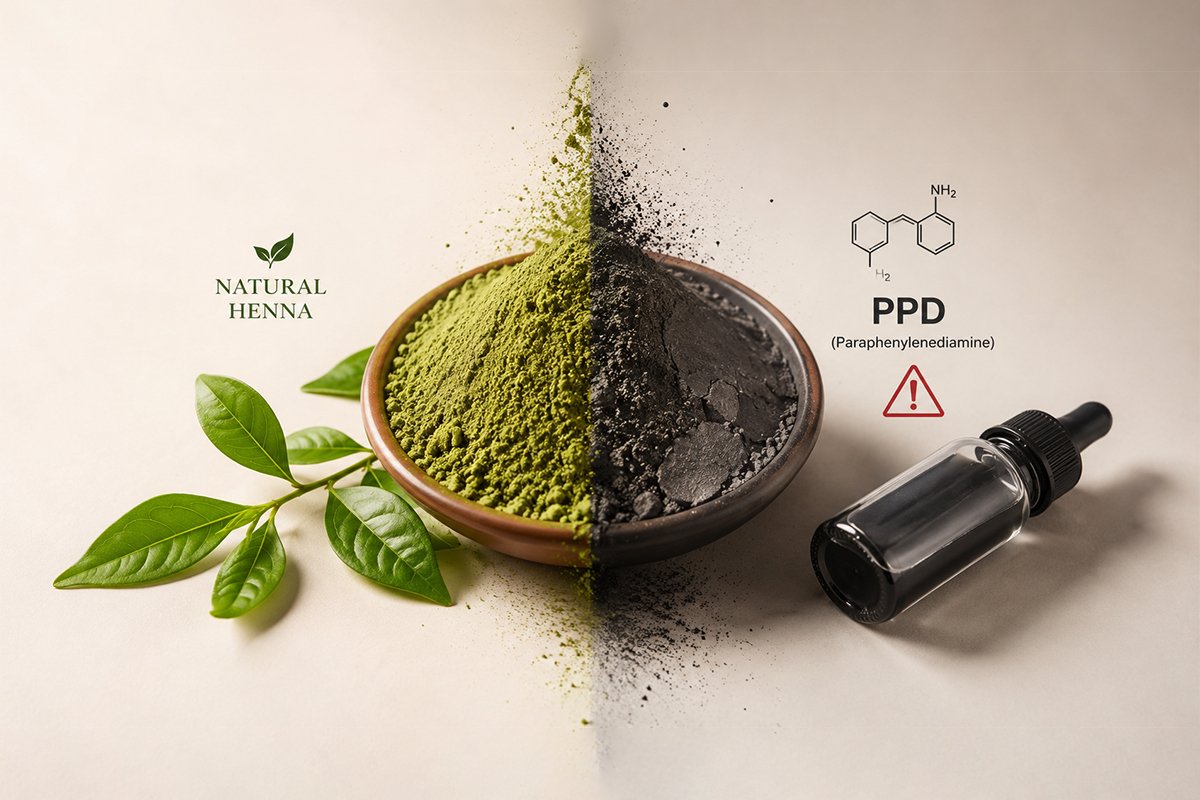
PPD stands for Para-phenylenediamine. It is a synthetic chemical added to many commercial “black henna” products to make the colour darker and longer-lasting. The problem? PPD is a known allergen. It can cause blistering, severe rashes, and even permanent skin sensitisation. The EU has repeatedly flagged PPD as a hazardous cosmetic ingredient, and France has gone further than most countries in enforcing this.
Real, plant-based henna powder contains no PPD. The colour comes from a molecule called Lawsone, found naturally in the Lawsonia inermis plant. But many products on the market mix synthetic dyes with henna — and still call themselves “natural.” That is the trap.
Important for French buyers: As of January 1, 2026, France became one of the first EU countries to ban PFAS (so-called “forever chemicals”) in cosmetics. This affects not just makeup but also hair dye formulations. Always ask your supplier for a PFAS-free certificate.
What “PPD-Free” Actually Means — and What It Doesn’t
A product labelled PPD-free is a good start. But it is not enough on its own. Here is why. Manufacturers can remove PPD and replace it with related compounds — like PTD (para-toluenediamine) or resorcinol — that carry similar risks. These substitutes are not always listed on labels and are sometimes worse for sensitive skin.
So what should you look for instead? Trustworthy henna powder manufacturers will provide:
- A full ingredient list with Lawsone content percentage (EU safety standard: under 1.4% for hair dyes)
- Third-party lab test results — not just their own internal claims
- PFAS-free certification (mandatory for French market compliance in 2026)
- ISO and GMP certifications showing production hygiene standards
- HALAL certification if relevant to your customer base
The point is simple: the label is the beginning of the conversation, not the end of it.
The 2026 French Cosmetics Landscape: What Changed
France’s new cosmetic ingredient rules, effective May 2026, require retailers to pull any product that does not meet updated safety standards. This is not just about PFAS. Several oxidative dye precursors, preservatives, and synthetic fragrance compounds are now banned or restricted.
For henna powder suppliers exporting to France, this means documentation is no longer optional — it is a market entry requirement. Buyers now ask questions like:
- Does this comply with EU Regulation 1223/2009 on cosmetic products?
- Is the Lawsone content within the 1.4% limit?
- Can you provide batch-level traceability — from farm to packaging?
- What is the shelf life, and how is the product protected from heat and light?
If your supplier cannot answer these questions quickly and clearly, that is a red flag.
Key France 2026 Rule Snapshot
- PFAS ban: Effective January 2026 — applies to all cosmetic formulations
- Oxidative dye restrictions: Several compounds restricted from May 2026
- Lawsone limit: Max 1.4% in leave-on hair colour products
- Traceability: Buyers increasingly required to document supply chain origin
How Adulterated Henna Reaches the Market
It sounds alarming, but adulterated henna is genuinely common. Here is how it happens. Small-scale producers mix pure henna with metallic salts, synthetic dyes, or even agricultural chemicals to bulk up the product or intensify the colour. This adulterated powder then travels through multiple middlemen before it reaches a retailer in France — and nobody along the way tests it.
The result is a product that looks like henna powder, smells faintly herbal, and markets itself as natural — but contains none of the purity the buyer expects. For French consumers already wary of ingredient transparency, this is a trust crisis.
The solution? Source from verified henna manufacturers who own their production chain from farm to export. This is not just good ethics — it is a business survival strategy in a market as regulated as France’s.
Case Study
How Kirpal Export Overseas Built a Traceable Supply Chain
Kirpal Export Overseas (KEO) is an Indian-based manufacturer founded around 2000 by Mr. Sunil Walia. KEO produces organic henna powder sourced from Sojat, Rajasthan — one of India’s most respected henna-growing regions. The company operates multiple production units and holds ISO, GMP, and HALAL certifications.
Rather than simply claiming “natural,” KEO built farm-to-export visibility. They maintain buyer-visit galleries, farm photography, and before-and-after media — not as marketing fluff, but as traceable evidence. When an EU retailer asks “where did this henna come from?”, KEO can answer with photos, certifications, and documentation.
For France-based buyers dealing with the 2026 regulatory landscape, this kind of supplier transparency is not a nice-to-have — it is essential. KEO’s 25+ years of experience in herbal hair colour manufacturing means they understand what compliance-focused European buyers actually need.
What French Buyers Should Ask Before Ordering
Whether you are a Paris-based salon, a Lyon retailer, or a private-label brand launching in France, these questions will protect you from regulatory risk and customer complaints:
About the product itself
- What is the exact Lawsone content, and can you show lab results?
- Is the product PFAS-free? Can you certify this per France’s 2026 rules?
- Does the formulation contain PPD, PTD, resorcinol, or any synthetic dye?
- What is the shelf life, and how should it be stored in a retail environment?
About the manufacturer
- Do you hold ISO, GMP, or HALAL certifications?
- Can you provide batch traceability from farm to packaging?
- What is the sifting process? (Triple-sifted powder is finer and less likely to contain contaminants.)
- Do you offer private-label or OEM services if I want custom branding?
Asking these questions before you commit to a supplier is not being difficult — it is being responsible. Any reputable manufacturer will welcome them.
Getting a Darker Colour Without Synthetic Additives
A common complaint from French consumers is that natural henna powder gives a lighter, more orange-red colour compared to darker chemical dyes. This is true — and it is actually a good sign. It means the product is clean. But there are ways to deepen the stain naturally:
- Mix with indigo powder — combining henna with natural indigo creates shades from dark brown to near-black. Herbal powder combinations like this have been used for centuries.
- Use a slightly acidic mix — adding lemon juice or apple cider vinegar to henna paste helps release the Lawsone dye molecule more effectively.
- Follow the no-water rule — for the first 24 hours after applying and removing henna, avoid water. This allows the oxidation process to continue and deepens the final colour naturally.
- Warm application area — gentle body heat (a warm towel wrap) during the sitting time intensifies the dye release.
These techniques are trusted by professional mehndi artists across South Asia and the Middle East. They work — and they involve zero chemicals.
Shelf Life and the Supply Chain Problem French Retailers Face
Pure, organic henna has a shelf life of roughly 12–18 months when stored correctly: sealed, away from light, in a cool environment. This creates a practical challenge for French retailers importing from India or North Africa. Long shipping times, customs delays, and poor storage during transit can degrade the product before it even reaches the shelf.
What good henna powder suppliers do differently is invest in what the industry calls “active packaging” — materials that protect against moisture and light degradation. Vacuum-sealed, nitrogen-flushed, or foil-lined packaging can extend shelf stability significantly, which directly affects colour quality for the end consumer.
If your current supplier is shipping henna in basic plastic bags with no protective packaging, the quality on your shelf will suffer — and so will your customers’ results.
Practical tip for French retailers: Ask your supplier specifically about packaging type and recommended storage conditions. A supplier who has thought about this has likely thought carefully about quality across the board.
The Private Label Opportunity in France
France has a strong appetite for clean beauty brands. French consumers are among the most ingredient-literate in Europe — they read labels, research brands, and reward transparency. This makes France an ideal market for private-label natural hair colour products built on a verified henna base.
For brands exploring this space, OEM or private-label manufacturing through trusted henna manufacturers is a practical path. You source the certified raw material, customise the packaging and branding, and enter the market with a product that is already compliant, traceable, and certified. The hard work of building the supply chain is done. You focus on the brand.
KEO, for example, offers complete OEM workflows from design and sampling through to production and export-ready packaging — relevant context for any French brand exploring this route and looking for how exporters navigate real-world market challenges.
FAQ: Henna Safety Questions French Buyers Ask Most
Q. Is “natural henna” automatically PPD-free?
Ans. Not always. The word “natural” is not regulated. Only third-party lab testing can confirm whether a henna product is free of PPD or similar synthetic compounds. Always ask for documentation.
Q. What Lawsone percentage is safe for hair dye in France?
Ans. The EU recommends a maximum of 1.4% Lawsone for leave-on hair colour products. Ask your henna powder manufacturer to confirm this in their lab certificate.
Q. Can I sell henna products in France that were manufactured in India?
Ans. Yes, but the product must comply with EU Regulation 1223/2009 and France’s 2026 updates, including PFAS restrictions. Your supplier must provide full documentation. Working with certified henna powder suppliers who understand EU export compliance is essential.
Q. How do I know if my henna is adulterated?
Ans. Pure henna paste stains orange-red and fades over 1–3 weeks. Rapid dark staining (especially near-black), an unusual chemical smell, or skin reactions are signs of adulteration. Request a lab test from your supplier if you are unsure.
Q. What certifications should a trustworthy henna manufacturer hold?
Ans. Look for ISO (quality management), GMP (Good Manufacturing Practice), and HALAL certifications as a minimum. For the French market specifically, ensure the supplier can also provide PFAS-free and EU cosmetic regulation compliance documentation.
The Bottom Line for France’s Henna Buyers in 2026
The henna market is not short of suppliers. It is short of trustworthy ones. As France’s regulatory environment tightens and consumers demand more ingredient transparency, the gap between compliant and non-compliant products will only grow — and so will the consequences for buyers who choose wrong.
The safest path is simple: source from henna manufacturers who show their work. That means farm traceability, third-party lab tests, active packaging, and certifications that match what EU markets actually require. Anything less is a risk — to your customers, your inventory, and your business.
For a deeper look at verified, export-ready organic henna powder that meets these standards, explore Kirpal Export Overseas’s product range — 25+ years of manufacturing experience built for exactly this kind of market.