
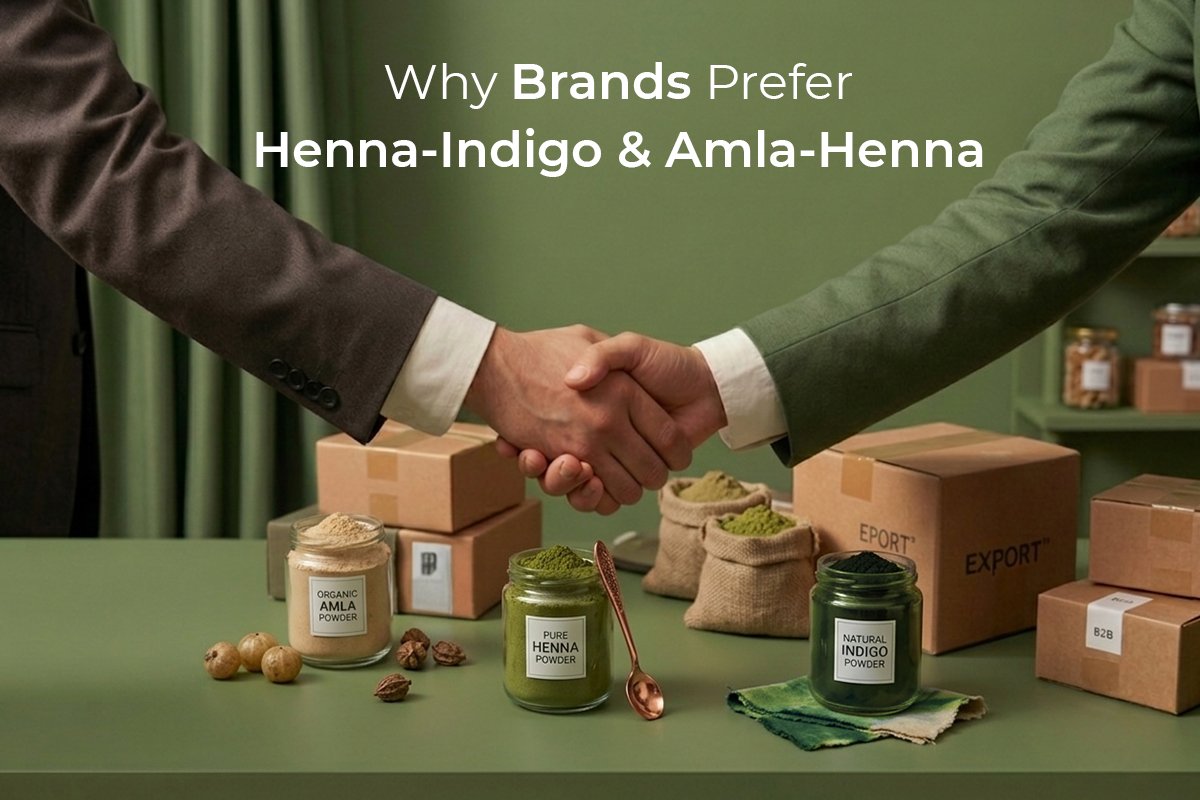
5 Proven Reasons Hair Dye Manufacturers Are Obsessed With Henna-Indigo and Amla-Henna Right Now
Walk into any natural beauty store in Germany, France, or the Netherlands today. You will notice something. More shelf space is going to henna-based hair color products. Less space is going to chemical dyes. This is not an accident. Buyers across Europe are actively choosing organic henna blends over synthetic options — and they have good reasons for it.
In this blog, we will look at why henna-indigo and amla-henna combinations are winning over modern buyers. We will also look at how hair dye manufacturers and private-label brands are responding to this shift.
First, Let’s Understand What These Blends Actually Are
Before we get into the reasons, let’s be clear about what we are talking about.
Henna comes from the Lawsonia inermis plant. When you dry the leaves and grind them into powder, you get a natural dye. By itself, henna gives a reddish-orange color to hair. That’s fine for some people — but not everyone wants that shade.
So people started mixing henna with indigo powder. Indigo comes from the Indigofera tinctoria plant. When you use henna first and then apply indigo on top — or mix them together — you get shades ranging from warm brown to deep black. No chemicals. No PPD. No ammonia.
Amla-henna is a different but equally popular blend. Amla is the Indian gooseberry. It has been used in Ayurvedic hair care for hundreds of years. When you mix amla with henna powder, two things happen at once. The henna colors the hair. The amla conditions it. People with dry or brittle hair love this combination because it does not strip the hair — it actually feeds it.
Reason 1: Buyers Are Done With Chemicals — And They Mean It
This one is straightforward. People have been reading ingredient labels more carefully since 2020. Especially in Europe.
A lot of European buyers have had reactions to synthetic hair dyes — redness, itching, swollen scalps. The main culprit in most chemical black dyes is PPD (para-phenylenediamine). It is a known allergen. The EU has been tightening rules around it for years.
When buyers discover that henna-indigo contains none of these ingredients, they switch. And they usually do not go back.
This is one reason why natural hair color manufacturers have seen steady demand growth. It is not hype. It is people making practical decisions about their health.
Reason 2: Grey Coverage That Does Not Destroy Your Hair
Let’s be honest about grey hair coverage. It is one of the biggest reasons people color their hair at all. And chemical dyes do cover grey effectively — but at a cost. Repeated use thins the hair, dries the scalp, and weakens the hair shaft over time.
Henna-indigo covers grey hair fully — but it works differently. Instead of stripping the outer layer of the hair shaft (like peroxide does), henna coats it. The color bonds on the outside and actually strengthens the structure of the hair.
For buyers who have been coloring their hair for 10–15 years, this difference is huge. Their hair is already tired. They want something that covers grey without causing more damage. Herbal hair color manufacturers who offer a henna-indigo formula are answering a very real need here.
The amla-henna blend goes even further. Amla adds a layer of conditioning. So buyers with damaged or over-processed hair find that regular use of amla-henna actually improves their hair’s texture over time — not just covers the grey.
Reason 3: Private-Label Brands Need Reliable Ingredients Fast
Here is something that does not get talked about enough. A big part of the henna boom in Europe is coming from small and medium wellness brands — not just individual buyers.
A lot of new brands are launching natural hair care lines. They do not grow henna. They do not make the powder. They go to henna suppliers in India to source finished or semi-finished products, add their own branding, and sell under their own label.
This is where henna powder manufacturers with OEM and private-label services become critical. These brands need:
- Consistent quality batch after batch
- Proper lab reports and certification documents for EU import
- Custom packaging that matches their brand aesthetic
- Reasonable minimum order quantities for a startup stage
Not every henna supplier in India can meet all four needs. The ones who can — like manufacturers from Sojat in Rajasthan — are building long-term relationships with European distributors and brands.
If you are a brand owner trying to figure out what shade works best for which hair type, this guide on matching hair color to skin undertone is genuinely useful for building your product range.
Reason 4: Sojat Henna Has a Reputation — And It Is Earned
Not all henna powder is equal. Buyers who have been in this space for a while know this.
Sojat henna from the Pali district of Rajasthan, India is widely considered the best in the world. The soil and climate conditions in that region produce henna with a higher lawsone content — lawsone is the active dye molecule. More lawsone means stronger, longer-lasting color.
Sojat henna manufacturers have been supplying markets in Europe, the Middle East, and Southeast Asia for decades. The reputation is built on consistent quality and a well-established processing ecosystem in the region.
When a buyer in France or the UK sources Rajasthani henna powder from a henna manufacturer in Rajasthan, they are not just buying a product. They are buying a supply chain that has been refined over many years.
Wholesale henna powder from Sojat typically has:
- High lawsone content (2.0–3.5% or more in quality grades)
- Low moisture content for long shelf life
- Fine mesh sieve quality for smooth application
- Consistent green-brown color indicating freshness
This is why sojat henna powder manufacturers get repeat orders from the same European distributors year after year. Quality is not a talking point — it shows up in the product.
Reason 5: Sustainability Has Become a Buying Criterion
Five years ago, “eco-friendly” was a nice bonus for European buyers. Today it is often a deal-breaker if it is missing.
Henna is a naturally sustainable crop. It grows well in semi-arid conditions, requires less water than many agricultural plants, and the entire plant can be used — leaves for dye, bark for other applications. Indigo powder manufacturers who grow their own raw material and process it locally are also cutting transportation waste significantly.
But sustainability for buyers is not just about the plant. It is about:
- Packaging that is recyclable or biodegradable
- Transparent sourcing so buyers know where the ingredient came from
- Fair trade practices at the farm level
- Certifications like HALAL, ISO, and GMP that confirm hygiene and process standards
Henna wholesale suppliers who can show farm photos, buyer-visit galleries, and third-party certification documents are winning trust in a way that pure price competition cannot match.
You can explore more about how sourcing and manufacturing decisions affect product quality at henna-manufacturers.com and hennasupplier.com — both are useful reference points for buyers doing supplier research.
A Real Example: How KEO Built Its Export Business Around These Blends
Kirpal Export Overseas (KEO) is a henna manufacturer in India based in Sojat, Rajasthan. They have been in this business since around 2000. Founded by Mr. Sunil Walia, KEO now operates under both his leadership and that of Vice-President Mrs. Payal Walia.
What KEO did differently was build the whole supply chain in-house. They own henna and indigo farms. They have their own processing units. They do quality checks at multiple stages. And they offer full OEM and private-label services for brands who want to launch under their own name.
Their certifications — ISO, GMP, and HALAL — are not just for show. For a European retailer or distributor, these are the documents that make import clearance smoother. Without them, suppliers spend months trying to get products through customs.
KEO’s product range covers a wide spectrum:
- Pure Sojat henna powder for raw material buyers
- Henna-indigo blends for grey coverage
- Amla-henna conditioning color treatments
- Herbal shampoos and conditioners
- Beard and eyebrow color products
For a private-label brand trying to launch a full natural hair care range, sourcing everything from one certified henna manufacturer in Sojat saves time and reduces risk.
Their blog section (active as of early 2026) also covers practical topics for buyers — making their website useful for research, not just sales.
For more context on how natural hair colors work and why they are gaining mainstream attention, this piece gives a good overview from a consumer perspective.
How Buyers in Europe Can Identify a Trustworthy Supplier
If you are sourcing henna powder wholesale or looking for a herbal hair color manufacturer for your brand, here is what to actually check — beyond just reading a website.
Ask for these documents before placing any order:
- Certificate of Analysis (CoA) for the specific batch
- Heavy metal test report (lead, arsenic, mercury levels)
- Microbial contamination report
- Allergen declaration
- ISO/GMP/HALAL certificates (with expiry dates — make sure they are current)
Visit the facility if possible — or ask for a video call tour. Serious wholesale henna powder manufacturers will not hesitate. Ones who dodge this request are a red flag.
Ask about shelf life and packaging. Good henna powder suppliers use active or modified-atmosphere packaging to keep the powder fresh during long transit. This is especially important for henna powder manufacturers in India exporting to Europe, where transit time can be 3–5 weeks by sea.
Start with a sample order. Most wholesale henna suppliers offer trial quantities of 5–25 kg before committing to larger volumes. Test the product on real hair (with patch tests) before scaling up.
A Quick Comparison: Henna-Indigo vs. Amla-Henna
| Situation | Better Blend | Why |
|---|---|---|
| Deep grey coverage needed | Henna-Indigo | Two-step process gives darker, longer-lasting result |
| Damaged or dry hair | Amla-Henna | Conditions while coloring — less drying effect |
| First time using natural dye | Pure henna powder | Easiest to apply and judge results |
| Warm brown shade wanted | Henna + light indigo | Adjustable ratio changes the final shade |
| Jet black result needed | Henna first, full indigo second | Classic two-step method |
FAQs That Buyers Actually Ask
Q. Does henna-indigo work on all hair types? Ans. Yes — but results vary. Coarse or porous hair absorbs more color. Fine hair may get a slightly lighter result. Always do a strand test first, especially when using indigo powder for the first time.
Q. How long does the color last compared to chemical dye? Ans. Henna color typically lasts 4–6 weeks before fading. Chemical dyes may last longer in terms of root regrowth, but henna-based hair color does not fade in the same harsh way — it softens gradually.
Q. Can I mix amla and indigo together with henna? Ans. Yes. Many hair color manufacturers offer three-ingredient blends. The ratio matters a lot for the final shade. A henna manufacturer in India offering custom formulations can help brands get the exact blend they want.
Q. Is bulk henna powder safe to import into the EU? Ans. Pure, unadulterated henna powder is generally permissible. But documentation is essential. Work only with henna powder manufacturers in Rajasthan or elsewhere who provide complete MSDS (Material Safety Data Sheet) and ingredient declarations.
Q. What is a realistic MOQ for wholesale orders? Ans. Most henna powder wholesale suppliers start at 50–100 kg for trial orders. Regular supply contracts usually run from 500 kg to multiple metric tonnes per shipment.
Confused about which shade actually suits your hair and skin? This article walks through how to stop guessing and make a confident choice.
To Sum It Up
The growing popularity of henna-indigo and amla-henna is not random. It comes from real shifts in how European buyers think about what goes on their hair. They want safety. They want results. And they want brands they can trust.
For hair dye manufacturers, henna suppliers, and private-label brands — this is one of the most real opportunities in the natural beauty market right now. The buyers are ready. The demand is growing. The question is just whether your supply chain is ready to meet it.